
Home › Cursive Numbers › Cursive 3
Cursive 3: How to Write Three in Cursive
3
3 in cursive · 1 (no pencil lift) · free tracing worksheet
Cursive 3 is the number three written as two smooth, connected curves that open to the left and meet at a small point in the middle. It flows in one stroke and leans gently to the right. Learn to make both curves even, step by step below.
Three began life as three stacked strokes, and fast writing gradually rounded and joined them into the two bumps we write today, as the history of the number 3 shows. Cursive 3 keeps that two-curve shape and runs it as one smooth movement. The secret to a good cursive 3 is balance: the top curve and the bottom curve should look like they belong together, with the bottom one just slightly larger so the digit stands steadily on the baseline.
At a glanceCursive 3 Quick Facts
Strokes
1 (no pencil lift)
Start here
Just below the top line, on the left side
Height
Top line to baseline (full height)
Don’t confuse with
The number 8 and the cursive lowercase z. Keep both curves open on the left.
How to Write 3 in Cursive Step by Step
- Make the Top Curve: Start just below the top line on the left. Curve up, over and around to the right, then back in toward the middle of the digit, like a small backwards C.
- Touch the Middle: Bring the stroke to a point near the midline, slightly to the left of center. This is the waist of the 3, where the two curves meet.
- Make the Bottom Curve: Without lifting, curve out to the right again, round down to the baseline, and finish by curving back to the left with a short tail.
Make the bottom curve a little larger than the top one. That small difference gives cursive 3 a stable base, the same way a snowman looks better with a bigger bottom ball. If the two curves are exactly equal, the digit can look top-heavy once it is slanted.
Free printableFree Cursive 3 Tracing Worksheet
Cursive 3 Tracing Sheet (PDF)
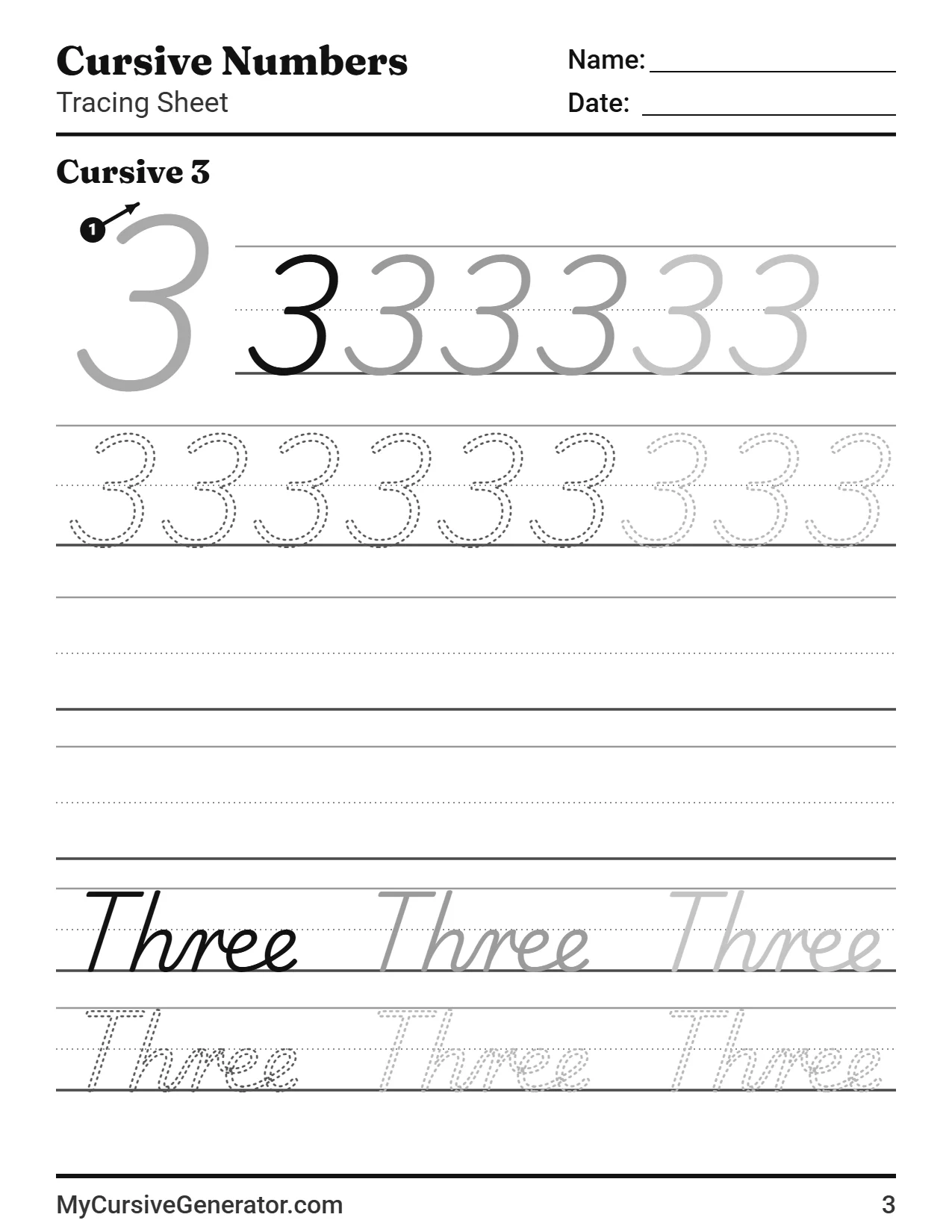
The cursive 3 tracing sheet fits on one US Letter page and prints cleanly in black and white. It starts with a large model of the digit and a numbered arrow that shows where the pen begins, then a row of 3s that fade from solid to light gray, a row of dotted 3s to trace, blank handwriting lines, and two rows of the word “Three” to copy and trace.
Use it in three passes: trace the dotted row, copy the digit on the blank lines without tracing, then write 3 in cursive from memory. The dashed midline shows where the curves should turn, so keep an eye on it while you work.
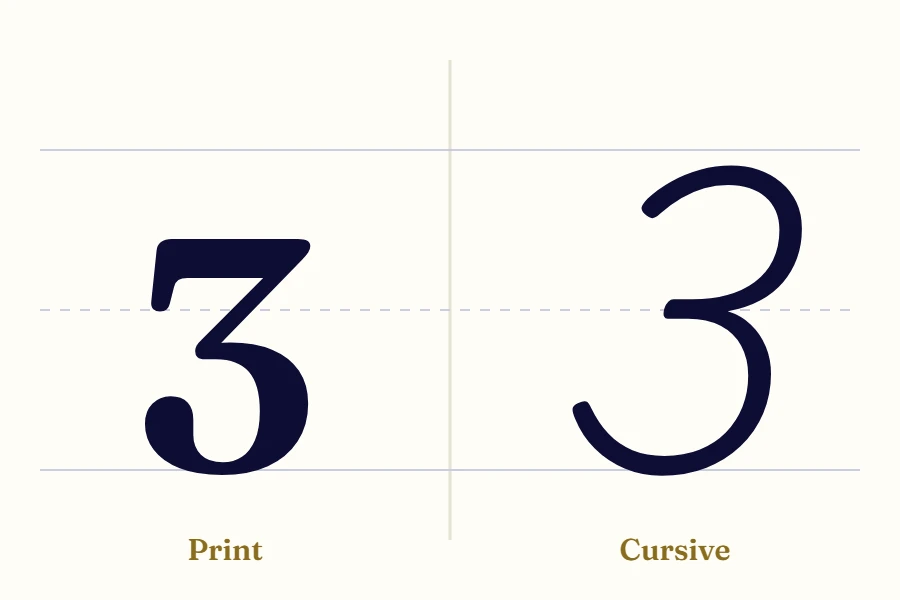
Cursive 3 vs Print 3
A printed 3 sometimes has a flat top, almost like a 7 bent back on itself, and an upright stance. Cursive 3 replaces the flat top with a rounded curve and leans the whole digit to the right, so both bumps follow the same slant as cursive letters.
Cursive 3 can be confused with a cursive capital B written without its stem, or with a backwards E in some decorative styles. Keep the curves open on the left and avoid closing them into loops. Open curves read as a three; closed loops start to read as letters.
Avoid mix-upsCommon Mistakes With Cursive 3
| Mistake | How to fix it |
|---|---|
| Equal or larger top curve | A big top makes cursive 3 look top-heavy. Keep the bottom curve a little larger. |
| A sharp, flat top | A flat top line is a print habit. Round it into a curve in cursive. |
| Closing the curves | If the curves close into loops, the digit looks like a letter. Keep both curves open on the left. |
| A middle point that wanders | When the waist sits too high or too low, rows of threes look uneven. Aim for the midline every time. |
| Lifting at the middle | The two curves are one stroke. A pen lift at the waist creates a visible break. |
Variations of Cursive 3
A flat-topped 3 (a short bar, then a diagonal and a curve) is common in Europe and on checks, because it is harder to alter into an 8. Either form is correct.
Beyond digitsHow to Write Three in Cursive
The word “three” starts with a tall cursive t and an h whose loop reaches the top line, then flows through r and two e letters. The double e is good practice for keeping small loops the same size. Cross the t only after the whole word is written, so the pen keeps moving.
If any letter in these words feels unfamiliar, practice it first in the cursive alphabet guides, then come back to the full word.
Everyday uses3 in Cursive: Dates, Times and Prices
Three shows up in dates like the 3rd and the 30th, in times like 3:30, and in prices like $3.33. Because it has two curves, it is one of the digits that most clearly shows the slant of your handwriting.
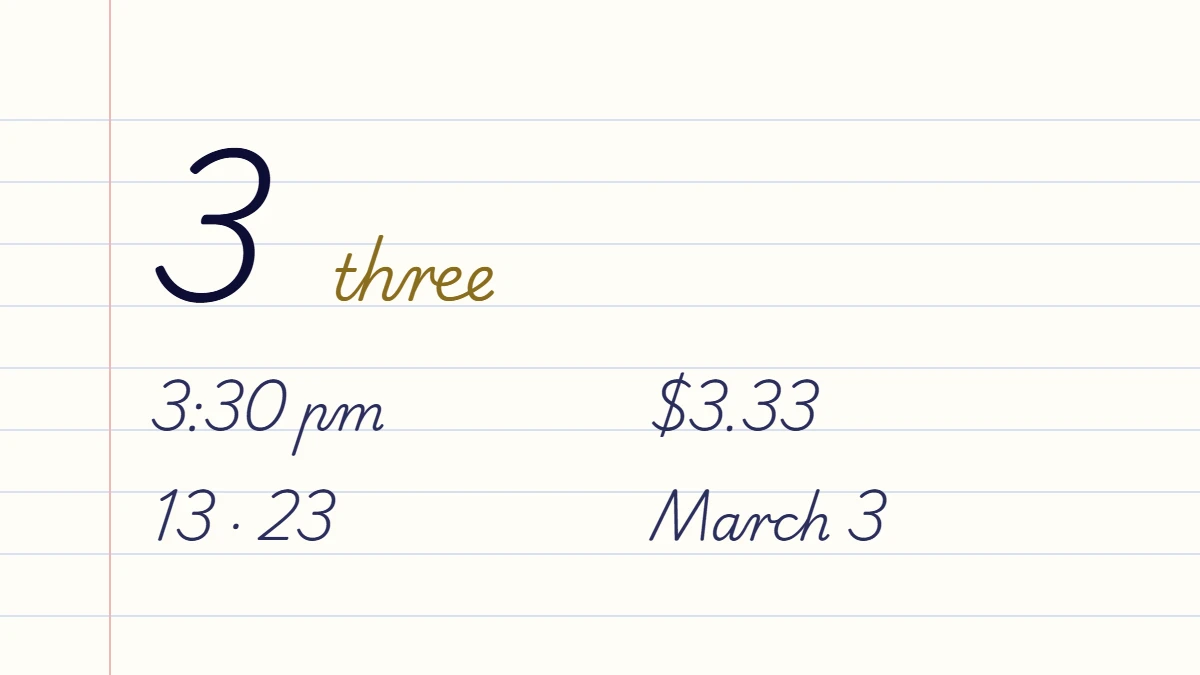
In repeated numbers such as 33 or 333, keep the middle points of all the threes at the same height. That one detail makes a row of threes look deliberate rather than rushed. To preview any date or amount in several cursive styles before writing it by hand, type it into our cursive generator.
10 minutes a day10-Minute Practice Routine for Cursive 3
Ten focused minutes a day for one week is enough to make cursive 3 feel automatic. Use the worksheet above or a lined notebook, and keep the pace slow until the shape is steady.
- Warm-up (2 minutes): draw a row of backwards Cs, then join two of them at a time into stacked pairs, keeping the gap between them open on the left.
- Trace (2 minutes): trace one full row of dotted 3s on the worksheet, starting every digit at the top line.
- Copy (3 minutes): write the digit on blank lines beside the model, checking height and slant after every three or four digits.
- Use it (2 minutes): write the word “three” and a few real numbers that contain 3, such as 13, 33, 300 and 2033.
- Check (1 minute): compare your last row with your first. Is the bottom curve slightly larger than the top one in every digit? Do all the middle points line up at the same height?
Teaching Cursive 3 to Children
Children usually find it easiest to learn cursive 3 after they can print the digit confidently. Show the movement slowly first, then let the child trace the dotted digits on the worksheet with a finger before using a pencil. Keep each session short and finish while the child is still enjoying it.
Praise the right things: a start at the top line, a steady slant and a digit that sits on the baseline. Those three habits matter more than perfect curves, and once they are in place the shape improves on its own. Adults can follow the same order, simply moving through it faster.
Keep goingPractice Cursive 3 With the Other Numbers
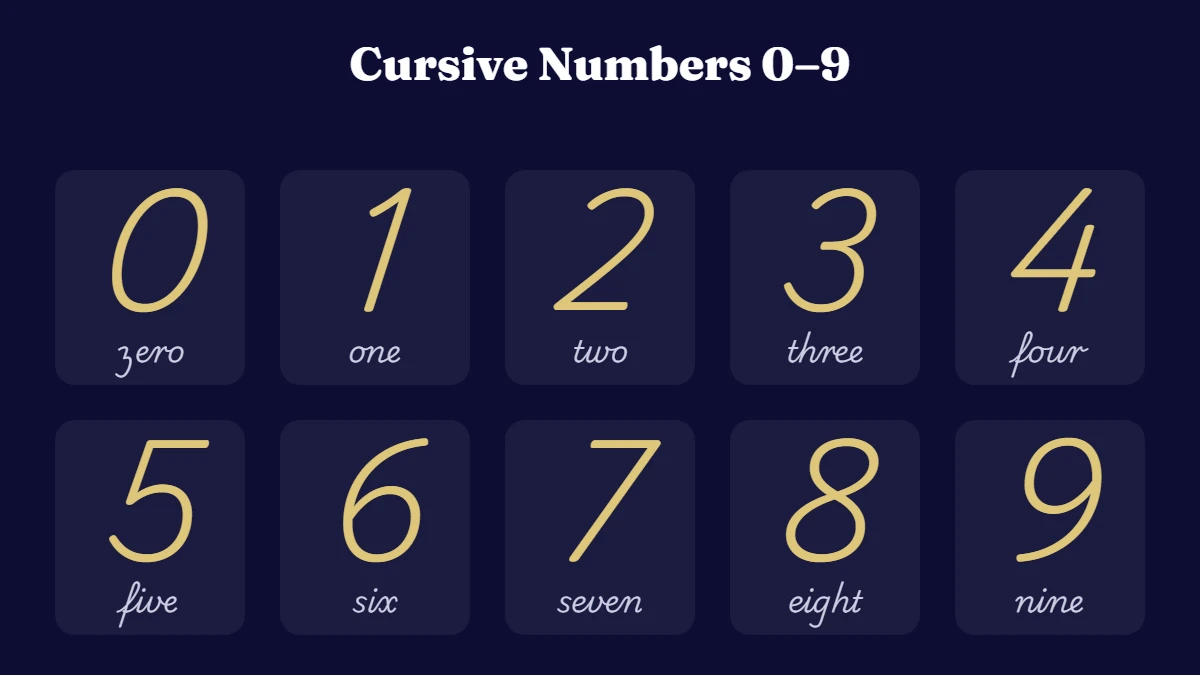
Cursive 3 shares its rounded top with 2 and its lower curve with 5, so practice the three digits as a group once the shape feels steady. The chart below shows all ten digits side by side, so you can check that your 3 matches the height and slant of its neighbors.
Cursive 3: Frequently Asked Questions
How do you write 3 in cursive?
Start below the top line, curve over to the right and back to a point at the middle, then curve out to the right again and down to the baseline, finishing with a short tail. Cursive 3 is one continuous stroke.
Should both curves of cursive 3 be the same size?
Make the bottom curve slightly larger. It gives the digit a stable base and stops it from looking top-heavy.
Does cursive 3 have a flat top?
Not usually. A flat top is common in print, but cursive 3 uses a rounded top curve that matches the flow of cursive letters.
Why does my cursive 3 look like a B?
Because the curves are closing into loops. Keep both curves open on the left side, and avoid adding a stem.
How do you write the word three in cursive?
Write a cursive t, loop up into the h, then join r and two small e loops. Cross the t at the end, once the word is finished.
Is cursive 3 easy for kids?
Yes, most children find it easy once they can draw a backwards C. Practice the top curve, then add the bottom one, then join them into one smooth movement.
Ready for 4?
keep goingMove on to the next digit, or go back to the hub for the full 0–9 chart and worksheets.