
Home › Cursive Numbers › Cursive 0
Cursive 0: How to Write Zero in Cursive
0
0 in cursive · 1 (no pencil lift) · free tracing worksheet
Cursive 0 is the number zero written as a smooth, slightly slanted oval that matches the rest of your cursive handwriting. It is the simplest digit to learn, and the oval it teaches appears again in 6, 8 and 9. Learn it step by step below.
Zero is a young digit compared with the others. The idea of a written symbol for “nothing” traveled with the history of the number 0 from India through the Arab world into Europe, and its shape has stayed a plain oval ever since. In cursive 0 that oval simply leans a little to the right and closes in one continuous movement. Because the shape is so simple, the real lesson of cursive 0 is control: making an oval that is the same size, the same slant and fully closed every single time.
At a glanceCursive 0 Quick Facts
Strokes
1 (no pencil lift)
Start here
Just below the top line, slightly right of center
Height
Top line to baseline (full height)
Don’t confuse with
The letter O and the number 6. Keep the zero closed, oval and tail-free.
How to Write 0 in Cursive Step by Step
- Start at the Top: Place the pencil just below the top line, slightly right of where the middle of the zero will be. Every cursive 0 starts here, not at the bottom.
- Curve Down the Left Side: Move up and over to the left, then sweep down the left side in a long, smooth curve until you reach the baseline. Keep the curve tall and narrow rather than round like a circle.
- Close the Oval: Curve along the baseline and travel back up the right side to meet the starting point exactly. A tiny overlap at the top is fine; a gap is not.
Count the movement out loud while you learn it: “top, down, round, up, close.” Saying the path helps the hand remember it, and after a dozen repetitions the counting is no longer needed. Most learners write a tidy cursive 0 within the first five minutes.
Free printableFree Cursive 0 Tracing Worksheet
Cursive 0 Tracing Sheet (PDF)
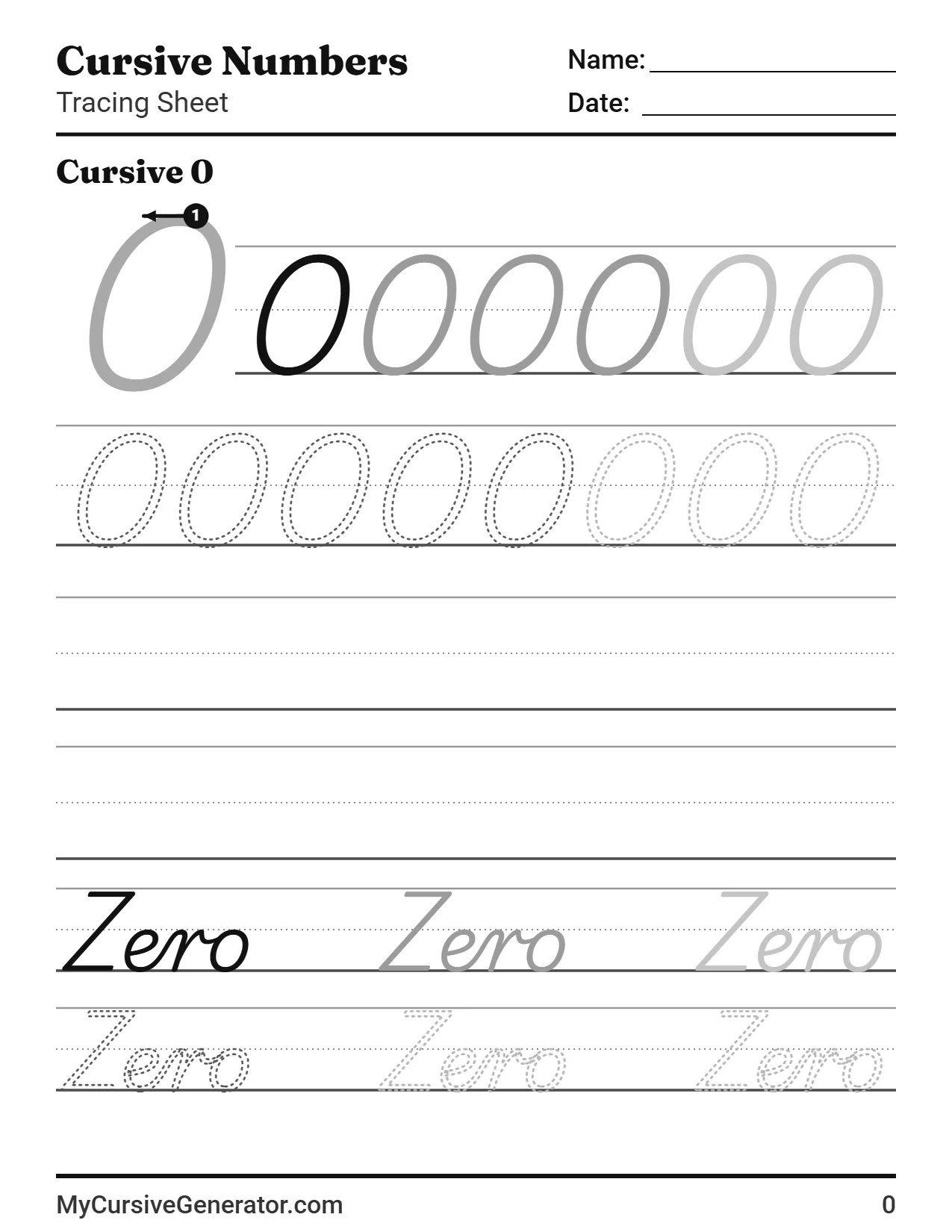
The cursive 0 tracing sheet fits on one US Letter page and prints cleanly in black and white. It starts with a large model of the digit and a numbered arrow that shows where the pen begins, then a row of 0s that fade from solid to light gray, a row of dotted 0s to trace, blank handwriting lines, and two rows of the word “Zero” to copy and trace.
Use it in three passes: trace the dotted row, copy the digit on the blank lines without tracing, then write 0 in cursive from memory. The dashed midline shows where the curves should turn, so keep an eye on it while you work.
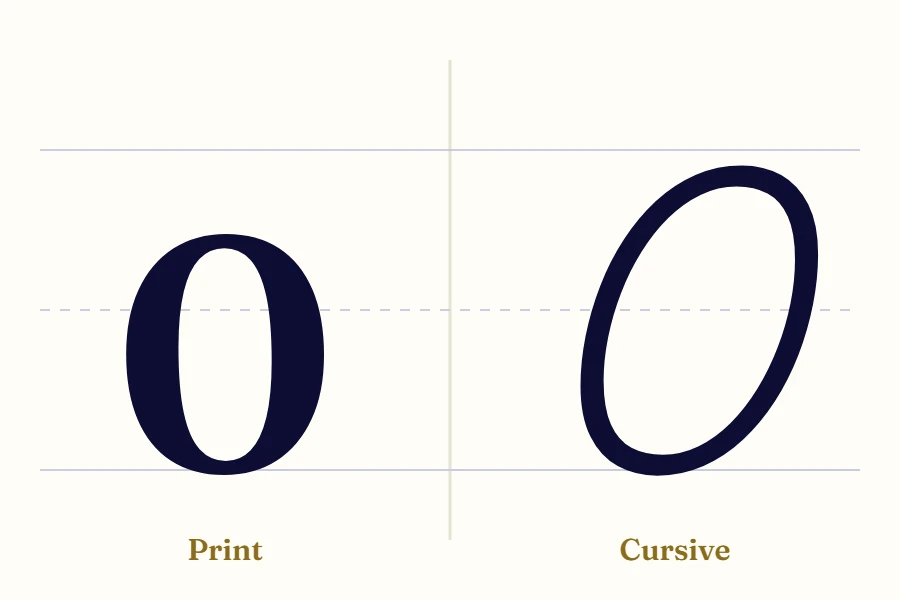
Cursive 0 vs Print 0
A printed zero is usually an upright oval, and many people draw it as two halves that meet at the bottom. Cursive 0 is one unbroken stroke that leans gently to the right, so it sits naturally beside slanted letters and other cursive numbers.
Zero is also the digit most easily confused with a letter. A cursive 0 should be taller and narrower than a cursive o, which is a small letter that only reaches the midline. In a mixed line such as a postcode or a code, that height difference is what tells the reader which one you meant. Some engineers and programmers add a slash through the zero for the same reason, but in everyday handwriting height and width do the job.
Avoid mix-upsCommon Mistakes With Cursive 0
| Mistake | How to fix it |
|---|---|
| Starting at the bottom | A zero started at the baseline usually ends with a gap or a crooked join at the top. Start at the top every time. |
| Leaving the top open | An open zero can read as a u or a c. Bring the stroke all the way back to the starting point. |
| Drawing a perfect circle | A round circle looks printed. Cursive 0 is a taller, narrower oval with a gentle lean. |
| Making it as small as the letter o | Zero reaches the top line; the small letter o stops at the midline. Keep the digit tall. |
| Changing the slant in a row | In numbers like 100 or 2000, zeros that lean in different directions look untidy. Hold one slant for the whole number. |
Variations of Cursive 0
Some engineers and programmers add a diagonal slash through 0 to tell it apart from the letter O. In school cursive the plain oval is standard; use the slashed form only in technical work.
Beyond digitsHow to Write Zero in Cursive
The word “zero” is a lovely joining exercise. It starts with a cursive z, a letter many people have not written since school, then flows through e, r and o. The z dips below the baseline in most school styles, so give it room. The final o ends high, at the midline, which is a useful habit for words like “zone” and “zoom”.
If any letter in these words feels unfamiliar, practice it first in the cursive alphabet guides, then come back to the full word.
Everyday uses0 in Cursive: Dates, Times and Prices
Zero appears constantly in real writing: in years like 2026, in prices like $10.50, and in times like 10:05. Because zeros so often sit next to each other, they are where uneven size shows up first.
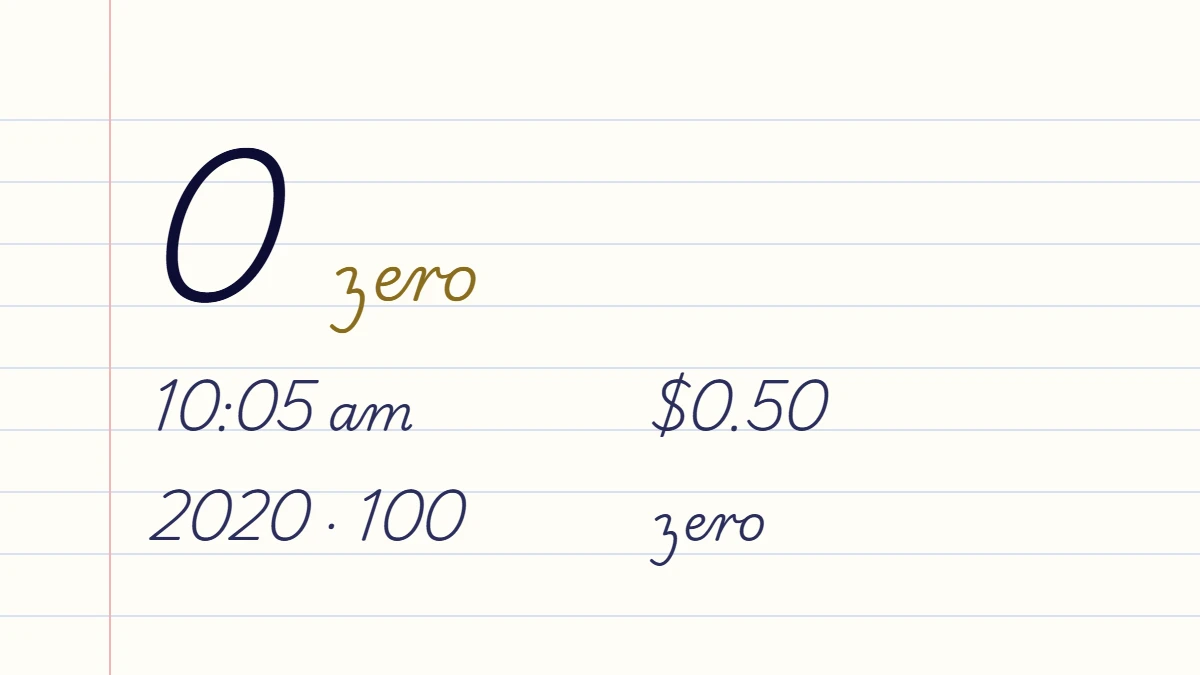
When you write a number with several zeros, such as 1,000 or 2,005, make every oval the same height and keep a small even gap between them. On a check, write zeros clearly closed so nobody can turn them into a 6 or a 9. To preview any date or amount in several cursive styles before writing it by hand, type it into our cursive generator.
10 minutes a day10-Minute Practice Routine for Cursive 0
Ten focused minutes a day for one week is enough to make cursive 0 feel automatic. Use the worksheet above or a lined notebook, and keep the pace slow until the shape is steady.
- Warm-up (2 minutes): draw a row of large relaxed ovals across the page, all leaning the same way, without lifting the pencil between them.
- Trace (2 minutes): trace one full row of dotted 0s on the worksheet, starting every digit at the top line.
- Copy (3 minutes): write the digit on blank lines beside the model, checking height and slant after every three or four digits.
- Use it (2 minutes): write the word “zero” and a few real numbers that contain 0, such as 10, 20, 100 and 2050.
- Check (1 minute): compare your last row with your first. Are all the zeros the same height, closed at the top, and leaning the same way? If they are getting wider, slow down and keep the oval narrow.
Teaching Cursive 0 to Children
Children usually find it easiest to learn cursive 0 after they can print the digit confidently. Show the movement slowly first, then let the child trace the dotted digits on the worksheet with a finger before using a pencil. Keep each session short and finish while the child is still enjoying it.
Praise the right things: a start at the top line, a steady slant and a digit that sits on the baseline. Those three habits matter more than perfect curves, and once they are in place the shape improves on its own. Adults can follow the same order, simply moving through it faster.
Keep goingPractice Cursive 0 With the Other Numbers
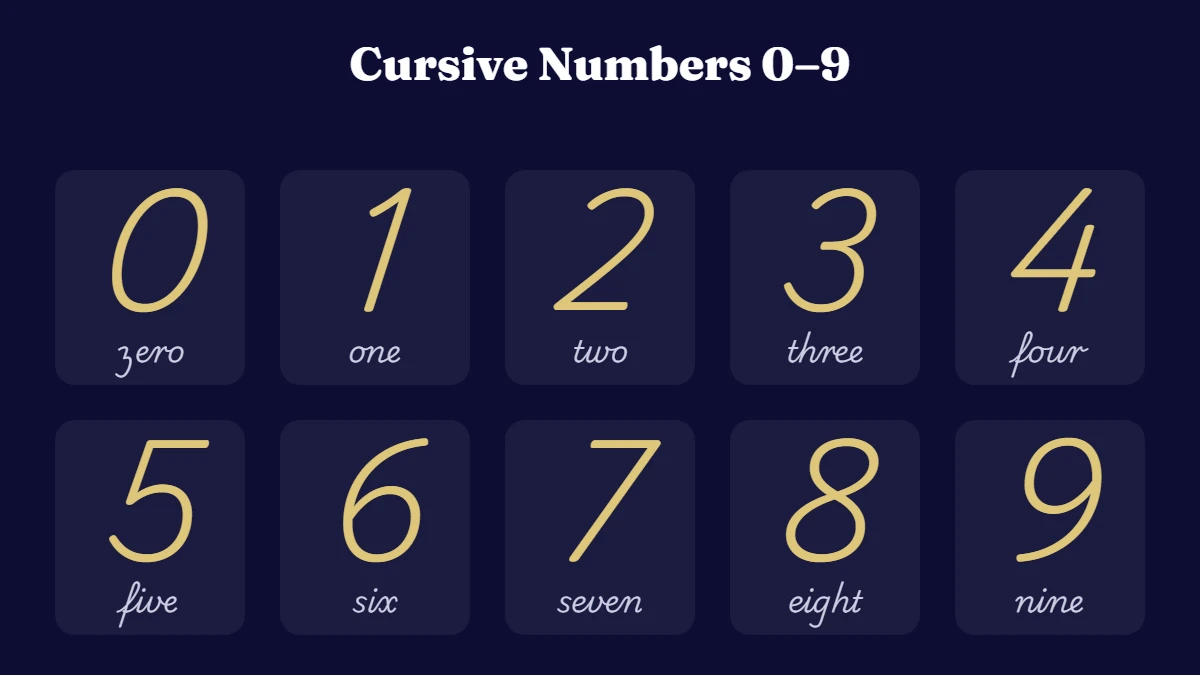
Zero shares its oval with 6, 8 and 9, so practice them as a family once cursive 0 feels steady. A good cursive 0 makes the round parts of those three digits much easier. The chart below shows all ten digits side by side, so you can check that your 0 matches the height and slant of its neighbors.
Cursive 0: Frequently Asked Questions
How do you write 0 in cursive?
Start just below the top line, curve up and over to the left, sweep down to the baseline, then curve back up the right side to close the oval. Cursive 0 is one continuous stroke with a gentle right slant.
Is cursive 0 different from print 0?
Only slightly. Cursive 0 is the same oval, but it is written in one stroke, leans gently to the right and is a little narrower, so it matches cursive letters on the same line.
How do I stop my cursive 0 looking like the letter o?
Make the zero tall. It should reach the top line, while the small letter o only reaches the midline. In a mixed code you can also add a slash through the zero.
Do zeros join together in cursive?
No. Even in numbers like 100 or 2000, each cursive 0 is written separately with a small gap. Only letters join in cursive writing.
How do you write the word zero in cursive?
Write a cursive z, which dips below the baseline, then join it to e, r and o without lifting the pen. Finish the o at the midline with a small exit stroke.
Is cursive 0 good for beginners?
Yes. Cursive 0 is the easiest digit because it is a single stroke with no pen lift. It also builds the oval movement needed for cursive 6, 8 and 9.
Ready for 1?
keep goingMove on to the next digit, or go back to the hub for the full 0–9 chart and worksheets.