
Home › Cursive Numbers › Cursive 5
Cursive 5: How to Write Five in Cursive
5
5 in cursive · 2 (lift once) · free tracing worksheet
Cursive 5 is the number five written with a short slanted neck, a round belly that opens to the left and a flag added across the top at the end. It is the digit learners most often get wrong, so it is worth a careful look. Learn it step by step below.
Five has changed shape many times, from early forms that looked almost like a 4 or a 6 to the flag-and-belly digit we know today, as the history of the number 5 shows. Cursive 5 keeps the modern shape and splits it into two strokes: the neck and belly first, the flag last. Writing the flag last is the key habit. It keeps the belly smooth and round, and it lets the flag sit exactly where it should, level with the top line.
At a glanceCursive 5 Quick Facts
Strokes
2 (lift once)
Start here
On the top line
Height
Top line to baseline (full height)
Don’t confuse with
The letter S and the number 6.
How to Write 5 in Cursive Step by Step
- Pull Down the Neck: Start at the top line and pull a short stroke down and slightly to the left, stopping around the midline. Keep it straight and short.
- Round the Belly: Without lifting, curve out to the right, round down to the baseline and back to the left, finishing with a small tail. The belly should be generous and open on the left.
- Add the Flag Last: Lift the pencil, place it at the top of the neck and draw a short flag to the right along the top line.
Do not skip the flag or attach it too early. A cursive 5 without its flag is easily read as a 6 or an S, while a flag drawn before the belly tends to make the whole digit stiff. Write neck and belly, lift, then add the flag as the final touch.
Free printableFree Cursive 5 Tracing Worksheet
Cursive 5 Tracing Sheet (PDF)
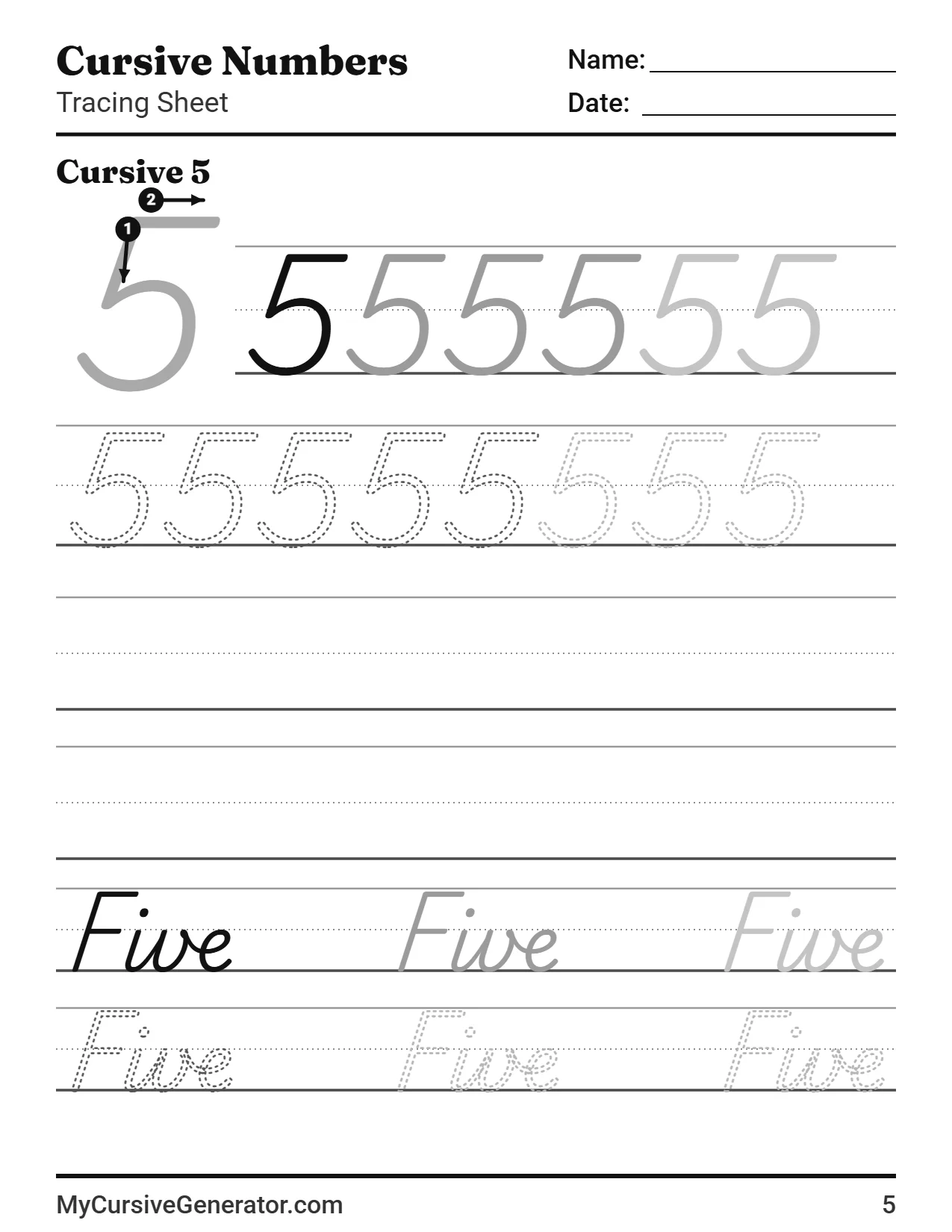
The cursive 5 tracing sheet fits on one US Letter page and prints cleanly in black and white. It starts with a large model of the digit and a numbered arrow that shows where the pen begins, then a row of 5s that fade from solid to light gray, a row of dotted 5s to trace, blank handwriting lines, and two rows of the word “Five” to copy and trace.
Use it in three passes: trace the dotted row, copy the digit on the blank lines without tracing, then write 5 in cursive from memory. The dashed midline shows where the curves should turn, so keep an eye on it while you work.
Cursive 5 vs Print 5
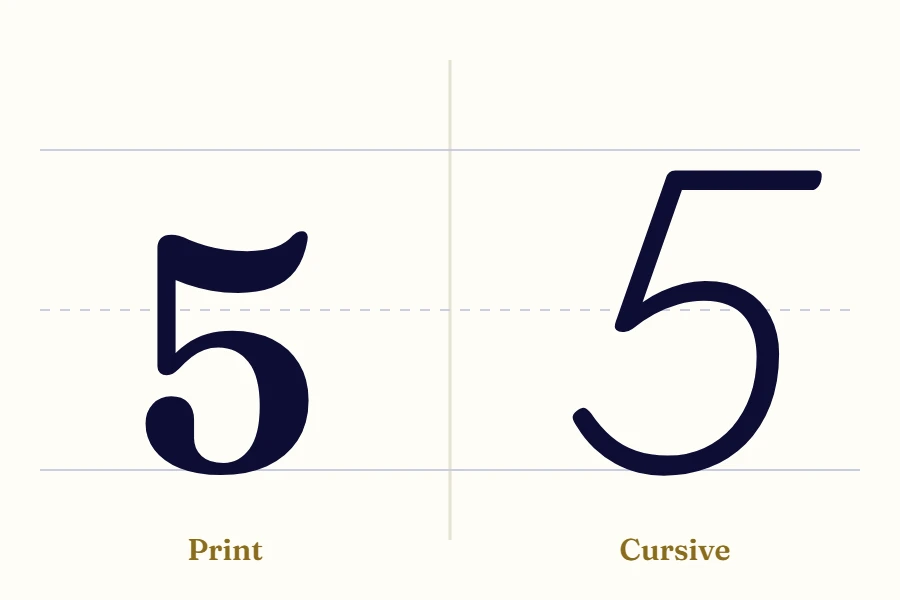
A printed 5 often looks boxy, with a sharp corner between neck and belly. Cursive 5 rounds that corner, leans the neck and gives the belly a fuller curve, then adds the flag in a separate quick stroke at the end.
The common confusion is with a cursive S or a 6. If the belly closes, the digit becomes a 6; if the neck curves instead of staying straight, it looks like an S. Keep the neck straight, the belly open, and the flag clearly horizontal, and cursive 5 will read correctly every time.
Avoid mix-upsCommon Mistakes With Cursive 5
| Mistake | How to fix it |
|---|---|
| Forgetting the flag | Without its flag, cursive 5 looks like a 6 or an S. Always add it last. |
| Drawing the flag first | A flag drawn first often makes the belly stiff and boxy. Leave it until the end. |
| Closing the belly | A closed belly turns five into six. Keep the bottom curve open on the left. |
| A curved neck | A curved neck makes the digit look like an S. Keep the neck short and straight. |
| A flag that floats or droops | The flag sits on the top line and runs to the right. A sloping flag makes the five look careless. |
Variations of Cursive 5
Some writers make the neck slightly slanted or start the bar first. The order matters less than the result: a clear vertical neck, a round belly and a flat bar.
Beyond digitsHow to Write Five in Cursive
The word “five” starts with a cursive f, which needs both an upper and a lower loop, then joins into i, v and e. The v ends high at the midline, so the e is joined from the top. Remember to dot the i after the word is finished, not in the middle of it.
If any letter in these words feels unfamiliar, practice it first in the cursive alphabet guides, then come back to the full word.
Everyday uses5 in Cursive: Dates, Times and Prices
Five appears in dates like the 5th or the 25th, in times like 5:05, in prices such as $5.50 and in every year ending in five. On receipts and checks it sits next to zeros very often, so a clear flag matters.
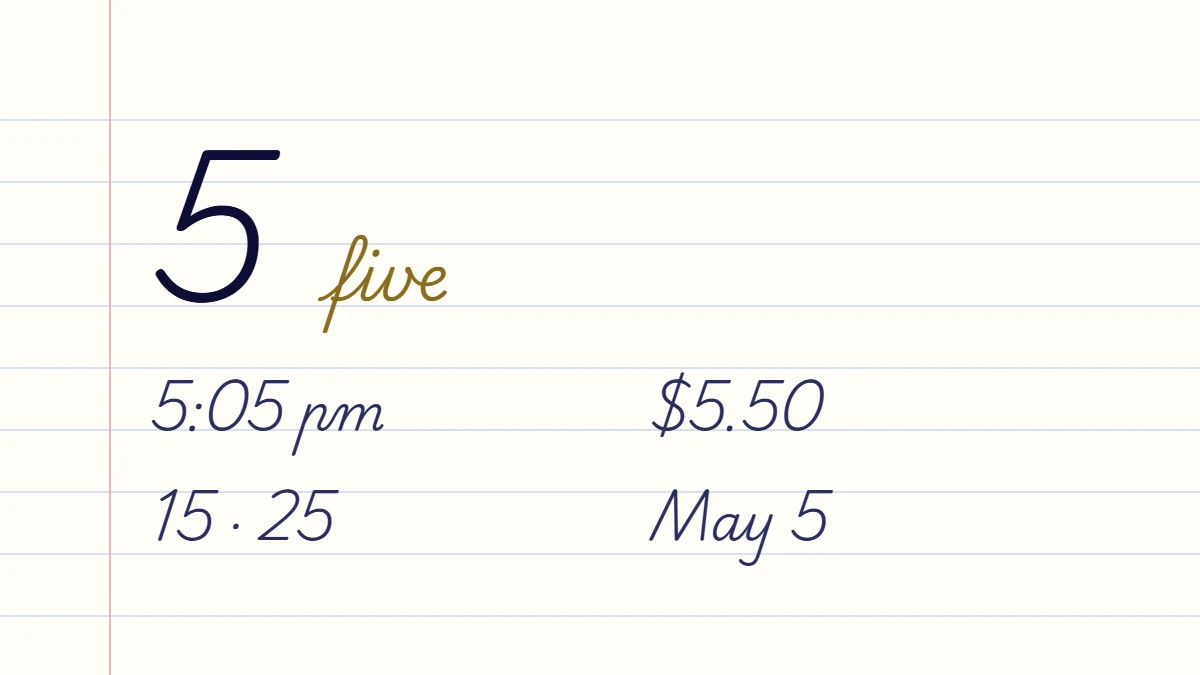
In numbers such as 55 or 505, make sure every five has its flag. Writers in a hurry tend to skip the flag on the second five, and that is exactly the one a reader misreads. To preview any date or amount in several cursive styles before writing it by hand, type it into our cursive generator.
10 minutes a day10-Minute Practice Routine for Cursive 5
Ten focused minutes a day for one week is enough to make cursive 5 feel automatic. Use the worksheet above or a lined notebook, and keep the pace slow until the shape is steady.
- Warm-up (2 minutes): draw a row of short straight necks, each followed by a round open belly, without the flag, then go back and add all the flags at the end.
- Trace (2 minutes): trace one full row of dotted 5s on the worksheet, starting every digit at the top line.
- Copy (3 minutes): write the digit on blank lines beside the model, checking height and slant after every three or four digits.
- Use it (2 minutes): write the word “five” and a few real numbers that contain 5, such as 15, 55, 500 and 2025.
- Check (1 minute): compare your last row with your first. Are all the flags level with the top line? Are all the bellies open on the left and about the same size?
Teaching Cursive 5 to Children
Children usually find it easiest to learn cursive 5 after they can print the digit confidently. Show the movement slowly first, then let the child trace the dotted digits on the worksheet with a finger before using a pencil. Keep each session short and finish while the child is still enjoying it.
Praise the right things: a start at the top line, a steady slant and a digit that sits on the baseline. Those three habits matter more than perfect curves, and once they are in place the shape improves on its own. Adults can follow the same order, simply moving through it faster.
Keep goingPractice Cursive 5 With the Other Numbers
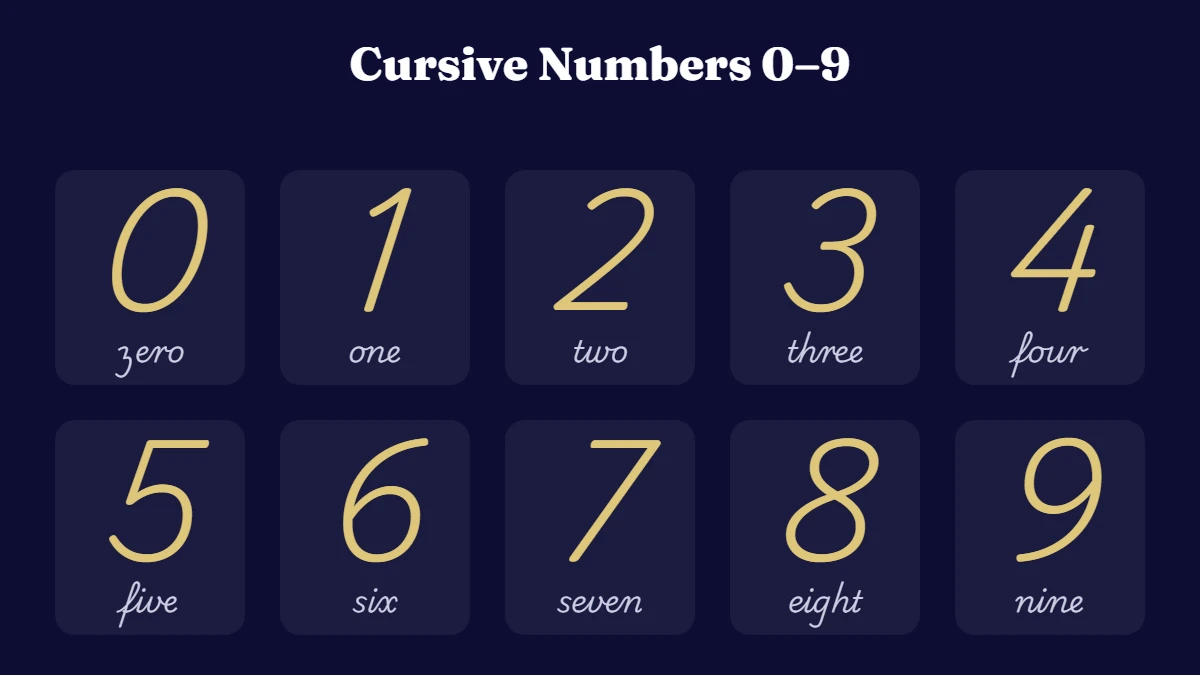
Cursive 5 shares its rounded belly with 3 and its flag-last method with 4 and 7. Practice those digits together so your pen lifts and flags become a consistent habit. The chart below shows all ten digits side by side, so you can check that your 5 matches the height and slant of its neighbors.
Cursive 5: Frequently Asked Questions
How do you write 5 in cursive?
Pull a short neck down from the top line, curve out into a round belly that ends on the baseline, then lift the pencil and add a short flag along the top line. Cursive 5 is written in two strokes.
Do you write the top line of cursive 5 first or last?
Last. Writing the flag at the end keeps the belly smooth and puts the flag exactly where it belongs on the top line.
Why does my cursive 5 look like an S?
Usually because the neck is curved or the flag is missing. Keep the neck straight and always add the flag.
Why does my cursive 5 look like a 6?
The belly is probably closing. Keep the bottom curve open on the left so it never meets the neck.
How do you write the word five in cursive?
Write a cursive f with its two loops, join it to i and v, then bridge from the top of the v into the e. Dot the i at the end.
Is cursive 5 the hardest number?
Many learners find it one of the trickiest because of the pen lift and the flag. With the flag-last method, most people write a clean cursive 5 after two or three short practice sessions.
Ready for 6?
keep goingMove on to the next digit, or go back to the hub for the full 0–9 chart and worksheets.