
Cursive Alphabet: A to Z Cursive Letters (Uppercase & Lowercase)
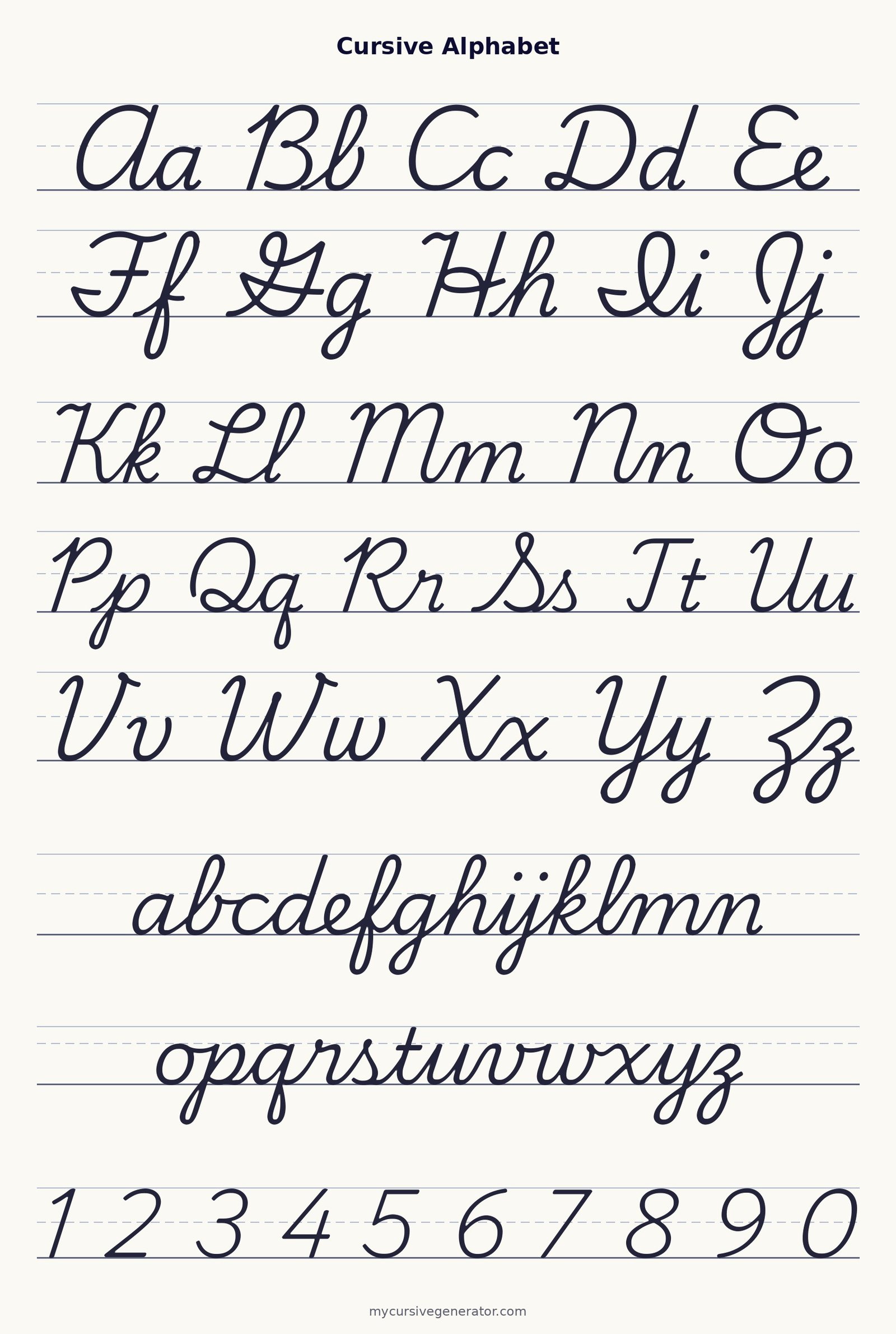
Learn every letter of the cursive alphabet in one place. See how each capital and small letter is formed, tap any letter for its full guide, and use the chart below to practice the complete A to Z in cursive writing. This is the complete set of cursive letters, from A to Z, with a free printable chart for daily practice.
All Cursive Letters A to Z
Click on a letter of the cursive alphabet to go directly to its tutorial and worksheet download for that letter.
Cursive Numbers
Numbers 0 to 9 have their own hub — guides, tracing worksheets and a free numbers chart.
Explore Cursive Numbers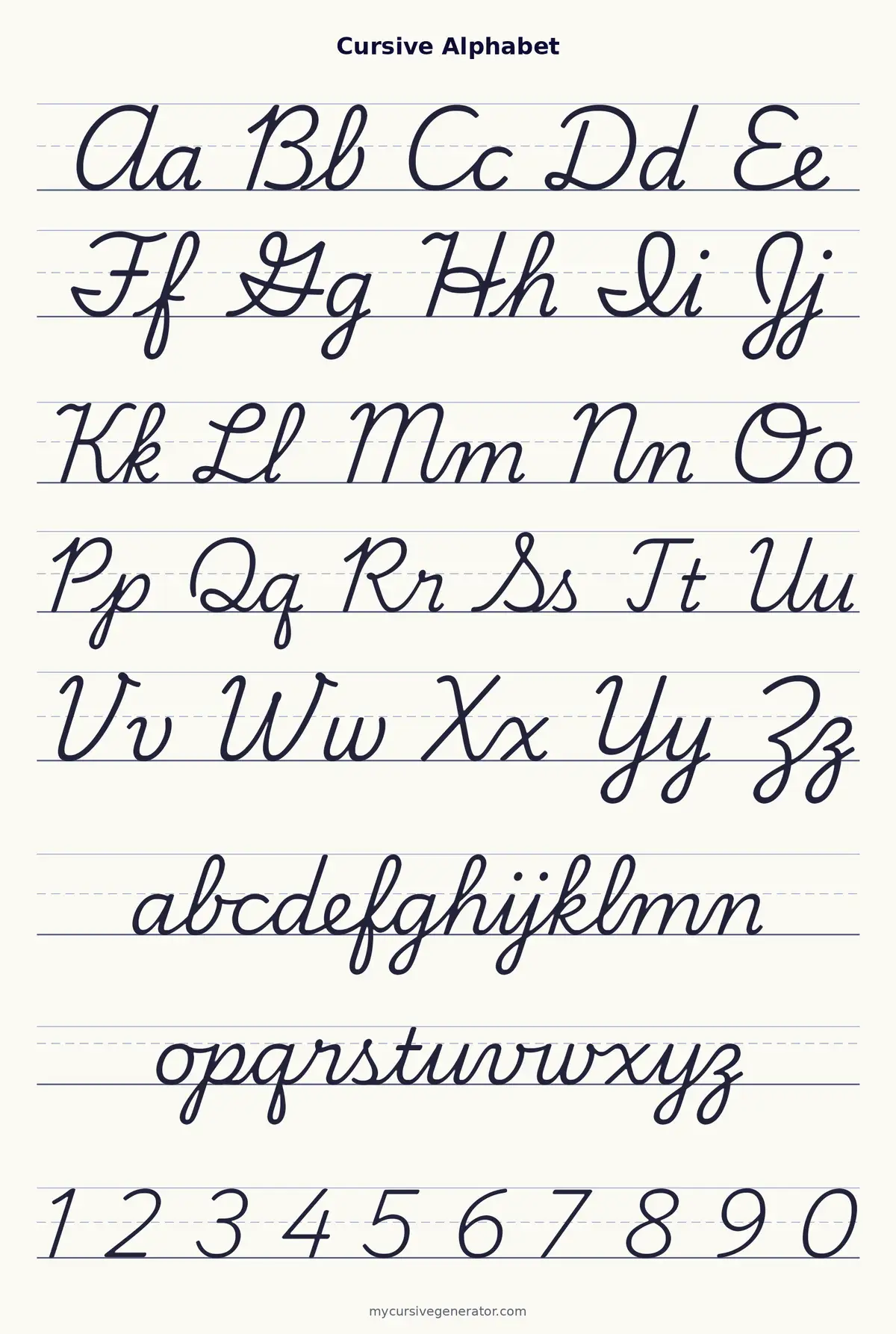
What Is the Cursive Alphabet?
The cursive alphabet is the set of 26 letters written in a flowing, joined-up style. Print letters are drawn stroke by stroke, with the pen lifting off the page again and again. Cursive letters are different: they connect to each other, so a whole word can flow from the pen in one smooth movement. Every letter of the cursive alphabet has two forms — uppercase cursive letters for starting sentences and names, and lowercase cursive letters that do most of the work inside words.
Children usually meet the cursive alphabet at school between the ages of seven and nine, but adults love it too — for signatures, journals, greeting cards and beautiful everyday notes. Because so many shapes differ from print, the quickest way to learn is to study the whole cursive alphabet first, one letter at a time, and only then start joining letters into words. That is exactly what this page helps you do: the complete chart above, plus a friendly guide for every letter.
Uppercase vs Lowercase Cursive Letters
In print, capital and small letters usually look like bigger and smaller versions of the same shape. Cursive is different. Many capital cursive letters have their own flowing form with loops and entry strokes, and a few lowercase letters change shape completely too. That is why learners often find the cursive alphabet harder than expected — you are really learning two alphabets, not one.
The letters that surprise people most are the capitals F, G, Q, S and Z, and the small letters b, f, k, r and s. A capital cursive F looks nothing like a printed F, and a lowercase cursive s looks more like a tiny sail than the s you already know. The good news: once you learn the handful of “different” letters, the rest of the alphabet falls into place quickly, because most cursive letters reuse the same basic strokes — the undercurve, the overcurve and the loop.
One more difference matters in everyday writing: capitals in the cursive alphabet rarely join to the letter that follows them, while small letters almost always do. That is why the lowercase set is the real engine of fluent handwriting — once your small letters connect smoothly, speed and neatness follow together.
Cursive Letters in Four Stroke Families
Fifty-two shapes sound like a lot to memorize, but nearly every shape in the cursive alphabet is built from just four basic strokes. Learn the four families below and the whole set of cursive letters suddenly feels much smaller.
Undercurve letters — a, c, d, e, g, o, q. These letters begin with a swing that curves underneath, like the bottom of a smile. Master this single stroke and seven letters come almost free.
Downcurve letters — i, j, p, t, u, w. A hump that arcs down to the baseline and back up again. This family teaches the steady rhythm of writing without lifting the pen.
Overcurve letters — b, f, h, k, l, m, n, r, s, x. Strokes that climb up and loop over. This is the biggest family in the cursive alphabet, and it includes all the tall loop letters.
Special shapes — v, y, z and the capitals F, G, Q, S, Z. A small group with shapes all of their own. They look strange on day one, but a little extra practice makes them feel as easy as the rest.
Teaching a child? Work through one family at a time, and keep the chart nearby — children love ticking off each family as it clicks.
✅ Easiest Letters to Learn First
Built from one simple curve.
The same hump stroke, repeated.
A single stroke plus one cross. Start here and you can already write many short words.
⭐ Letters That Need Extra Practice
Capital shapes unlike their print forms.
The only lowercase letter with both a top and a bottom loop.
Small letters whose cursive shapes surprise almost everyone.
How to Practice the Cursive Alphabet
Learn the strokes
Master the four basic strokes first — undercurve, overcurve, downcurve and the loop. Every letter is built from them.
Start with easy letters
Begin with a, c, e, i, l, o and u. Quick wins build the confidence to attempt the harder shapes.
Trace, then write
Use the printable chart and practice sheets: trace each letter, then write it from memory on the blank lines.
Join letters into words
Once single letters feel easy, practice joining them — cat, sun, mom — before moving to full sentences.
Cursive Alphabet Practice Tips That Actually Work
Little and often wins. Ten minutes with the cursive alphabet every day builds far more skill than one long session a week, because your hand learns the movements through short, regular repetition. Anyone starting to learn cursive should keep sessions short and regular — that is how the movements stick.
Say the strokes out loud. As you write, quietly name each stroke — undercurve, loop, down. It feels simple, but learners who do this memorize new letters noticeably faster.
Write real words early. Do not wait until every letter is perfect. Your name, the days of the week and short greetings use most letters, and real writing keeps practice fun.
Use paper with a midline. Half of neat cursive is size control — small letters reach the midline, tall letters reach the top line, and letters with tails dip below the baseline in a loop.
Cursive Alphabet — Frequently Asked Questions
How many letters are in the cursive alphabet?
The cursive alphabet has the same 26 letters as the print alphabet — A to Z — each with an uppercase and a lowercase form, so there are 52 letter shapes to learn in total.
What is the easiest cursive letter to learn?
Lowercase l, e and c are usually the easiest: each is a single simple stroke. Most teachers start with the group a, c, e, i, l, o, u because they all share the same basic curve.
What is the hardest cursive letter?
Capital F, G, Q and Z are the hardest for most learners because their cursive shapes look nothing like print. Lowercase f is also tricky — it is the only letter with a loop both above and below the line.
Can I print the cursive alphabet chart?
Yes — the chart at the top of this page is free to save and print for home or classroom practice.
How long does it take to learn the cursive alphabet?
With 10–15 minutes of daily practice, most learners can write all 52 letter shapes within 3–4 weeks. Joining letters into smooth words takes a few more weeks of regular writing.
Where can I practice each letter separately?
Every letter above has its own page with step-by-step strokes, example words, common mistakes and a printable worksheet — just tap a letter in the grid.
At what age should children start learning the cursive alphabet?
Most schools introduce it around age seven or eight, in grades 2–3, once print letters are secure. Younger children can still enjoy tracing the big shapes, and older children and adults can begin at any age — they often progress faster because they already read fluently.
Is cursive handwriting the same in every country?
Almost. Schools in the US, the UK and most English-speaking countries teach the same cursive letter shapes, with small style differences in a few capitals such as Q and Z. The chart and guides on this page follow the traditional cursive alphabet style used in most classrooms.
See Your Name in Cursive
Type any name or word and see it in beautiful cursive fonts instantly — free, no sign-up.
Try the Free Cursive Generator