
Home › Cursive Alphabet › Cursive V
Cursive V: How to Write the Letter V in Cursive
Cursive V is a sharp, open letter, and it rewards a steady hand. Capital cursive V starts with a small entry loop, drops to a clean point, and rises back to the top line. Lowercase v is a smaller copy of that same point, made between the midline and the baseline.
Cursive script joins the letters of a word, and cursive v is a good letter to learn early because it teaches height, slant, and a clean change of direction in one short movement. The point at the bottom is the whole test. If it is sharp and sits on the line, the letter reads at once. If it rounds off, it can look like a small u.
Trace the Cursive Letter V
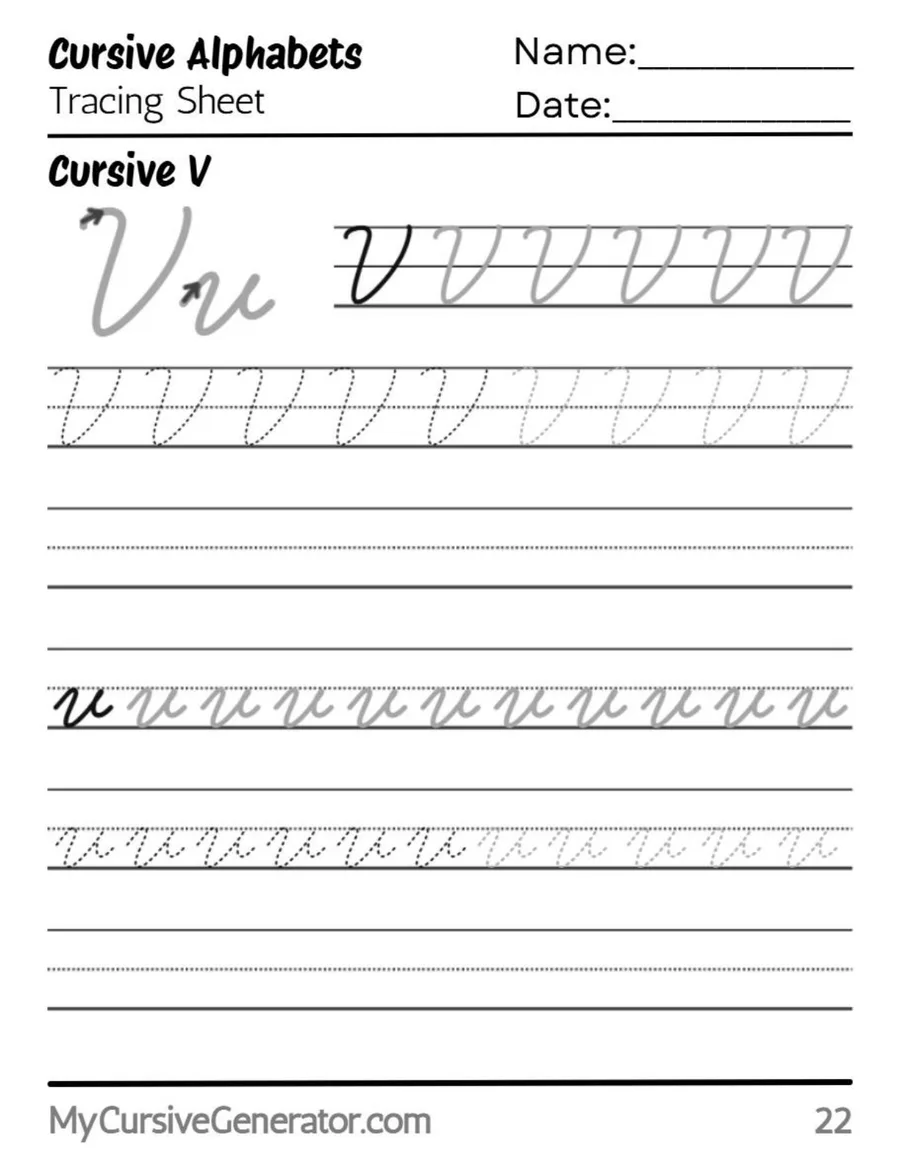
Tracing is the fastest way to fix the shape of cursive v before you write it on your own. Trace the capital form first, then the small form, and keep your eyes on the lines, not on the pen tip. Say the path out loud as you trace: loop, down, point, up. Then write one row without tracing and compare the two rows.
Before You Start
Sit with both feet flat and tilt the paper a little to the left if you write with your right hand. Left handed writers should tilt it the other way, a point covered later on this page. Hold the pencil loosely, about two finger widths above the tip, because a tight grip makes diagonal strokes shaky. Check three lines before you start: the top line for the capital, the midline for the small form, and the baseline for the point.
How to Write Capital Cursive V
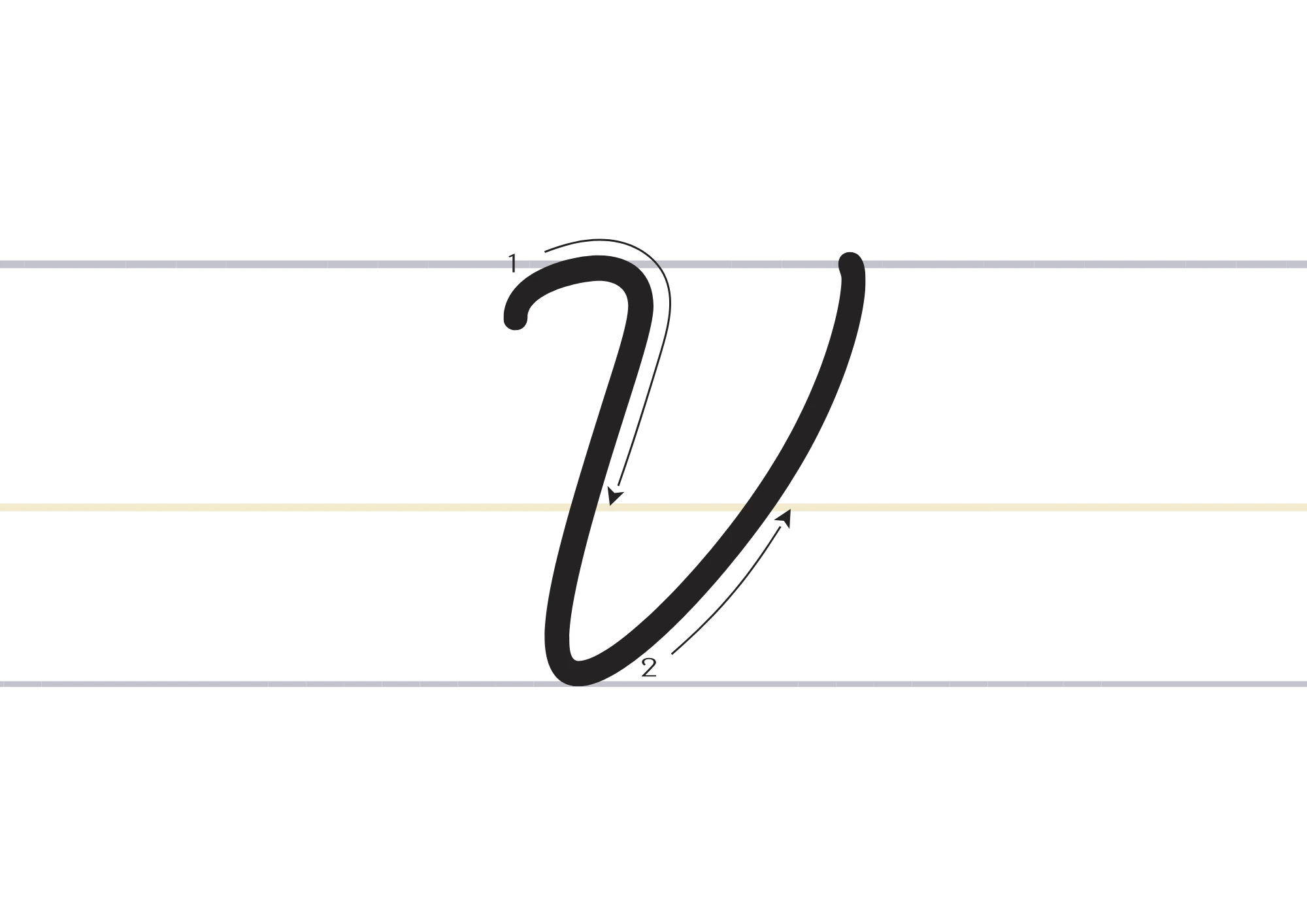
Capital cursive V is one continuous stroke, and the three steps below are three phases of that one stroke. Start just below the top line, make the entry loop, drop to the point, and rise back to the top line.
The Entry Loop
Start just below the top line and curve up and to the right until you touch the top line, then curve back a short way to form a small half loop. This loop is the real start of the capital, and it is the part most short guides leave out. Keep the loop small.
Drop to the Point
From the loop, sweep down diagonally to the baseline in one smooth movement. Keep the slant steady and do not slow down so much that the line wobbles. Stop on the baseline and turn at a sharp point. That point is what sets cursive V apart from cursive U, which rounds at the bottom instead.
Rise and Finish
From the point, rise diagonally back to the top line, mirroring the downstroke so both sides match in height and slant. Finish with a short flick to the right at the top line, then lift the pen. This flick is a finish, not a join. The capital does not join to the next letter, so the next letter starts fresh after a small gap.
How to Write Lowercase Cursive v
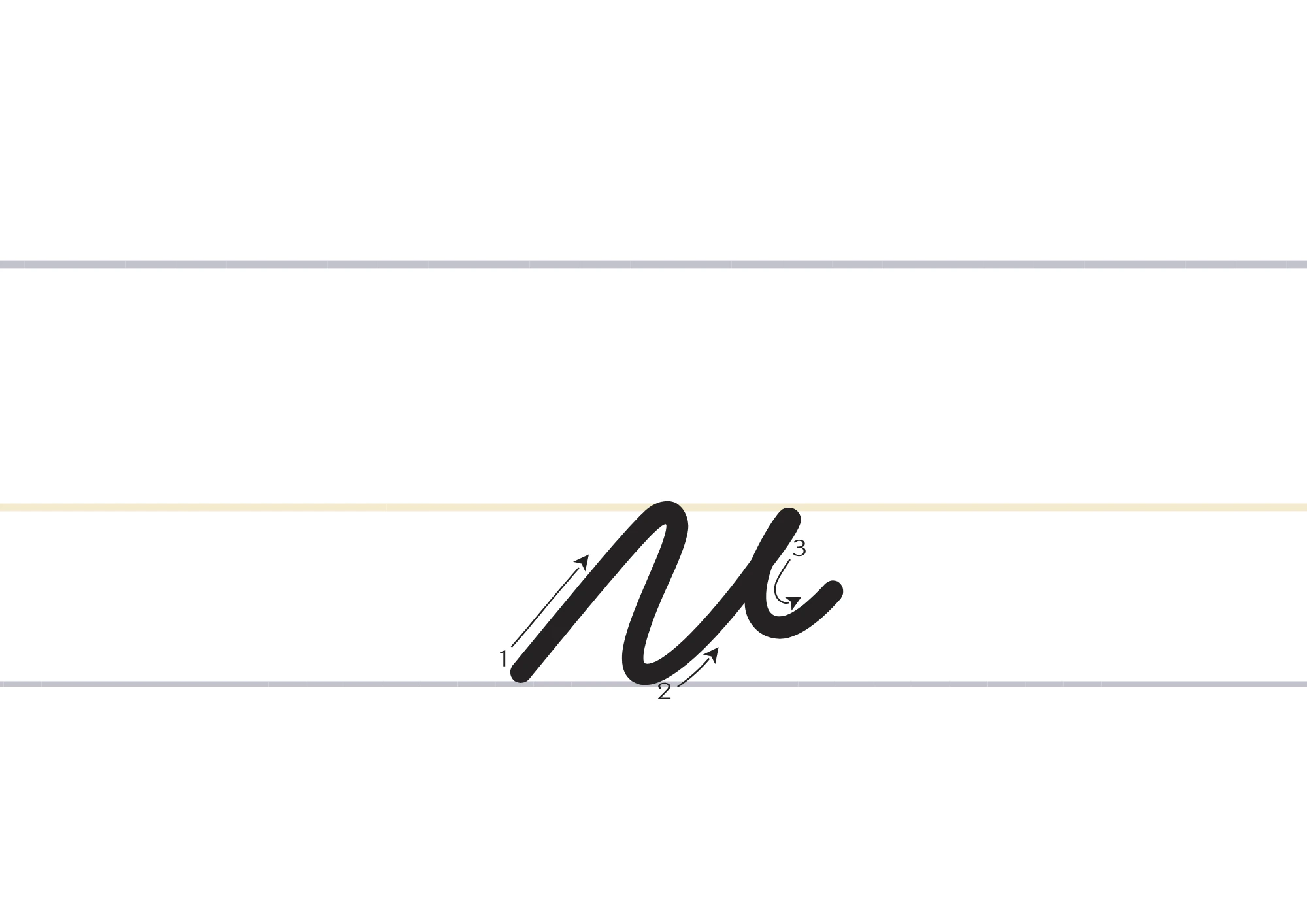
Lowercase v is the form you will use most often, because most v sounds sit inside words, not at the start. It is one continuous stroke, made between the midline and the baseline.
The Entry Undercurve
Start on the baseline and curve up and to the right to the midline. This short entry curve is the lead in for the small form, and it sets the slant for the whole letter. Keep the curve light and even, and do not start above the midline.
Down to the Point
From the midline, drop diagonally back down to the baseline in one smooth stroke. Land on the baseline and turn at a sharp point, just as you did for the capital. Do not round the turn. A rounded turn turns cursive v into a small u, and that is the most common reading error for this letter.
Up and Connect
From the point, rise diagonally back to the midline, then carry the stroke a short way to the right, staying close to the midline. That short connector is what joins lowercase cursive v to the next letter, so do not stop dead at the midline. In va, ve, and vi, this connector flows straight into the next letter without a lift.
Why Capital V Does Not Join to the Next Letter
Many short guides say every cursive letter joins to the next letter. Capital cursive V is an exception, and that exception matters. It ends at the top line, well above the midline where most small letters begin, so there is no natural path from its finish into the next letter. Trying to force a join from the top line usually drags a long, sloping line across the word and spoils the spacing. The correct habit is simple: finish the capital, lift the pen, leave a normal letter gap, and start the next letter on its own. Words like Victor, Vera, and Vincent all start this way. Once you accept the lift, the capital gets easier.
Cursive V Compared With Cursive U and W
V is easy to confuse with two neighbors, so it helps to set them side by side. U rounds at the bottom and rises with a softer turn, while v cuts to a sharp point and changes direction at once. If your v looks soft, you have written a u. W is a double v, with two points on the baseline and a wider body, while v has only one point. A v that is too wide can start to look like the first half of a w. Print V is two straight lines that never join, while cursive v adds curves, an entry, and a connector.
How to Write Cursive V: 10-Minute Daily Practice Routine
A short daily routine beats one long session. Ten focused minutes a day for a week is enough to make cursive v feel steady. Use a lined notebook and keep the pen moving slowly.
- Warm-up strokes (2 minutes): draw the entry curve and the downstroke again and again, keeping every point on the baseline and every top at the same line.
- Capital form (2 minutes): write capital cursive V slowly, checking the entry loop, the point, and the finish at the top line on every row.
- Lowercase form (3 minutes): write small v rows inside the midline and baseline, keeping every letter the same size and every point sharp.
- Words (2 minutes): write van, vet, and very in full, joining each letter without lifting the pen, and watch how the letter hands over to the next letter.
- Quick check (1 minute): compare your last row with your first row. Are the points sharp? Is the slant steady? If a row looks shaky, slow down rather than pressing harder.
Repeat the same routine tomorrow.
Words That Start With V in Cursive
Practice these common V words first. Read each word, trace it, then write it on your own:
Violin · Volcano · Van · Violet · Vulture · Vase
Victor · Vera · Vincent · Vanessa · Valerie · Vikram
See these words with our cursive generator, or go back to the full cursive alphabet chart.
V Inside Words
Most v sounds do not start a word. They sit in the middle, in words like river, never, cover, seven, and travel, and that is where lowercase cursive v does most of its work. In the middle of a word, the letter arrives on a connector from the letter before it, so the entry curve is shorter than it looks on its own. The point still has to land on the baseline, and the connector still has to leave at the midline, or the word will sag in the middle. Practice middle v words as whole words, not as single letters, because the joins are the skill. Try river, never, cover, and seven slowly, then at a normal pace.
Writing Cursive V Left Handed
Left handed writers can write a clean cursive v, but the paper setup is the mirror image of the right handed setup. Tilt the paper a little to the right, not to the left, so the diagonal downstroke runs away from the hand instead of under it. Keep the wrist straight and let the arm move, rather than hooking the wrist over the top of the line. Watch the entry loop most, because a hooked wrist tends to flatten it into a straight tick. A softer pencil helps here, because it needs less pressure, and less pressure means less smudge.
Common Mistakes With Cursive V
- Writing the letter as two straight print lines. With no entry curve and no connector, it turns back into print. It needs curves and a join to live inside a word.
- Rounding the point. Rounding the bottom turn makes lowercase cursive v look like a small u. Check the point before you check anything else, and sharpen it until the turn is a clear V shape.
- Getting the height wrong. Letting the small form rise above the midline, or letting the capital fall short of the top line, throws the word out of scale.
- Forcing a capital join. Dragging a long line from the top of the capital into the next letter spoils spacing and slant. Lift the pen after the capital, as described above, and start the next letter fresh.
- Changing the slant halfway through. A steady, gentle slant to the right keeps the letter neat. A slant that changes inside one letter makes the whole word look shaky, so slow down when the slant starts to drift.
- Skipping the entry. Skipping the small entry loop on the capital, or the entry curve on the small form, leaves a bare pointed shape with no cursive character. Those small entries are what mark the letter as cursive, not print.
How to Join V Cursive Letters
A capital letter usually starts a word, so it rarely joins from the left, and capital cursive V does not join to the right either. Its job is to open the word cleanly, then hand over with a lift and a gap. The lowercase form does most of the joining work, because it connects on both sides. Good pairs to practice first are the short, common ones: va, ve, vi, vo, vu, and vr. Write each pair slowly and watch the join itself, not just the two letters. The connector should leave at the midline at the same gentle angle every time and meet the next letter at the same height.
Two habits make joins look natural. First, keep the pen on the paper through the whole word after the capital, because every extra lift creates a visible break. Second, keep the spacing even.
How to Write V in Cursive: Practice Sentences
Single letters are only half the skill, because sentences teach spacing, rhythm, and stamina. Try each sentence three times: slowly, at a normal pace, and without stopping.
Victor played a violin in the valley.
Vera visited a volcano on vacation.
Violet covered the vase with velvet.
We practice cursive v with violin and volcano every day.
When a sentence is finished, read it back and check: are the joins smooth, is the slant steady, and does every cursive v keep the right height?
Letter V in Cursive for Names and Signatures
Names are where most people first notice their own handwriting, because a name is written far more often than any practice word. For a first name that begins with this letter, keep the capital a little larger and more open than in ordinary writing, because it reads better at a glance and gives the name a clear starting point. For signatures, write the same shape faster and looser, but keep it recognizable: the point must stay visible, and the finish must stay at the top line. If a signature becomes a scribble, slow it down until the shape is visible again, then build speed back up gradually.
When to Teach Cursive V to a Child
Most US schools introduce cursive in third grade, when learners are about eight years old, and cursive v fits well early in that sequence because its shape is short and its point is easy to check. Start with the lowercase form, because it appears inside words right away. Let the child trace the form first, then copy it, then write it from memory. Keep sessions short, and praise a sharp point and a steady height before correcting anything else. If the point keeps rounding into a u, go back to tracing for a day rather than pushing on to words.
Cursive V, Frequently Asked Questions
What does the letter V look like in cursive?
Capital cursive V starts with a small entry loop, drops to a sharp point on the baseline, and rises back to the top line. Lowercase cursive v is a smaller copy between the midline and the baseline, with a short connector.
Is cursive V hard to learn?
No. Cursive v is one of the shorter letters to learn, because it has one point and no loops below the line. Practice both forms separately, then join the small form into short words.
Does capital cursive V join to the next letter?
No. Capital cursive V ends at the top line, so it cannot join naturally to the next letter. Finish it, lift the pen, leave a normal gap, and start the next letter fresh.
How do you join lowercase cursive v to the next letter?
Use the short connector that leaves at the midline after the upstroke. It flows straight into the next letter, so the pen stays on the paper inside a word. Start with va, ve, vi, vo, and vu.
What words can I practice with cursive V?
Start with van, vet, very, violin, and volcano, then try middle v words like river, never, and cover.
Should I learn the capital or the lowercase form first?
Start with the lowercase form. Lowercase cursive v appears inside words far more often than the capital, so it pays off at once.
Why does my cursive v look like a u?
The point has rounded off. Sharpen the turn on the baseline until it is a clear point, and check that the letter stays between the lines.
Why does my capital cursive V look wrong?
Check three things in order: the entry loop, the height, and the point. A missing loop, a short capital, or a rounded point will all make the letter look off.
How do I teach cursive V to a child?
Start with the lowercase form on lined paper. Let the child trace it, then copy it, then write it from memory in short sessions.
See Your Name in Cursive
Type any name or word and convert it into cursive text you can copy anywhere, free, with no sign-up.
Open the Cursive Generator