
Home › Cursive Alphabet › Cursive T
Cursive T: How to Write the Letter T in Cursive
Cursive T is the letter that most beginners write wrong, because they copy the wrong capital. The capital cursive T is not a looped stem, and it is not a print T with a straight top bar. It is a tall, curved stroke from the top line to the baseline, with a short cross near the top. The lowercase cursive t is a tall stem with a cross on the midline, added after the letter, or after the whole word, not in the middle of the stem. If the cross is too high, or the stem is looped, the letter stops looking like a T.
Cursive script is a style of handwriting in which the letters of a word are joined together, and cursive T tests that idea in a special way. Capital T almost always starts a word, so it opens the word rather than joining into it. Lowercase t sits inside words such as cat, tree, and letter, and it must join cleanly on both sides without colliding with the tall letters beside it. A printed T is made of straight lines, but a cursive T is made of curves, and that curve is what keeps it readable at speed.
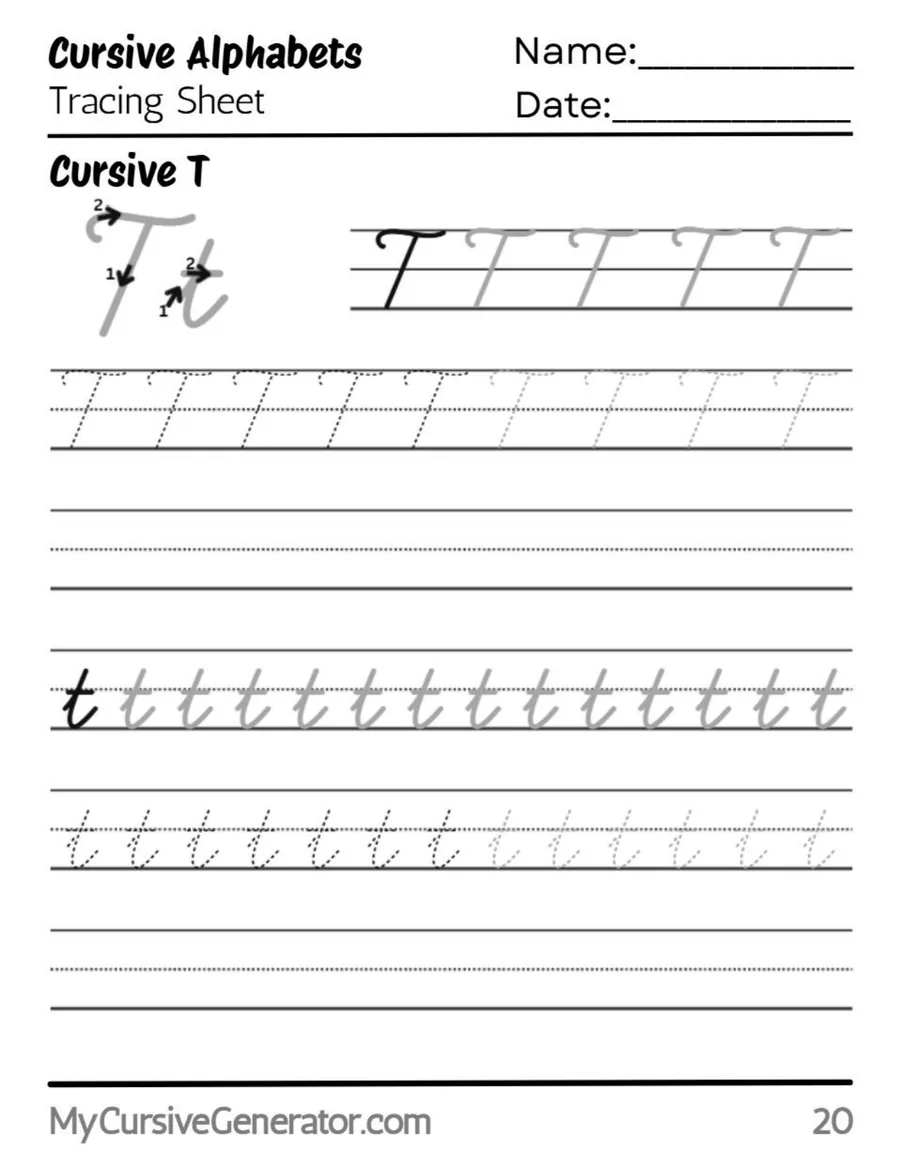
Trace the Cursive Letter T
Trace the capital T first, and watch the top. It should be a tall, curved stroke, not a loop, with a short cross near the top. A long cross turns it into a print T, and a loop at the top turns it into a fancy L. Trace the lowercase t next, and watch the exit. The stem should end low, at the baseline, so the next letter can start without a collision.
Use the worksheet in three passes: trace, copy without tracing, then write short words such as tea, top, and tree from memory. Check the cross on every t. If a lowercase t has no cross, it reads as a tall l. If a capital T has a loop, it reads as something else entirely.
The Anatomy of Cursive T
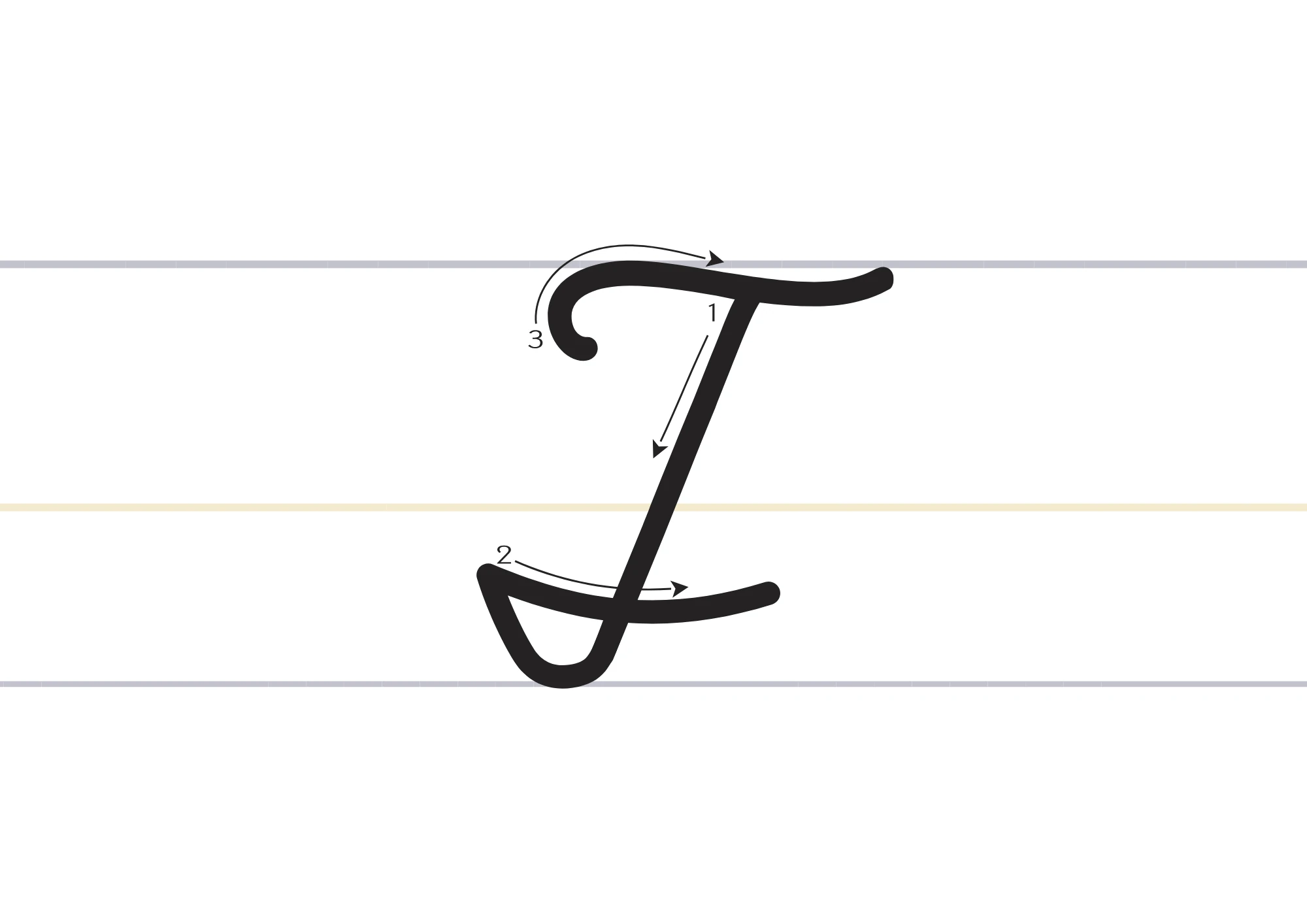
Capital T has two parts: a tall curved stem and a short cross near the top. The stem starts at the top line, curves slightly as it falls, and ends on the baseline with a small curve to the left. It is not a straight line, and it is not a loop. The cross sits near the top, a little below the top line, and runs a short distance to each side.
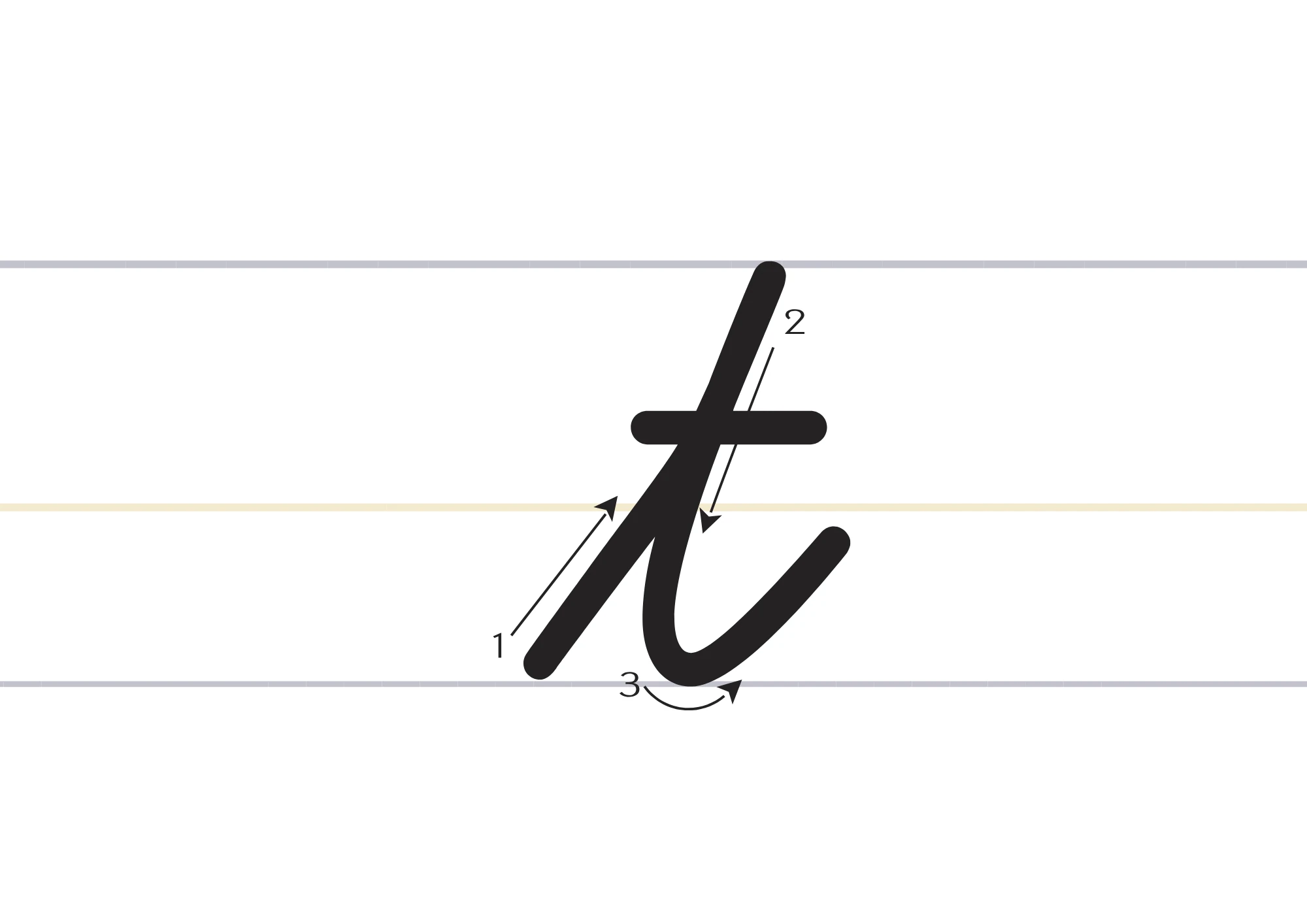
Lowercase t has three parts: a tall stem, a cross on the midline, and a low exit. The stem rises from the baseline to the top line, no taller than the other tall letters, such as l and h. The cross sits on the midline, short, about the width of one small letter. The exit leaves from the bottom of the stem, at the baseline, to the right. A lowercase t should be no more than twice the x-height, a useful check that keeps it from growing too tall.
Cursive T Versus Cursive L, F, and I
Capital T is most often confused with capital L and capital F, and the test is the cross. Capital L has a tall stem and a bottom curve, but no cross near the top. Capital F has a tall stem, a cross near the top, and a second, smaller cross or loop lower down. Capital T has only one cross, near the top, and a small curve at the bottom. If a T has a second cross, it is an F. If it has no cross, it is an L.
Lowercase t is most often confused with lowercase l and lowercase i, and the test is the cross and the height. Lowercase l is a tall stem with no cross. Lowercase i is a short stem with a dot, added after the word. Lowercase t is a tall stem with a cross on the midline. If a t has no cross, it reads as l. If a t is short, it reads as i without a dot. Check the cross first, then the height, and t stays distinct from both.
Before You Start
Sit with both feet flat and the paper tilted slightly to the left if you write with your right hand, and slightly to the right if you write with your left hand. Hold the pencil loosely, about two finger widths above the tip. Cursive T needs a smooth curved stem, and a tight grip makes a smooth curve wobble. Use lined paper with a clear midline, so you can see whether each lowercase t cross sits on it. If your paper has no midline, draw a light dotted line halfway between the top line and the baseline as a guide.
How to Write Capital Cursive T
Capital cursive T is written as a tall curved stem plus a short cross near the top. Keep the stem curved, not looped, keep the cross short, and keep the bottom curve small.
Draw the Tall Curved Stem Down
Start at the top line and draw a tall, slightly curved stem down to the baseline, leaning slightly right. Curve a little to the left at the bottom, so the stem ends with a small hook on the baseline. Do not make a loop at the top, and do not make the stem straight and vertical like print.
Add the Short Cross Near the Top
Lift the pen, then draw a short, straight cross stroke near the top of the stem, a little below the top line, running a short distance to the left and right of the stem. Keep the cross level and short. A long cross turns the letter into a print T.
Finish at the Baseline and Exit Right
Finish at the baseline, where the stem ends, and exit to the right for the next letter. The exit should be low and short, ready for the next lowercase letter, and it should not rise back up the stem.
How to Write Lowercase Cursive t
Lowercase cursive t is the form that causes most errors, because its cross is added at the wrong time. In real writing, the cross is added after the letter, or after the whole word, not in the middle of the stem. For practice on a single letter, cross on the midline as soon as the stem is done, then learn to delay the cross in words.
Lead In and Draw the Tall Stem
Start at the baseline with a short lead in curving up, then draw a tall stem to the top line and back down to the baseline, curving slightly right at the bottom. Keep the stem straight in the middle, and keep the top no higher than the other tall letters.
Cross on the Midline
Draw a short, straight cross stroke across the stem on the midline, running a short distance to the left and right. In a word, delay this cross until the word is finished, then go back and cross every t. A cross above the midline makes the letter look like a tall f.
Exit Low to the Next Letter
Exit from the bottom of the stem, at the baseline, to the right, ready for the next letter. Keep the exit low, so a tall letter that follows, such as h, can start without a collision. Do not exit from the top of the stem.
How to Write Cursive T: 10-Minute Daily Practice Routine
A short daily routine beats one long session. Ten focused minutes a day, for a week, is enough to make cursive T feel natural.
- Warm-up stems (2 minutes): draw tall curved stems and tall lowercase stems, keeping every stem at the same slant and height.
- Capital form (2 minutes): write capital T slowly, checking that the stem is curved, not looped, and the cross stays short.
- Lowercase form (3 minutes): write small t, with a cross on the midline, keeping every cross at the same height.
- Words (2 minutes): write tea, top, and tree slowly, then go back and cross the t in each word.
- Quick check (1 minute): compare your last row with your first. Are the crosses level? Are the stems curved? If a row looks shaky, slow down.
Repeat the routine tomorrow. The goal is a steadier hand by the end of the week, not a perfect page on day one.
Words That Start With T in Cursive
Practice these common T words. Read them, trace them, then write them on your own:
Tea · Top · Tree · Tiger · Train · Table
Tom · Tara · Tim · Tina · Theo · Tess
Inside words, t is very common: cat, letter, water, and sister all test the lowercase form. In letter, the double t must match in height and cross height, or the word looks uneven. In tree, the t stem must not collide with the r peak that follows it, so keep the exit low. In water, the t to e join must be short, or the word looks spaced out.
Common Mistakes With Cursive T
- Making a looped stem on capital T. Capital T is a tall curved stroke with a cross, not a looped stem. Keep the stem curved, not looped.
- Making the cross too long. A long cross turns the letter into a print T. Keep the cross short on both sides of the stem.
- Crossing above the midline on lowercase t. A high cross makes the letter look like a tall f. Cross on the midline every time.
- Leaving out the cross on lowercase t. Without a cross, lowercase t reads as l. Cross every t, after the word if needed.
- Exiting high from the stem. A high exit collides with the next tall letter. Exit low, from the baseline.
- Making lowercase t too tall. Lowercase t should be no more than twice the x-height. If it grows taller, it crowds the tall letters.
How to Join T Cursive Letters
Capital T joins from the baseline, where its stem ends, to the right. The next lowercase letter starts beside it, and the join should feel like a handoff, not a pull. Into a vowel such as e or a, keep the exit short and level. Into a tall letter such as l, let the exit rise slightly, so the tall stem starts cleanly, but do not rise from the top of the T stem.
Lowercase t joins from the bottom of its stem, at the baseline, to the right. Into e, keep the connector at mid height. Into a, exit along the baseline and rise into the oval. Into r, keep the exit low, so the r peak can start without a collision. Drill the pairs ta, te, to, ti, and tu before you write full words.
When to Cross the T: After the Word, Not Mid Letter
In real cursive writing, the cross of a lowercase t is added after the whole word, not in the middle of the letter. This is the same rule as the dot of i and j. Stopping midword to cross a t breaks the flow. Practice this way: write the whole word without crossing, then go back and cross every t, from left to right.
How to Write T in Cursive: Practice Sentences
Single letters are only half the skill, because sentences teach spacing, rhythm, and stamina. Try each sentence three times: once very slowly, once at a normal pace, and once without stopping.
Tom took the train to town.
The tiger sat on the table.
We taste tea and toast together.
Practice cursive t with tea, top, and tree every day.
Read each sentence back and check the stems, the crosses, and the exits. In the first sentence, check the t in train first, if its cross is on the midline and its exit is low, the rest usually follows.
Letter T in Cursive for Names and Signatures
For a first name that begins with T, keep the capital a little larger and more open than in ordinary writing, so it reads at a glance. The rest of the name should stay at normal size. Tom, Tara, Tim, and Tina all need a capital T with a curved stem and a short cross, or the name can be misread as starting with L or F.
For signatures, the same form can be faster and looser, but it must stay recognizable: the stem curved, the cross short, and the exit low. A signature T without a cross looks like an L.
Cursive T in D’Nealian and Zaner-Bloser
Most US classrooms teach either D’Nealian or Zaner-Bloser cursive, and for T the difference is mainly in the stem and the cross. D’Nealian capital T uses a curved stem with a short cross near the top, as described on this page, and lowercase t uses a tall stem with a cross on the midline. Zaner-Bloser T can be a little more upright, with a stem that sits differently. Match the model on your school worksheet, and use one model for a whole assignment, because mixing them makes stems and crosses look inconsistent.
Cursive T, Frequently Asked Questions
What does the letter T look like in cursive?
Capital cursive T is a tall curved stem with a short cross near the top. Lowercase cursive t is a tall stem with a cross on the midline and a low exit.
Is cursive T hard to learn?
The capital is not hard, once you drop the looped stem. The lowercase is harder, because the cross must sit on the midline and be added at the right time.
How do you join cursive T to the next letter?
Capital T exits from the baseline, where its stem ends. Lowercase t exits low, from the bottom of its stem, to the right.
What words can I practice with cursive T?
Start with tea, top, and tree, then tiger, train, and table. Inside words, practice cat, letter, water, and sister.
Should I learn the capital or the lowercase form first?
Start with the lowercase form. It appears in many words. The capital uses a simpler curved stem and cross, and it is easier once the lowercase stem is steady.
Why does my letter T look like L or F?
If a capital T looks like L, the cross was left out. If it looks like F, a second cross was added. If a lowercase t looks like l, the cross was left out.
How do I teach cursive T to a child?
Start with the stem, then add the cross as a separate step. Trace first, then copy, then write from memory. Teach the cross after the word, not midword.
What is the difference between cursive T and print T?
A print T is made of straight lines. A cursive T is made of curves, with a short cross, and it hands over to the next letter from the baseline.
See Your Name in Cursive
Type any name or word and convert it into beautiful cursive text you can copy anywhere, free, with no sign-up.
Open the Cursive Generator