
Home › Cursive Alphabet › Cursive P
Cursive P: How to Write the Letter P in Cursive
Cursive P is the letter that goes in two directions at once. The capital cursive P stays tall, with a stem from the top line to the baseline and a single bowl in the upper half. The lowercase cursive p drops below the baseline, then comes back up to make a small bowl at mid height. If you get the height of that bowl wrong, or let the descender wander, the whole word loses its line, even when the rest of the letters are clean.
Cursive script is a style of handwriting in which the letters of a word are joined together, and cursive P tests that idea in a special way. Capital P opens a word rather than joining into it. Lowercase p sits in words such as apple, open, and paper, and it must drop below the line without breaking the flow. A cursive p does it in one motion, retracing its own stem, and that retrace is the part most beginners skip.
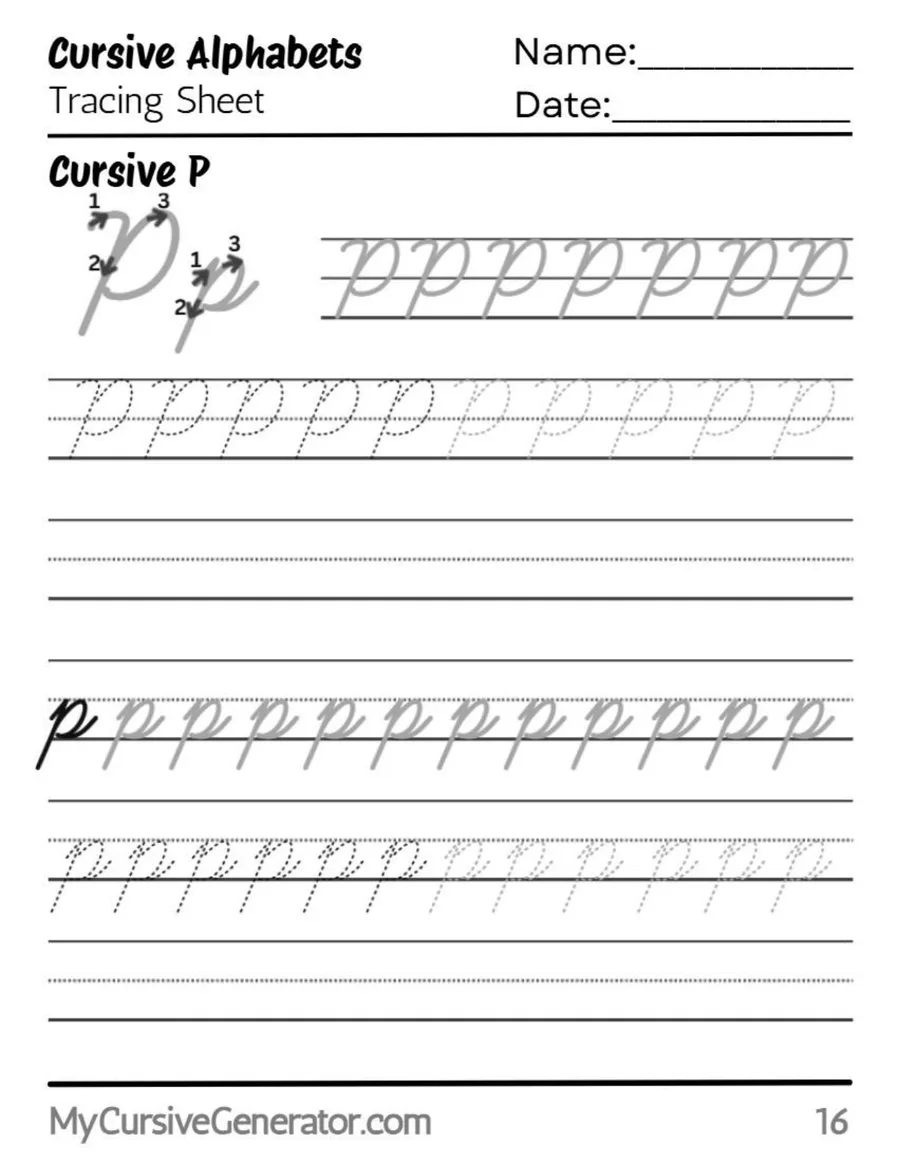
Trace the Cursive Letter P
Trace the capital P first, and watch the bowl. It should fill only the upper half, from the top line down to about the midline, and it should return to the stem at the midline. A bowl that reaches the baseline is too large, and it starts to look like a capital B without a lower loop. Trace the lowercase p next, and watch the stem. It should go straight down below the baseline, then come straight back up along the same line, before the bowl is made. That retrace feels strange at first, but it is what keeps the stem straight.
Use the worksheet in three passes: trace, copy without tracing, then write short words such as pen, pie, and paper from memory. Check the descender on every lowercase p. All descenders on one line should reach the same depth below the baseline, and none should touch the writing on the line below. If one p drops deeper than the rest, slow down and trace one more row before you write words again.
The Anatomy of Cursive P
Capital P has three parts: a tall stem, a single upper bowl, and a short exit at the stem near the midline. The stem runs from the top line to the baseline, leaning slightly right. The bowl starts at the top of the stem, curves right and down, and returns to the stem at about the midline. There is no lower bowl. That missing lower bowl is the fastest way to tell capital P from capital B, which has two bowls, and from capital R, which adds a diagonal leg after the bowl.
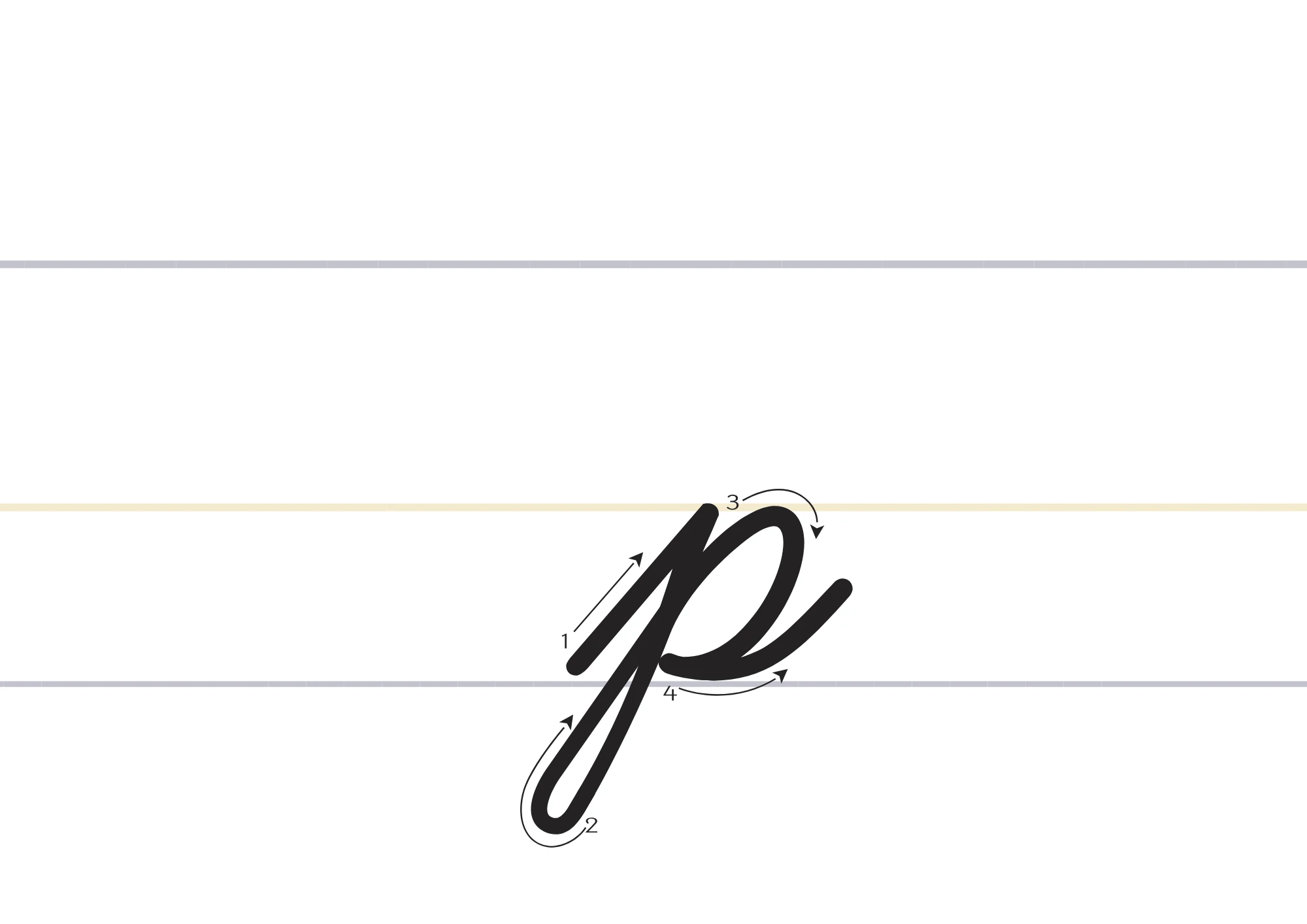
Lowercase p has three parts in a different order: a descender stem, a retrace up that same stem, and a small bowl to the right of the stem between the midline and the baseline. The bowl should be round and closed at the stem, not pointed and not left open. The exit leaves from the bowl to the right at about baseline height.
Cursive P Versus Cursive R: The Bowl Test
Capital P and capital R share the same opening: a tall stem and an upper bowl. The test is what happens at the midline. Capital P stops at the stem and exits. Capital R continues from the midline with a diagonal leg down to the baseline on the right. If you write a diagonal leg by habit, you have written an R, not a P. If you stop too early, before the bowl returns to the stem, you have written a shape that looks like a tall D. Practice P and R in alternating rows, and stop after each pair to check the midline. The P row should end at the stem. The R row should end with a leg.
Lowercase p and lowercase r confuse in fast writing for a different reason. Lowercase r is small, with a short stem and a small peak. Lowercase p is long, with a stem below the baseline and a bowl at mid height. If a p stops at the baseline, it starts to look like an r with a bowl. Keep the descender full length.
Before You Start
Sit with both feet flat and the paper tilted slightly to the left if you write with your right hand, and slightly to the right if you write with your left hand. Hold the pencil loosely, about two finger widths above the tip. Cursive P needs a straight stem, and a tight grip makes a straight line wobble. Use lined paper with a clear descender zone below the baseline, so you can see how far each lowercase p should drop. If your paper has no descender zone, draw a light dotted line below the baseline as a guide.
How to Write Capital Cursive P
Capital cursive P is written with a stem and a bowl. Keep the stem tall and straight, and keep the bowl in the upper half only. Do not lift the pen until the bowl returns to the stem and the short exit is done.
Draw the Tall Stem Down
Start at the top line and pull a straight stem down to the baseline, leaning slightly right. Keep the stem straight and at full height. A stem that leans back to the left will make the bowl look lopsided.
Return Up and Form the Upper Bowl
Without lifting the pen, return up along the stem to the top, then curve right and down to form a single bowl. Bring the bowl back to the stem at about the midline. The bowl should be round, not pointed, and it should not reach the baseline.
Finish at the Stem and Exit Right
Finish at the stem near the midline with a short exit to the right at baseline height, ready for the next lowercase letter. Do not add a diagonal leg. That leg belongs to capital R, not to capital P.

How to Write Lowercase Cursive p
Lowercase cursive p is the form that causes most errors, because its stroke order is not the order in which its parts appear on the page. The stem is drawn first, then retraced, then the bowl is made. If you try to draw the bowl first, the stem will not line up, and the letter will lean.
Drop the Stem Below the Baseline
Start at the midline and draw a straight stem down, through the baseline, and below it to the descender depth. Keep the stem straight and slightly slanted right. This depth should match your other descenders, such as g, j, q, and y.
Retrace Up the Same Stem
Without lifting the pen, retrace straight back up along the same stem to the midline. This retrace is not a second line beside the first. It is the same line, drawn again, and it is what keeps the stem straight and the bowl centered.
Form the Bowl and Exit Right
From the midline, curve right and down to form a small round bowl between the midline and the baseline, and close it back at the stem. Then leave to the right at about baseline height for the next letter. The bowl should not be a loop that crosses the stem.
How to Write Cursive P: 10-Minute Daily Practice Routine
A short daily routine beats one long session. Ten focused minutes a day, for a week, is enough to make cursive P feel natural.
- Warm-up stems (2 minutes): draw tall capital stems and long lowercase descenders, keeping every stem straight and at the same slant.
- Capital form (2 minutes): write capital P slowly, checking that the bowl stays in the upper half and returns to the stem at the midline.
- Lowercase form (3 minutes): write small p, with the full drop, retrace, and bowl, keeping every descender at the same depth.
- Words (2 minutes): write pen, pie, and paper slowly, joining each letter without lifting the pen.
- Quick check (1 minute): compare your last row with your first. Are the bowls round? Are the descenders equal? If a row looks shaky, slow down.
Repeat the routine tomorrow. The goal is a steadier hand by the end of the week, not a perfect page on day one.
Words That Start With P in Cursive
Practice these common P words. Read them, trace them, then write them on your own:
Pen · Pie · Pig · Panda · Pine · Pizza
Peter · Paula · Paul · Penny · Patrick · Priya
Inside words, p is just as common: apple, open, paper, happy, and help all test the lowercase form. In apple, the double p must match in depth and bowl size. In open, the p must hand over cleanly to e.
Common Mistakes With Cursive P
- Skipping the retrace on lowercase p. Without the retrace, the stem leans and the bowl sits off center. Draw down, then straight back up the same line.
- Making the capital bowl too large. A bowl that reaches the baseline turns P into a shape like B without a lower loop. Keep the bowl in the upper half.
- Leaving the lowercase bowl open. An open bowl reads as a curve, not as a p. Close the bowl back at the stem before you exit right.
- Uneven descenders. If one p drops deeper than the next, the line of writing looks ragged. Use a descender guide line until the depth is steady.
- Adding a diagonal leg to capital P. That leg makes it an R. Stop at the stem and exit right.
- Writing lowercase p like print p. Print p is made in separate strokes with a straight stem and a separate bowl. Cursive p is one continuous motion with a retrace.
How to Join P Cursive Letters
Capital P joins from the stem near the midline, with a short exit to the right at about baseline height. Into a vowel such as e or a, keep the exit short and level. Into a tall letter such as l, let the exit rise slightly.
Lowercase p joins from its bowl, to the right at about baseline height. Into e, keep the connector at mid height, so the e loop does not collide with the bowl. Into a, exit along the baseline and rise into the oval. Into n, glide into the first arch. The descender never joins. Only the bowl exits.
Descenders: How Far Below the Baseline
Descenders are the part of cursive P that most beginners get wrong, because they have no line to stop at on ordinary ruled paper. In a four line system, the descender zone is usually about the same depth as the x-height, from the baseline down to a lower guide line. In practice, that means a lowercase p should drop about as far below the baseline as a lowercase letter rises above the midline. If your descenders are much longer, they will tangle with the writing on the line below. If they are much shorter, p starts to look like r.
Check descenders in groups. Write a row of p, g, j, q, and y, and draw a light line under the bottom of each descender. That line should be straight. Left-handed writers should tilt the paper to the right, or descenders can slant the wrong way.
How to Write P in Cursive: Practice Sentences
Single letters are only half the skill, because sentences teach spacing, rhythm, and stamina. Try each sentence three times: once very slowly, once at a normal pace, and once without stopping.
Peter picked a purple pen.
Paula put paper on the piano.
The puppy played in the park.
We practice cursive p with pen and paper every day.
Read each sentence back and check the bowls, the descenders, and the joins. In the first sentence, check the double p in puppy first, if those match, the rest usually matches too.
Letter P in Cursive for Names and Signatures
For a first name that begins with P, keep the capital a little larger and more open than in ordinary writing, so it reads at a glance. The rest of the name should stay at normal size. Peter, Paula, Paul, Penny, and Patrick all need a capital P with a clear upper bowl and no diagonal leg, or the name can be misread as R.
For signatures, the same form can be faster and looser, but it must stay recognizable: the stem tall, the bowl in the upper half, and the exit visible. A signature P without a bowl looks like a tall I, and one with a leg looks like an R.
Cursive P in D’Nealian and Zaner-Bloser
Most US classrooms teach either D’Nealian or Zaner-Bloser cursive, and for P the difference is mainly in the entry and the roundness of the bowl. D’Nealian lowercase p uses the drop and retrace described on this page, with a rounded bowl. Zaner-Bloser p is often a little more upright, with a bowl that can look more like a loop. Match the model on your school worksheet, and use one model for a whole assignment, because mixing them makes descenders and bowls look inconsistent.
Cursive P, Frequently Asked Questions
What does the letter P look like in cursive?
Capital cursive P is a tall stem with a single bowl in the upper half, returning to the stem at the midline. Lowercase cursive p is a stem below the baseline, retraced up, with a small bowl between the midline and the baseline.
Is cursive P hard to learn?
The capital is not hard. The lowercase is harder, because of the drop below the baseline and the retrace. Practice the retrace slowly until it feels like one motion.
How do you join cursive P to the next letter?
Capital P exits from the stem near the midline. Lowercase p exits from its bowl to the right at about baseline height. The descender never joins. Only the bowl exits.
What words can I practice with cursive P?
Start with pen, pie, and paper, then Peter, Paula, and Patrick. Inside words, practice apple, open, happy, and help.
Should I learn the capital or the lowercase form first?
Start with the lowercase form. It appears inside many words. The capital uses a simpler stem and bowl, and it is easier once the lowercase bowl is steady.
Why does my letter P look like R?
Usually a diagonal leg was added after the bowl. Stop at the stem and exit right. If the bowl is too large, it can also look like B.
How do I teach cursive P to a child?
Start with the drop and retrace as a drill, before you add the bowl. Trace first, then copy, then write from memory. Keep sessions short.
What is the difference between cursive P and print P?
A print P is made in separate strokes. A cursive P is one continuous motion, with a retrace on the lowercase form, and a bowl that hands over to the next letter.
See Your Name in Cursive
Type any name or word and convert it into beautiful cursive text you can copy anywhere, free, with no sign-up.
Open the Cursive Generator