
Home › Cursive Alphabet › Cursive R
Cursive R: How to Write the Letter R in Cursive
Cursive R is the letter that looks like two letters at once, and that is why it confuses beginners. The capital cursive R starts like a P, with a tall stem and an upper bowl, then finishes with a diagonal leg down to the baseline. The lowercase cursive r is much smaller, with a short stem and a small sharp peak below the midline, ending in a point rather than a rounded curve. If the peak is rounded or raised too high, lowercase r starts to look like n, and if the leg is missing, capital R starts to look like P.
Cursive script is a style of handwriting in which the letters of a word are joined together, and cursive R tests that idea in a special way. Capital R almost always starts a word, so it opens the word rather than joining into it. Lowercase r sits inside words such as red, tree, and river, and it must join cleanly on both sides without losing its peak. A printed R also has a bowl and a leg, but a cursive R draws the stem, the bowl, and the leg in one continuous motion, without lifting the pen.
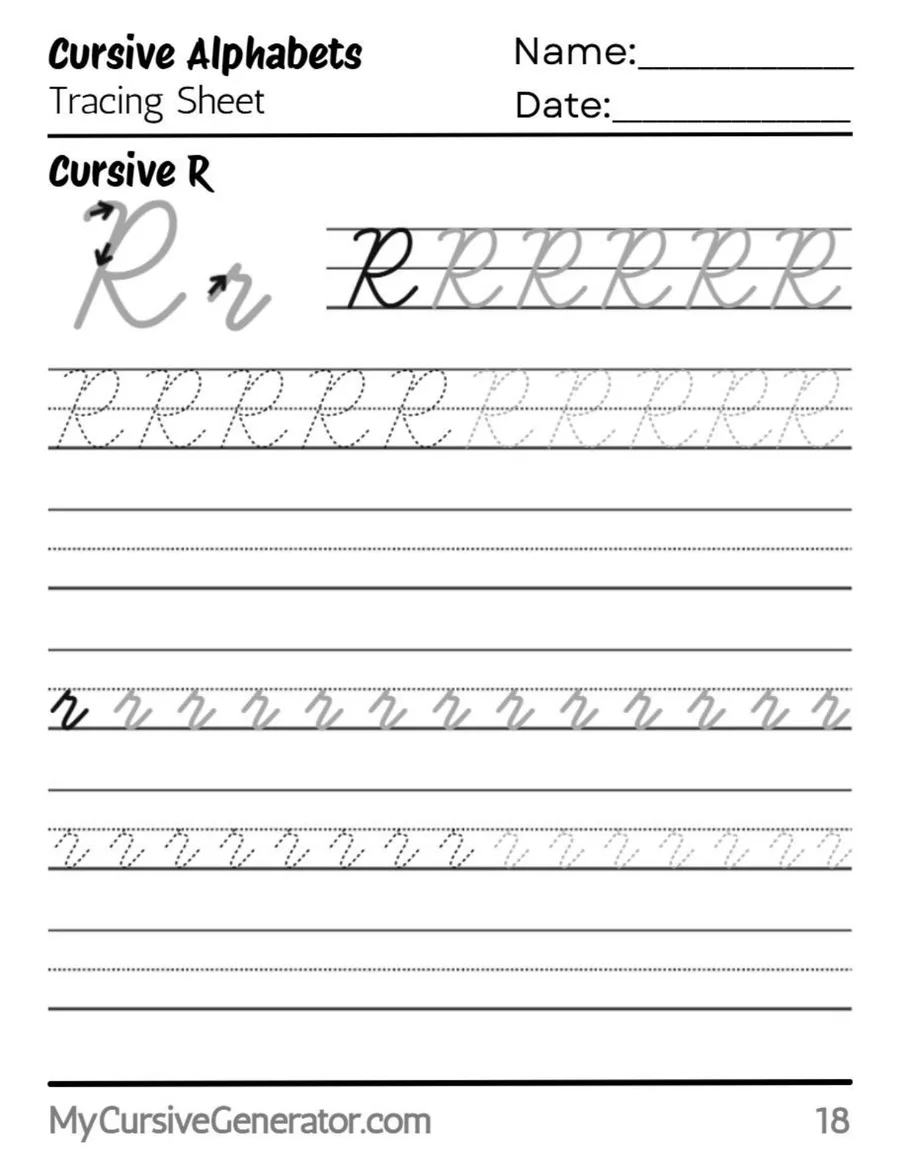
Trace the Cursive Letter R
Trace the capital R first, and watch the midline. The bowl should return to the stem at the midline, and the leg should start from that point. A leg that starts too high makes a loop, and a leg that starts too low looks like a P with a stray line. Trace the lowercase r next, and watch the peak. It should stay below the midline, rise to a sharp point, and fall back to the baseline. A rounded peak is the most common error, and it turns r into n.
Use the worksheet in three passes: trace, copy without tracing, then write short words such as red, run, and river from memory. Check the peak on every lowercase r and the leg on every capital R. If a lowercase r reads as n, sharpen the peak. If a capital R reads as P, add the leg.
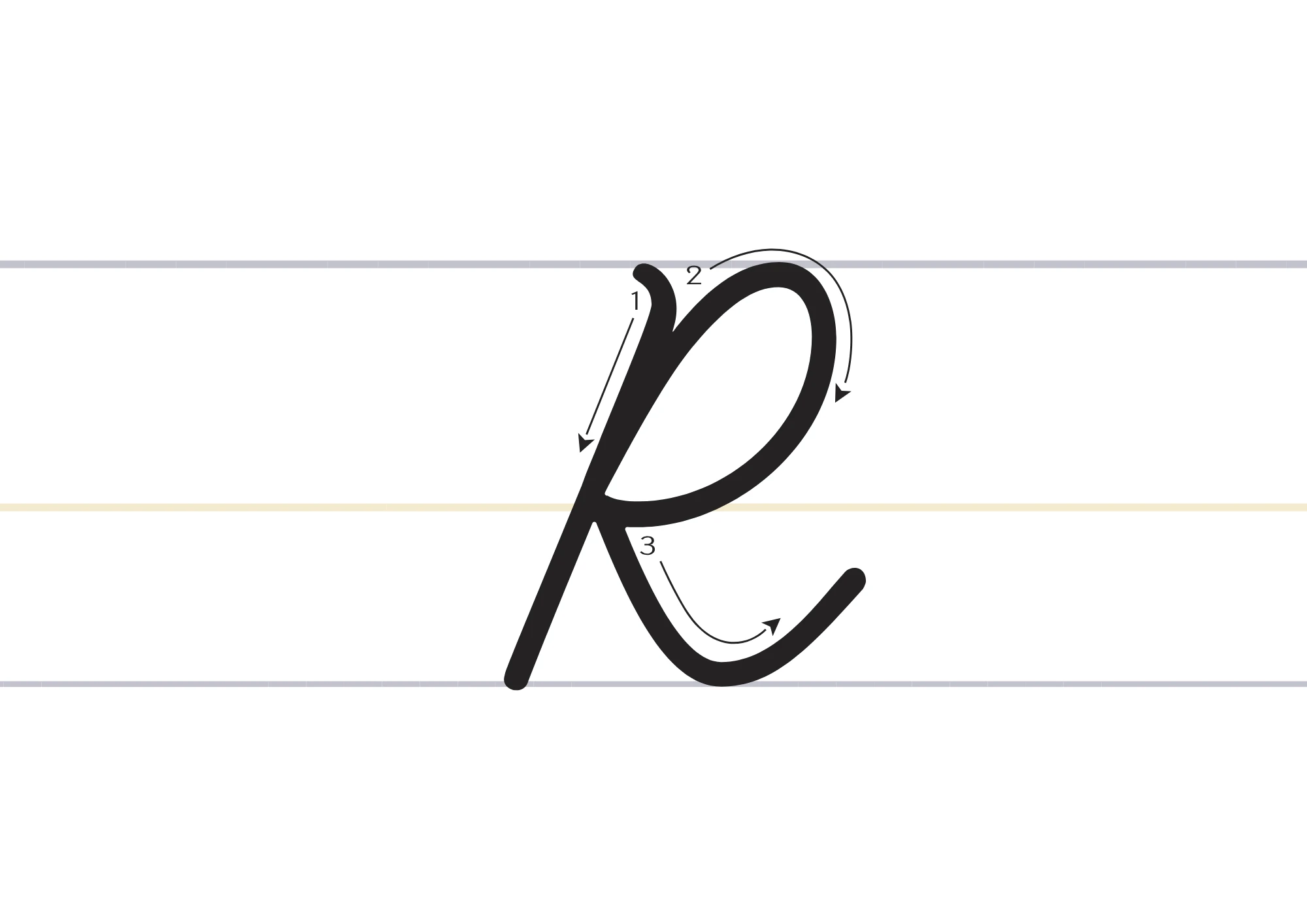
The Anatomy of Cursive R
Capital R has three parts: a tall stem, an upper bowl, and a diagonal leg. The stem runs from the top line to the baseline, leaning slightly right. The bowl starts at the top of the stem, curves right and down, and returns to the stem at about the midline, just like the bowl of capital P. The leg then leaves from that midline point and runs diagonally down to the baseline, to the right of the stem. The leg should end on the baseline, not below it, and it should not be as wide as the bowl.
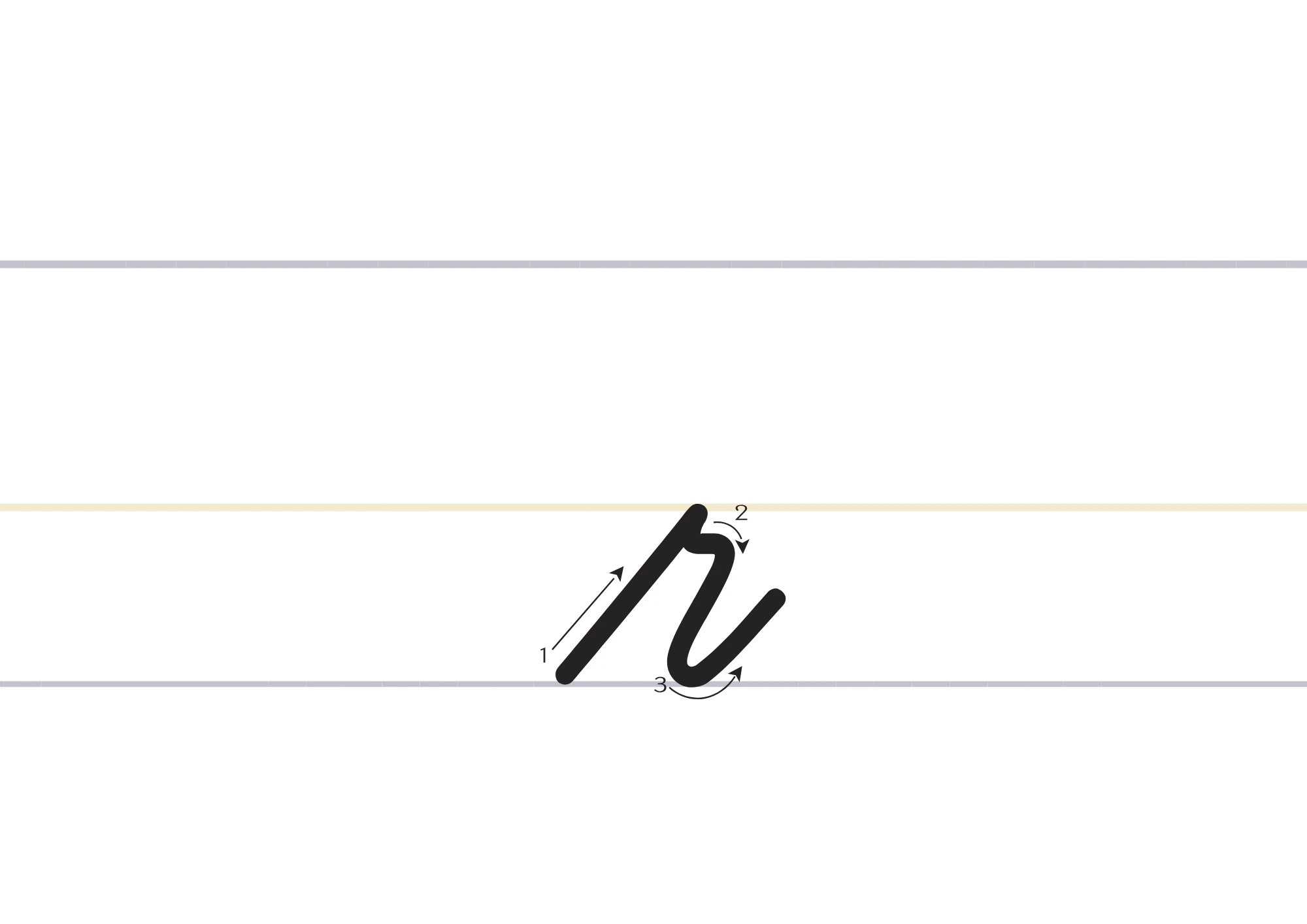
Lowercase r has three parts: a short stem, a small peak, and a short exit. The stem rises from the baseline to just below the midline. The peak is a small, sharp point, made by rising, turning sharply, and falling back to the baseline. The exit leaves from the baseline to the right. A peak that reaches the midline is too tall, and a rounded peak looks like the arch of n.
Cursive R Versus Cursive P, N, and B
Capital R is most often confused with capital P and capital B, and the test is at the midline. Capital P stops at the stem at the midline and exits. Capital R continues with a diagonal leg from the midline to the baseline. Capital B has two bowls, an upper bowl and a lower bowl, and no diagonal leg. Practice R, P, and B in alternating rows, and stop after each row to check the midline. The R row should show a leg. The P row should show none. The B row should show a lower bowl.
Lowercase r is most often confused with lowercase n, and the test is the peak. Lowercase n has two rounded arches that rise to the midline. Lowercase r has one short stem and one sharp peak below the midline, followed by a fall to the baseline. If an r looks like an n, the peak was rounded or raised too high. Sharpen the peak, lower it below the midline, and keep the fall straight, and r stays distinct from n.
Before You Start
Sit with both feet flat and the paper tilted slightly to the left if you write with your right hand, and slightly to the right if you write with your left hand. Hold the pencil loosely, about two finger widths above the tip. Cursive R needs a straight stem and a sharp peak, and a tight grip makes both wobble. Use lined paper with a clear midline, so you can see whether each lowercase r peak stays below it. If your paper has no midline, draw a light dotted line halfway between the top line and the baseline as a guide.
How to Write Capital Cursive R
Capital cursive R is written as a stem, a bowl, and a leg, in one continuous motion. Keep the stem tall and straight, keep the bowl in the upper half, and keep the leg diagonal, not vertical.
Draw the Tall Stem Down
Start at the top line and pull a straight stem down to the baseline, leaning slightly right. Keep the stem straight and at full height. A stem that leans back to the left will make the bowl look lopsided.
Return Up and Form the Upper Bowl
Without lifting the pen, return up along the stem to the top, then curve right and down to form a single bowl. Bring the bowl back to the stem at about the midline, just like the bowl of capital P. The bowl should be round, not pointed.
Draw the Diagonal Leg to the Baseline
From the midline point on the stem, draw a diagonal leg down to the baseline, to the right of the stem. End on the baseline, then exit to the right for the next letter. Do not let the leg drop below the baseline.
 Lowercase cursive r is the form that causes most errors, because its peak looks simple but must stay sharp and low. If you write it like a small n, the word will be misread.
Rise to Just Below the Midline
Start at the baseline and rise in a slight curve to just below the midline. Do not rise to the top line, and do not rise to the full midline. The peak of r sits below the midline, lower than the arches of n and m.
Turn Sharply Into a Small Peak
At the top of the rise, turn sharply, without rounding, into a small pointed peak. This point is the signature of lowercase r. A rounded turn makes the letter look like n, so keep the turn tight.
Fall to the Baseline and Exit Right
Fall back down to the baseline in a smooth curve, then exit to the right for the next letter. The fall should be a little steeper than the rise, and the exit should be short, ready for the next arch or letter.
How to Write Cursive R: 10-Minute Daily Practice Routine
A short daily routine beats one long session. Ten focused minutes a day, for a week, is enough to make cursive R feel natural.
- Warm-up stems (2 minutes): draw tall capital stems and short lowercase rises, keeping every stem straight and at the same slant.
- Capital form (2 minutes): write capital R slowly, checking that the leg starts at the midline and ends on the baseline.
- Lowercase form (3 minutes): write small r, with a sharp peak below the midline, keeping every peak the same height and sharpness.
- Words (2 minutes): write red, run, and river slowly, joining each letter without lifting the pen.
- Quick check (1 minute): compare your last row with your first. Are the peaks sharp? Are the legs diagonal? If a row looks shaky, slow down.
Repeat the routine tomorrow. The goal is a steadier hand by the end of the week, not a perfect page on day one.
Words That Start With R in Cursive
Practice these common R words. Read them, trace them, then write them on your own:
Red · Run · River · Rose · Rain · Road
Rachel · Ryan · Ruby · Robert · Rosa · Ray
Inside words, r is very common: tree, river, bread, and read all test the lowercase form. In tree, the r peak must stay below the midline, or it collides with the tall t stem. In river, the r to i join must be short, or the word looks spaced out. In bread, the r peak must not be confused with the a oval that follows it.
Common Mistakes With Cursive R
- Rounding the lowercase peak. A rounded peak turns r into n. Keep the turn sharp and pointed.
- Raising the lowercase peak too high. A peak at the midline looks like an n arch. Keep it below the midline.
- Leaving out the capital leg. Without a leg, capital R reads as P. Always finish with a diagonal leg to the baseline.
- Starting the leg too high. A leg from the top of the bowl makes a loop. Start the leg at the midline, where the bowl returns to the stem.
- Making the capital bowl too large. A bowl that reaches the baseline leaves no room for the leg. Keep the bowl in the upper half.
- Writing lowercase r like print r. Print r is a stem with a small curve at the top. Cursive r is a rise, a sharp peak, and a fall, in one motion.
How to Join R Cursive Letters
Capital R joins from the end of its leg, on the baseline, to the right. The next lowercase letter starts beside it, and the join should feel like a handoff, not a pull. Into a vowel such as e or a, keep the exit short and level, so the leg does not push the next letter up. Into a tall letter such as l, let the exit rise slightly, so the tall stem starts cleanly.
Lowercase r joins from the baseline, to the right, after its fall. Into e, keep the connector at mid height, so the e loop does not collide with the peak. Into a, exit along the baseline and rise into the oval without lifting. Into n, glide into the first arch, but keep the r peak sharp, or the pair can look like two n arches. Into i, keep the connector short, and add the dot after the whole word, not in the middle of the join.
Why Cursive R Looks Like N in Fast Writing
When writers speed up, lowercase r often drifts toward n for one reason: the peak rounds off. At slow speed, the peak is sharp, because the hand has time to turn. At fast speed, the hand skips the turn and draws a curve, and a curve at the top of a short stem is exactly what n looks like. To stop it, practice r and n in alternating rows. Write r, n, r, n, and stop after each pair to check the top. The r row should show a point. The n row should show a rounded arch. Once the hand can feel that difference at slow speed, it can keep it at normal speed too.
How to Write R in Cursive: Practice Sentences
Single letters are only half the skill, because sentences teach spacing, rhythm, and stamina. Try each sentence three times: once very slowly, once at a normal pace, and once without stopping.
Rachel ran to the river.
The red rose grew by the road.
We read and write every day.
Practice cursive r with red, run, and river every day.
Read each sentence back and check the peaks, the legs, and the joins. In the first sentence, check the r in river first, if it is sharp, the rest usually follows.
Letter R in Cursive for Names and Signatures
For a first name that begins with R, keep the capital a little larger and more open than in ordinary writing, so it reads at a glance. The rest of the name should stay at normal size. Rachel, Ryan, Ruby, and Robert all need a capital R with a clear leg, or the name can be misread as starting with P.
For signatures, the same form can be faster and looser, but it must stay recognizable: the stem tall, the bowl in the upper half, and the leg visible. A signature R without a leg looks like a P.
Cursive R in D’Nealian and Zaner-Bloser
Most US classrooms teach either D’Nealian or Zaner-Bloser cursive, and for R the difference is mainly in the peak and the leg. D’Nealian lowercase r uses a sharp peak below the midline, as described on this page, and a diagonal leg on the capital. Zaner-Bloser r can be a little more upright, with a peak that sits differently. Spencerian R adds flourishes that school forms leave out, and Palmer R simplifies the bowl for speed. Match the model on your school worksheet, and use one model for a whole assignment.
Cursive R, Frequently Asked Questions
What does the letter R look like in cursive?
Capital cursive R is a tall stem with an upper bowl and a diagonal leg to the baseline. Lowercase cursive r is a short stem with a small sharp peak below the midline.
Is cursive R hard to learn?
The capital is not hard, once you add the leg. The lowercase is harder, because the peak must stay sharp and low. Practice r and n in alternating rows.
How do you join cursive R to the next letter?
Capital R exits from the end of its leg on the baseline. Lowercase r exits from the baseline after its fall, to the right.
What words can I practice with cursive R?
Start with red, run, and river, then rose, rain, and road. Inside words, practice tree, bread, and read.
Should I learn the capital or the lowercase form first?
Start with the lowercase form. It appears in many words. The capital uses a stem and bowl like P, plus a leg.
Why does my letter R look like P or N?
If a capital R looks like P, the leg was left out. If a lowercase r looks like N, the peak was rounded or raised too high.
How do I teach cursive R to a child?
Start with the peak as a drill, before you add full words. Trace first, then copy, then write from memory. Keep sessions short.
What is the difference between cursive R and print R?
A print R is made in separate strokes. A cursive R is one continuous motion, with a bowl and leg, or a peak, that hands over to the next letter.
See Your Name in Cursive
Type any name or word and convert it into beautiful cursive text you can copy anywhere, free, with no sign-up.
Open the Cursive Generator