
Home › Cursive Alphabet › Cursive U
Cursive U: How to Write the Letter U in Cursive
Learning this letter is easier than it looks, because both forms use one smooth bowl shape. The capital adds a small entry loop at the top, and the small form stays low, between the midline and the baseline.
Cursive script is handwriting in which the letters of a word are joined together, and cursive U is a good letter to learn early. It teaches the undercurve, the rounded bowl, and the short connector found in many other small letters.
Trace the Cursive Letter U
Tracing cursive U is mostly about two habits: keeping the bowl the same width, and landing every downstroke on the baseline. Start slowly, keep a gentle slant to the right, and let each curve finish before the next one.
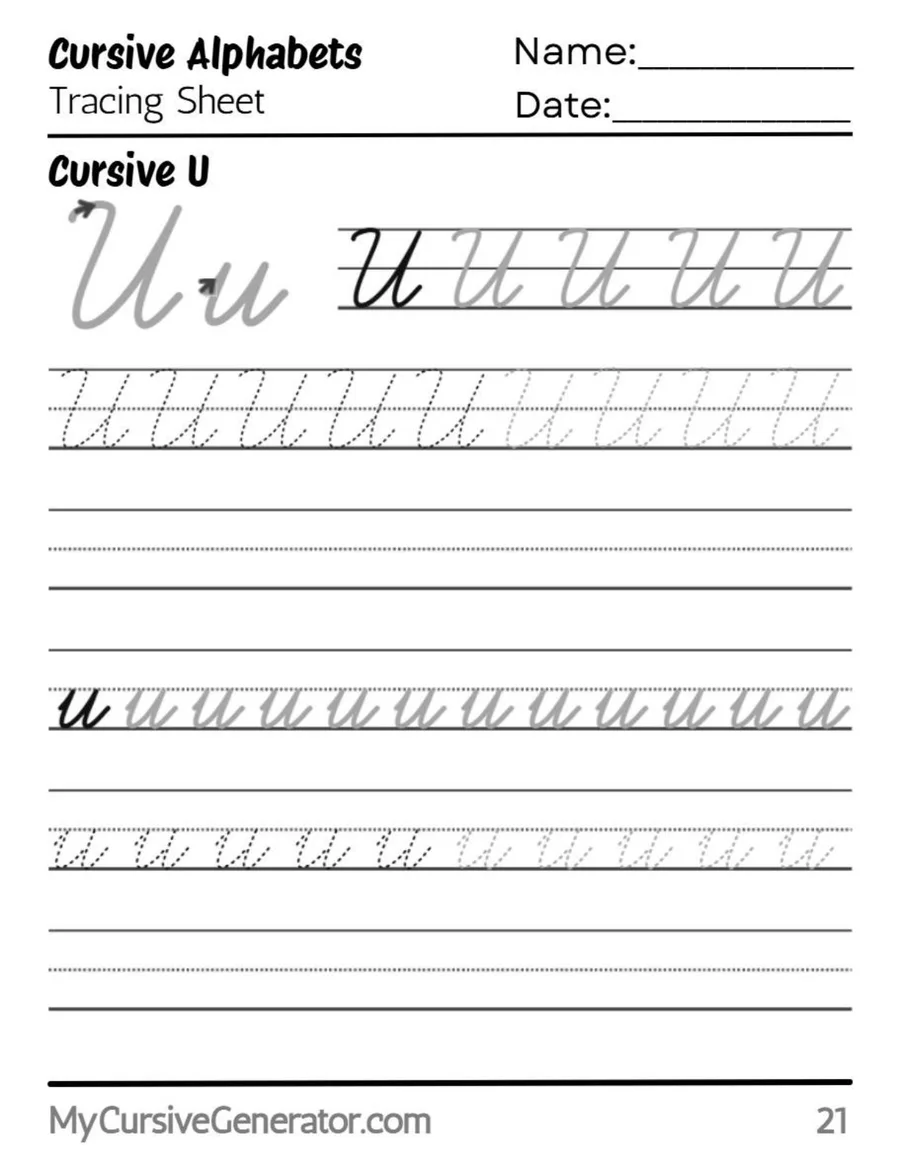
Use the worksheet beside this text for your first rows: trace three rows, copy three rows, then write one row from memory.
Before You Start
Sit with both feet flat and tilt the paper slightly to the left for right hand writers, and slightly to the right for left hand writers. Hold the pencil loosely, about two finger widths above the tip, because a tight grip makes a bowl look pointed.
What D’Nealian Cursive U Looks Like
This page follows the D’Nealian school form used on the worksheet, so the steps match the model you trace. In that form, cursive U slants gently to the right, the bowl is round, and the pen stays on the paper through the whole letter. Do not mix forms on one page.
Three lines control cursive U: the top line for the capital, the midline for the small form, and the baseline, where every bowl lands. A small u floating above the baseline reads as a mistake even when the curve is perfect.
How to Write U in Cursive
Think of cursive U as one bowl with two entrances. The capital enters through a small loop at the top left, then drops into a tall bowl. The small form enters from the baseline, then makes two short valleys. Both finish with a connector, so neither is a closed print shape.
How to Write Capital Cursive U
Write the capital form in one continuous motion. Do not lift the pen between the three phases below. The entry loop, the tall bowl, and the finishing curve are parts of one stroke, and lifting in the middle breaks the smooth look that makes cursive U recognizable.
Make the entry loop
Begin just below the top line on the left. Swing up and around in a small, narrow loop, then turn down. Keep this loop much smaller than the bowl that follows.
Drop into the tall bowl
From the entry loop, sweep down to the baseline, round the bottom in a wide curve, and rise up the right side to the top line. Keep the sides evenly spaced, so the bowl stays open.
Turn and finish into the join
At the top of the right side, turn and sweep down toward the baseline in a short finishing curve, then lift into a short connector. End low, near the baseline.
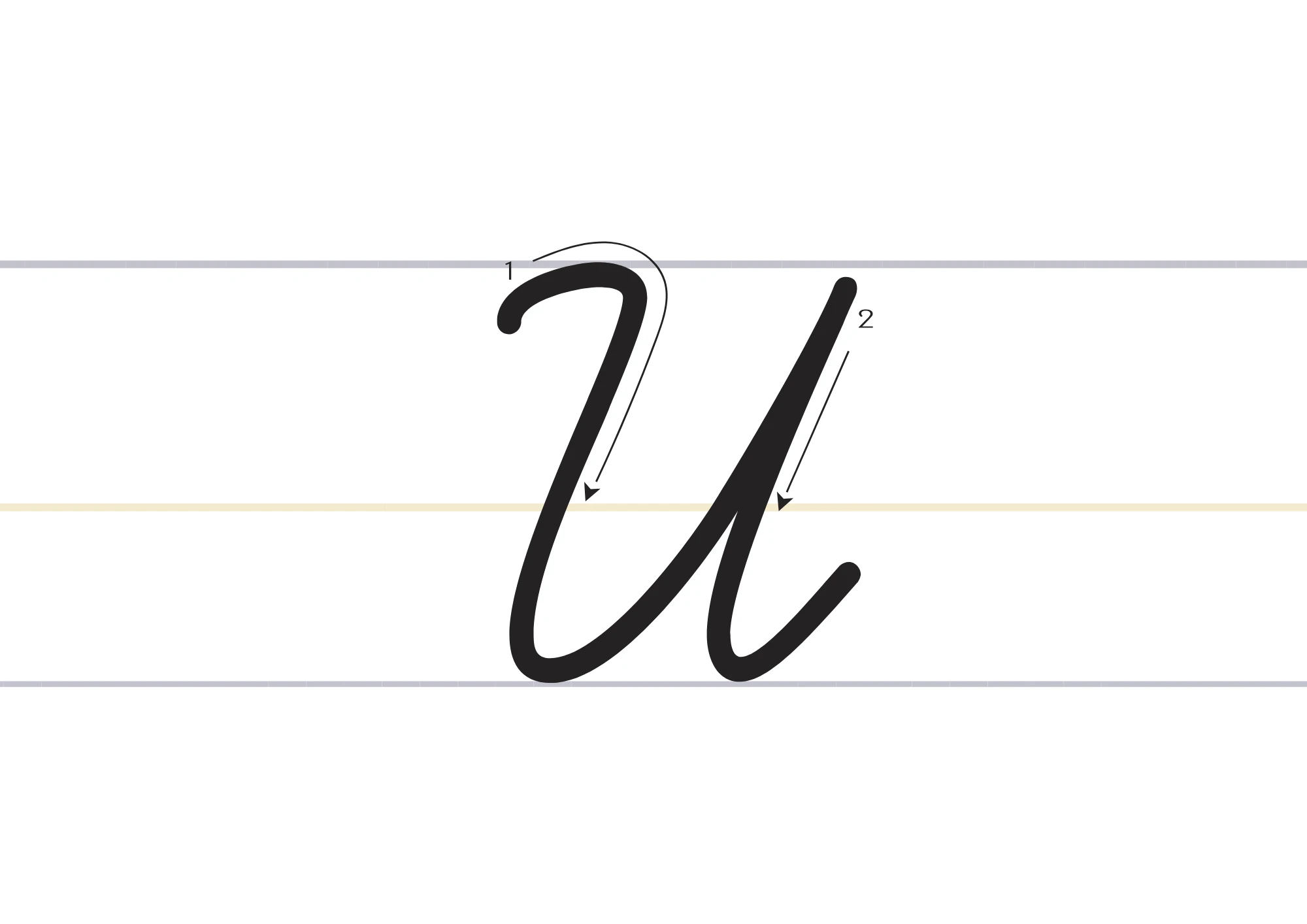
The most common capital error is skipping the entry loop and drawing a plain print U. Slow down the first phase until the small loop is visible.
How to Write Lowercase Cursive u
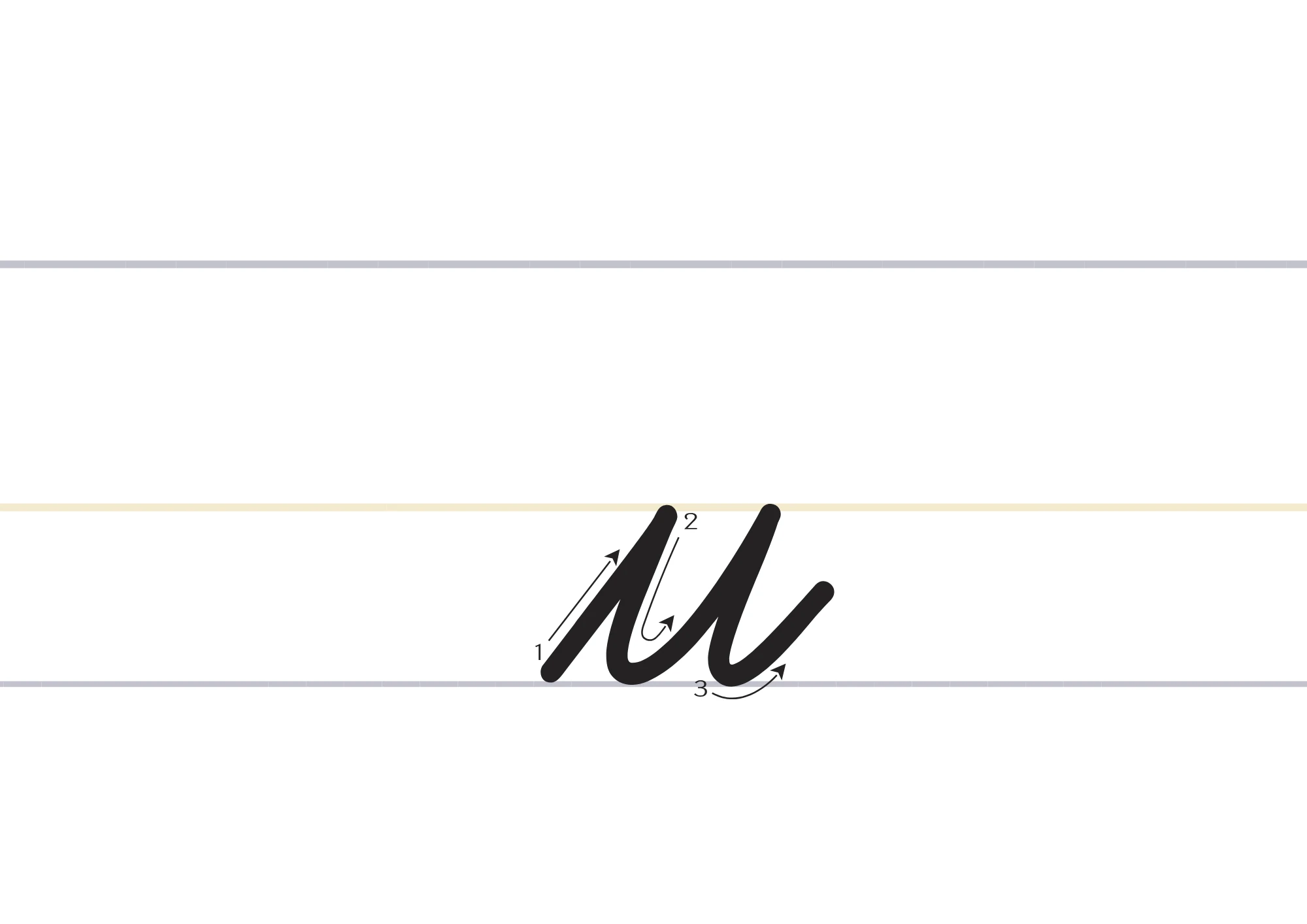
Write the small form in one continuous motion as well. It is the form you will use most often, because it appears inside words such as sun, cup, and under. Keep it small, keep it between the midline and the baseline, and keep both valleys the same depth.
Enter and make the first valley
Begin on the baseline, push up to the midline, then retrace down to the baseline. This valley should be narrow and rounded, not pointed like a V and not flat.
Make the second valley
Without lifting, rise again to the midline and retrace down to the baseline. The two valleys should match in width and height.
Rise into the connector
From the baseline, rise to the midline and curve right into a short connector. Do not close the top, add a dot, or lift before the next letter begins.
Capital Cursive U and Lowercase Cursive U at a Glance
The capital is tall, starts with an entry loop, and is used only at the start of a sentence, a name, or a proper noun. The small form is short, starts on the baseline, and does the everyday work inside words. To check size, write both on one line: the capital should reach the top line, the small form should stop at the midline, and both should share the same slant.
Lowercase Cursive u Compared With n, v, and w
Most confusion around cursive u comes from its neighbors. Lowercase n is built from humps near the top, while cursive u is built from valleys on the baseline. If your u looks like n, check the bottom: u has two rounded valleys, n has two rounded humps.
Lowercase v is sharper: it has a pointed bottom, while cursive u keeps a round bottom. A pointed u will be read as v in words such as up and cup. Lowercase w is like a u with an extra valley, so count the valleys: a clear u has two, a clear w has three. The word minimum is a good test, because it packs u, n, and m together.
How to Join U Cursive Letters
A capital usually starts a word, so it rarely joins from the left. Its job is to open the word and hand over through its low connector. The small form does most joining, because it connects on both sides.
Start with outgoing pairs: ua, ue, ui, uo, uu, ul, un, and um. The connector should leave at the same gentle angle every time and meet the next letter near the midline. Then practice incoming joins, which many short guides skip. In sun, the s connector must arrive on the baseline so the first valley can start without a jump. In cup, the p connector rises from below, so the u must start low and stay low. For qu, as in queen, quick, and quiet, keep the u exactly the same size as elsewhere in the word, and do not let it rise above the midline.
U Cursive Words and Names
Practice these words in cursive U. Trace each word once, then write it on your own. The first list starts with U, the second puts U in the middle or at the end, where most real writing uses it:
Umbrella · Unicorn · Uniform · Umpire · Uncle · Under · Up · Us
Sun · Cup · Run · Music · Under · Unicorn · Upstairs · Umbrella
Uma · Umar · Ursula · Ulysses · Una · Udit · Umair · Ursula
See any of these words in copyable cursive text with our cursive generator, or go back to the full cursive alphabet chart to pick your next letter. Typed script letters show the shape, but they do not teach the join, so practice the same name by hand.
Common Mistakes With Cursive U
- Drawing cursive U like a printed U. The cursive capital needs its small entry loop, and the small form needs its connector. Without those, the letter is print, not cursive.
- Skipping the capital entry loop. A capital without a loop looks plain and starts too abruptly. Add the loop back, even if it is small.
- Floating above the baseline. If the bowl does not land on the baseline, the letter looks like it is hovering. Check the bottom of every valley against the line.
- Making the bowl pointed like a V. A sharp bottom turns u into v. Round the bottom curve and keep the pen moving through the turn.
- Flattening the bowl. A flat bottom makes u look like a tray. Keep the sides close enough that the bowl stays narrow and upright.
- Changing the slant halfway through. A steady gentle slant to the right makes the letter look neat. A slant that changes inside one letter makes the word look shaky.
- Mixing school forms in one word. Do not pair a D’Nealian bowl with a different entrance in the same word. Keep the worksheet form for the whole page.
- Closing the top of small u. Small u stays open at the top. Closing it turns the letter into an oval, and the join to the next letter disappears.
Fix a Flat, Pointed, or Floating Cursive U
First, look at the bottom of the bowl. If it is flat, narrow the letter and curve the bottom more. If it is pointed, slow down and keep the pen moving through the turn. If it is floating, land every valley on the baseline for one row.
Next, look at the top. If the capital loop is missing, write five capitals with an oversized loop, then shrink it back. If the small form rises above the midline, use a finger above the midline as a guard for one row, then remove it.
How to Write Cursive U: 10-Minute Daily Practice Routine
A short daily routine beats one long session. Ten focused minutes a day, for a week, is enough to make cursive U feel natural. Pause only between words, not inside a letter.
- Warm-up valleys (2 minutes): draw short undercurves across a row, keeping every valley the same width, depth, and slant.
- Capital form (2 minutes): write capital cursive U slowly, checking that the entry loop is visible, the bowl reaches the top line, and the finishing curve ends low.
- Lowercase form (3 minutes): write small cursive u in rows, keeping every form the same size and inside the lines. Count two valleys per letter.
- Words (2 minutes): write two short words from the list above, joining each letter to the next without lifting the pen, and watch how cursive u joins to the next letter.
- Quick check (1 minute): compare your last row with your first row. Are the heights the same? Is the slant steady? Does every bowl land on the baseline?
Repeat the routine tomorrow, adding one harder word each day: up and sun first, then under and music, then umbrella and unicorn.
How to Write U in Cursive: Practice Sentences
Single letters are only half the skill, because sentences teach spacing, rhythm, and stamina. Try each sentence three times: once very slowly, once at a normal pace, and once without stopping.
Uma opened an umbrella in the rain.
Umar wore a uniform to school.
The unicorn stood under the stars.
We practice cursive U with umbrella and unicorn every day.
The sun was up before we ran to school.
When a sentence is finished, check the joins, the slant, and the height, then circle your best attempt and try to beat it next time.
Letter U in Cursive for Names and Signatures
Names are where most people first notice handwriting, because a name is written far more often than any practice word. For a name that begins with cursive U, keep the capital a little larger and more open, so it reads well at a glance. The rest of the name should stay at normal size.
For signatures, the same shape can be written faster and looser, but it should still be recognizable: the bowl must stay visible and the entry loop should still hint at the start. If a signature becomes a scribble, slow it down until the bowl is visible again.
Left Handed Writers and Cursive U
Left hand writers often hook the wrist to see the bowl, and that hook flattens the bottom curve. Tilt the paper to the right instead, keep the wrist straight, and let the hand follow behind the pen. That tilt helps the undercurve flow left to right.
Two adjustments help: start the capital entry loop a little higher, so the hand does not smudge it, and keep the small form slightly narrower, because a wide bowl smudges more easily. Neither change alters the D’Nealian form.
How to Teach Cursive U to a Child
Start with the small form, because it is easier to see on lined paper and it appears in words such as sun and cup. Let the child trace first, then copy, then write from memory. Keep sessions short, and praise the steady height and rounded bottom before correcting anything else.
For an adult relearning cursive U, spend one session on the bowl, one on joins, and one on whole words. Adults often rush the entry loop, while a child often rushes the second valley, so slow down that part.
Cursive U, Frequently Asked Questions
What does the letter U look like in cursive?
Capital cursive U is a tall bowl with a small entry loop at the top left, and lowercase cursive u is a small bowl with two rounded valleys between the midline and the baseline. Both finish with a connector.
Is cursive U hard to learn?
No, this letter is one of the easier letters. Practice the small and capital forms separately for a few minutes, then join them into short words.
How do you join cursive U to the next letter?
Both forms finish low, near the baseline, and the connector flows into the next letter, so the pen stays on the paper inside a word. Start with ua, ue, ui, uo, uu, ul, un, and um.
What words can I practice with cursive U?
Start with umbrella, unicorn, uniform, and umpire, then try sun, cup, run, and music. Try names like Uma, Umar, and Ursula as well.
Should I learn the capital or the lowercase form first?
Start with the lowercase form. It appears in almost every short word, while the capital is only needed at the start of sentences and names.
Why does my cursive U look wrong?
Usually the problem is size, slant, or the bowl. A pointed u can look like v, a floating u has missed the baseline, and a capital without a loop looks like print.
How do I teach cursive U to a child?
Start with the small form, because it is easier to see on lined paper. Let the child trace first, then copy, then write from memory. Keep sessions short.
What is the difference between cursive U and print U?
A print U uses separate strokes that do not join. Cursive U is one flowing movement, with an entry loop on the capital and a connector on both forms.
Does capital cursive U need an entry loop?
Yes, in the D’Nealian form on this page, the capital starts with a small entry loop. It marks the letter as cursive and gives a smooth start into the tall bowl.
Why does my lowercase cursive u look like n?
That happens when valleys are drawn as humps. Lowercase n uses humps near the midline, while cursive u uses valleys on the baseline.
See Your Name in Cursive
Type any name or word and convert it into beautiful cursive text you can copy anywhere, free, with no sign-up.
Open the Cursive Generator