
Home › Cursive Alphabet › Cursive L
Cursive L: How to Write the Letter L in Cursive
Capital cursive L has two loops, one at the top and one at the bottom, while lowercase cursive l has only one narrow loop at the top. That difference is the whole lesson of this page.
Cursive script joins the letters of a word together. A cursive L teaches height, slant, and joining in one movement, and both forms end with a connector into the next letter.
Trace the Cursive Letter L
Start on the worksheet. Trace the capital first: a small loop near the top line, a long stroke down to the baseline, and a second loop at the baseline curving right. Then trace the lowercase form: one narrow loop, no second loop, and a small flick at the baseline.
Use three passes. Trace each model slowly, copy it beside the model, then write it inside a short word. Keep the pen on the paper through each form.
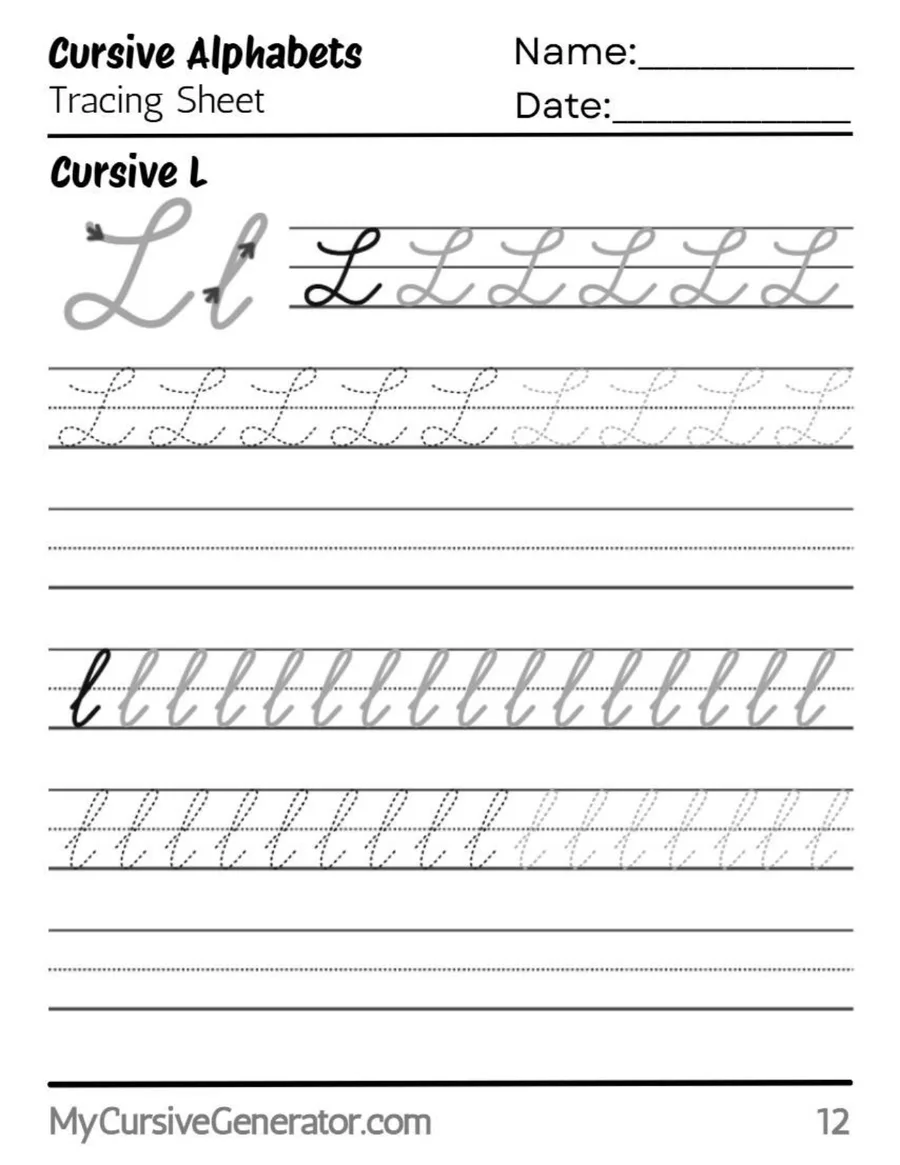
Before You Start: L in Cursive on Three Lines
Name the three lines before you write. The top line is the ceiling for both forms of cursive L. The midline is the ceiling for small letters such as a and e, but not for a lowercase l. The baseline is the floor where both forms finish.
Sit with both feet flat and tilt the paper slightly left for right hand writing, or slightly right for left hand writing. Hold the pencil loosely, about two finger widths above the tip.
L Cursive at a Glance: Two Loops, Two Jobs
The capital form is full height with two loops, so it looks larger and rounder at the top. The lowercase form is also full height, because it is an ascender, but its one loop is narrow and tall. Two loops means a capital at the start of a word, one narrow loop means a lowercase letter inside a word.
That is why a lowercase l stands out in love, little, and ball. Its tall loop rises above the small letters around it. If it is too wide, the word looks loose. If it is too short, the word looks flat.
How to Write Capital Cursive L
The capital form is one continuous movement. It starts just below the top line, forms a small loop near the top, travels down to the baseline, then forms a second loop at the baseline curving right. That second loop is the connector to the next letter.
Enter Below the Top Line and Loop
Start just below the top line, not on it. Curve up and left, then come back down a short way. This makes a small loop, wider and rounder than a lowercase loop.
Draw the Long Stroke Down
Without lifting the pen, draw a long stroke down to the baseline on a gentle slant to the right. Do not retrace the rising stroke exactly.
Loop at the Baseline and Connect
At the baseline, curve right and loop back a short way, then curve right again. This bottom flourish flows into the next letter, as in Liam.
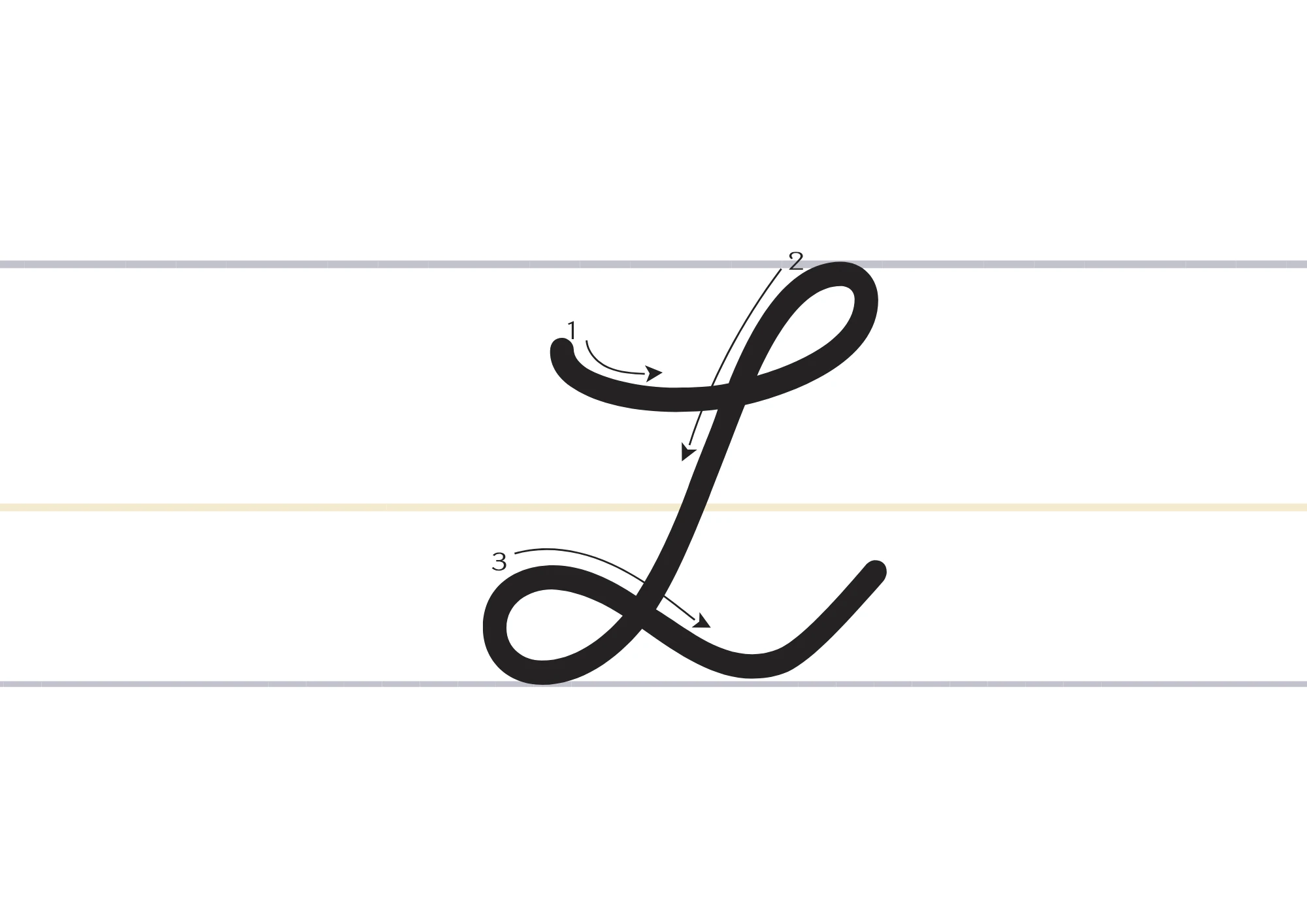
Check the capital: top loop near the top line, downstroke at the baseline, bottom loop turning right. No top loop means a plain stem. No bottom loop means an unfinished cursive L.
How to Write Lowercase Cursive L
The lowercase form appears most often, inside words such as love, little, and ball, and at the start of light and lemon. It is an ascender, so it rises to the top line, and it has no bottom loop.
Start at the Baseline and Sweep Up
Start at the baseline, curve slightly right, then sweep up to the top line. It must reach the top line, not stop at the midline.
Curve Left and Come Down
At the top line, curve left and come down to the baseline. Keep the loop narrow and tall, like a thin leaf, not a round oval.
End With a Small Rightward Flick
At the baseline, end with a small flick to the right. That flick is the connector, much smaller than a capital bottom loop. In love, it flows into the small o.
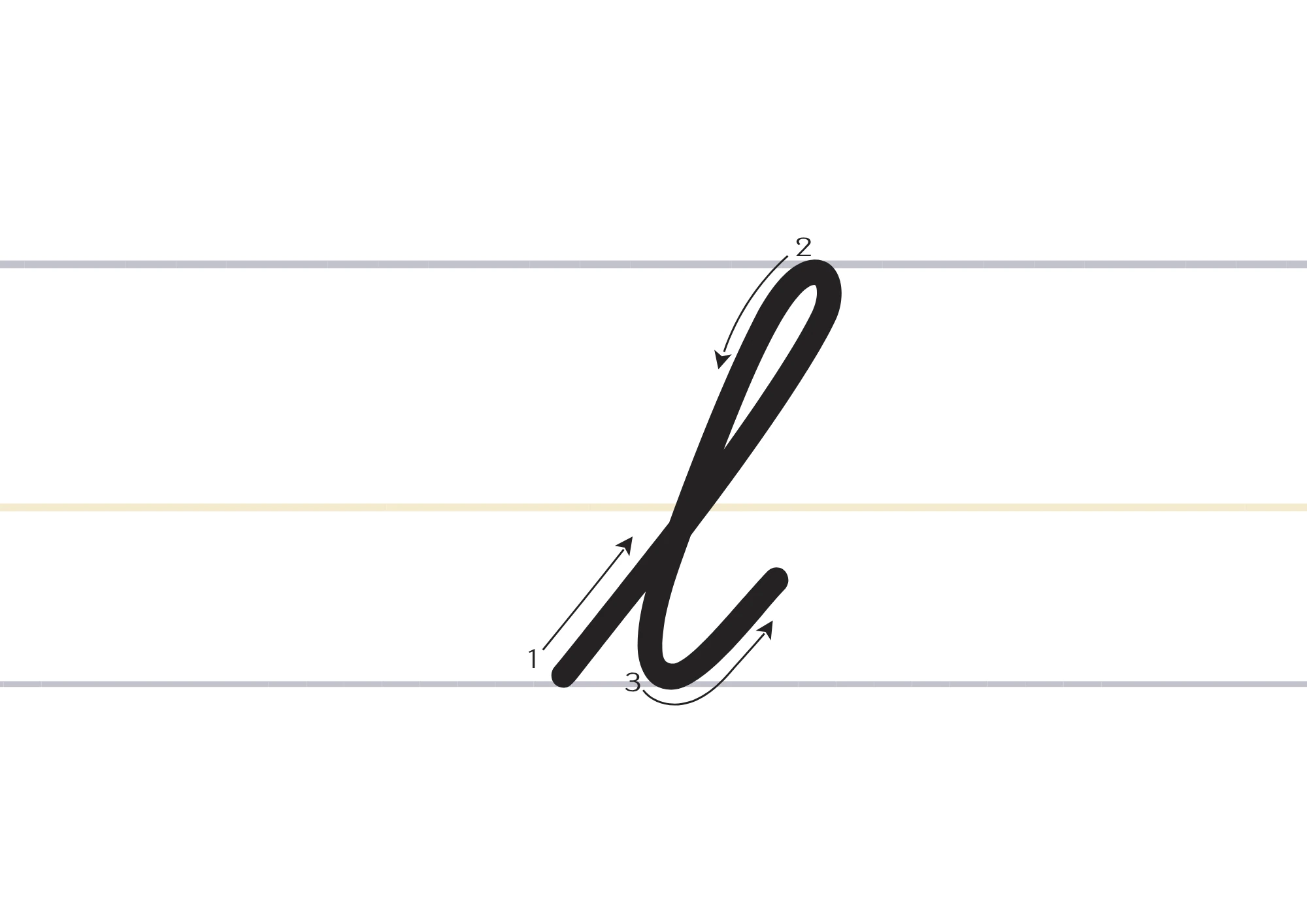
Check the lowercase form: baseline start, top line height, narrow loop, and only a small flick at the end. A bottom loop here means you wrote a small capital by mistake.
Capital Cursive L: The Top Loop, the Long Downstroke, and the Bottom Flourish
Each part has a job. The top loop marks a capital, because it is wider and rounder than a lowercase loop. The downstroke gives height and slant. The bottom flourish gives the exit and the style.
Learners often rush the bottom flourish. They stop at the baseline, or draw a flat line right and call it done. Take one extra beat: curve right, loop back a short way, then curve right again into the next letter.
Lowercase Cursive L: Why Loop Width Matters
A narrow loop, about the width of a small stem, reads as l at once. A wide loop reads as a loose oval and takes space from the next letter. Keep the downstroke close to the rising stroke to control width.
If loops keep coming out wide, slow the top turn and bring the pen down sooner, so the loop closes before it can spread. Five narrow loops in a row beat a full page of wide ones.
Lowercase l vs Capital I vs the Number 1
In print, a lowercase l, a capital I, and the number 1 can look almost the same. In cursive, three checks tell them apart. First, look for a loop: a cursive lowercase l has a narrow top loop, while a number 1 usually has no loop and no connector. Second, look at position: a lowercase l sits inside a word, a number 1 sits alone in a number, and a capital I starts a word. Third, look at the exit: a lowercase l ends with a flick right, ready to join the next letter.
The same check sorts out a small i without a dot. A small i is short, rises only to the midline, and needs a dot. A lowercase l is tall, rises to the top line, and needs no dot. Midline height means i, top line height with a narrow loop means l.
How to Write L in Cursive Without Closing the Loop Too Early
Closing too early hurts both forms. For a lowercase l, turning down before the top line makes a short arch, not a tall loop. For a capital, shutting the top loop early makes the top look pinched.
Finish the top turn first. Sweep all the way to the top line, make a rounded turn left, and only then come down. Trace the top turn on its own three times if the fault keeps returning.
How to Write Cursive L in Words: Joining l Into Vowels and Into l Itself
A capital joins only on the right, through its bottom loop. A lowercase l joins on both sides: it enters from the baseline and exits with a small flick at the baseline. Keep both at the same height and angle, so the word looks even.
Joining l Into Vowels: la, le, li, lo, lu
Practice la, le, li, lo, and lu first. In la, rise into the a oval without closing it early. In le, rise into the e loop at the midline. In li, rise into the short i stem, and dot the i only after the word is done. In lo, flow into the o oval. In lu, flow into the first arch of u. Watch the connector, because a fast jump up makes the second letter look too tall.
Joining l Into l Itself: ball and fall
The double l in ball and fall tests matching. Write the first l, flick at the baseline, then sweep up again for the second l from the same point. Keep both loops the same height and width, with a small gap between them. In fall, the same rule applies after the small a, with both loops rising to the top line.
Words That Start With L in Cursive
Practice these common L words. Read them, trace them, then write them on your own:
Lion · Lamp · Light · Lemon · Lizard
Liam · Lily · Lucas · Lucy
Lion, lamp, light, lemon, and lizard start with a capital, so they practice the two loop form. Love, little, and ball practice the lowercase form, and ball also practices double l. Liam, Lily, Lucas, and Lucy start with a capital, and Lily and Lucy also hold a lowercase l later in the name. See these words in copyable cursive text with our cursive generator, or go back to the full cursive alphabet chart to pick your next letter.
Common Mistakes With Cursive L
- Starting the capital on the top line. Start just below it, or the top loop flattens.
- Leaving out the bottom loop of a capital. Without it, the letter looks unfinished and the join looks sharp.
- Making the lowercase loop too wide. A wide loop looks like a loose oval and crowds the next letter.
- Closing the loop too early. Turning down before the top line makes a lowercase l short and a capital pinched.
- Adding a bottom loop to a lowercase l. A lowercase l has no bottom loop, so one at the baseline is a mistake.
- Confusing lowercase l with capital I, small i, or the number 1. Use the height test in the section above.
- Skipping the exit flick. Without that small flick, the word breaks into print.
- Changing the slant inside a word. Keep one gentle right slant, or the word looks shaky.
How to Write Cursive L: 10-Minute Daily Practice Routine
Ten focused minutes a day, for a week, makes cursive L feel steady. Use a lined notebook and keep the pen moving slowly.
- Warm-up loops (2 minutes): Draw narrow tall loops in the air, then on paper, all the same height and width.
- Capital form (2 minutes): Write capitals slowly, checking the top loop and the bottom loop at the baseline.
- Lowercase form (3 minutes): Write lowercase forms in rows, narrow and tall, with only a small flick at the baseline.
- Words (2 minutes): Write lion, lamp, light, love, little, and ball slowly, without lifting the pen inside a word.
- Quick check (1 minute): Compare your last row with your first. Same heights? Steady slant? If a row shakes, slow down.
Repeat tomorrow. The goal is not a perfect page on day one, it is a steadier hand by the end of the week.
How to Write L in Cursive: Practice Sentences
Sentences teach spacing, rhythm, and stamina. Try each sentence three times: once very slowly, once at a normal pace, and once without stopping.
Liam looked at a lion in the light.
Lily lit a lamp at lunch.
Lucas loves a lemon, and Lucy loves a lizard.
We practice cursive L with lion and lamp every day.
When done, check: two loop capitals, narrow tall lowercase loops, and smooth joins?
Letter L in Cursive for Names and Signatures
For a name starting with cursive L, keep the capital a little larger and more open than in ordinary writing, so it reads well at a glance. The rest of the name stays at normal size, and any lowercase l inside it stays narrow and tall.
For a signature, the shape can be faster and looser, but it must stay readable: top loop visible, capital bottom loop in place, exit at the baseline. If it turns into a scribble, slow down until the loops show again.
A 7-Day Plan to Master Cursive L
Day 1: capital top loop alone. Day 2: capital bottom loop and connector. Day 3: lowercase narrow loop, with a width check. Day 4: joining pairs la, le, li, lo, and lu. Day 5: double l words ball and fall. Day 6: names Liam, Lily, Lucas, and Lucy, plus a sentence with lion, lamp, and light. Day 7: review one handwritten paragraph, circle the best capital and lowercase forms, and note one fix for next week.
When Cursive L Keeps Breaking
Plain stem capital means a missing loop: add the top loop, then the bottom loop. Wide lowercase means the downstroke is too far from the rising stroke: bring it closer. Early closing means the top turn was rushed: finish it before coming down. A broken word means a missing exit: keep the flick, or the bottom loop, and do not lift the pen inside a word.
Cursive L, Frequently Asked Questions
What does cursive L look like?
Capital cursive L has a small loop near the top line, a long stroke to the baseline, and a second loop at the baseline curving right. Lowercase cursive l has one narrow tall loop, from the baseline up to the top line, curving left and down, ending with a small rightward flick.
Why is lowercase l confused with capital I and the number 1?
In print they can look almost the same. In cursive, use height: small i rises only to the midline and needs a dot, lowercase l rises to the top line with a narrow loop and needs no dot, and the number 1 has no loop and no connector.
How do you write capital cursive L?
Start just below the top line, form a small wider top loop, draw a long stroke to the baseline, then loop at the baseline and curve right into the next letter, all without lifting the pen.
How do you write lowercase cursive l?
Start at the baseline, sweep up to the top line, curve left, come down in a narrow tall loop, and end with a small rightward flick. There is no bottom loop.
How do you join cursive L to other letters?
A capital joins only on the right, through its bottom loop. A lowercase l joins on both sides, entering and exiting at the baseline. Start with la, le, li, lo, and lu, then practice ball and fall.
What words can I practice with cursive L?
Try lion, lamp, light, lemon, and lizard for capitals, and love, little, and ball for lowercase forms. For names, try Liam, Lily, Lucas, and Lucy.
Should I learn the capital or the lowercase form first?
Start with the lowercase form, because it appears in love, little, and ball, so it pays off at once. The capital is needed only at the start of sentences and names.
Why does my cursive L loop close too early?
The pen turns down before the top turn is finished. Sweep to the top line, make a rounded turn left, and only then come down. Trace that top turn three times, then write the full letter again.
See Your Name in Cursive
Type any name or word and convert it into beautiful cursive text you can copy anywhere, free, with no sign-up.
Open the Cursive Generator