
Home › Cursive Alphabet › Cursive Y
Cursive Y: How to Write the Letter Y in Cursive
Capital cursive Y is tall, open, and finished above the line. Lowercase cursive y is small on top and looped below the line. Learn the two forms separately first, then join them into words.
Cursive script is a style of handwriting in which the letters of a word are joined together. Cursive Y teaches two skills at once: control of height in the capital form, and control of depth in the lowercase form. The capital stays between the top line and the baseline, while the lowercase body sits between the midline and the baseline and then drops below it.
What Cursive Y Looks Like
Capital cursive Y looks like a wide, slanted fork with a small loop in its lower half. The left arm is a tall curve, the right arm is a long diagonal to the top line, and where the arms cross, the stroke turns back into a loop above the baseline. Lowercase cursive y is a narrow, slanted u, followed at once by a loop below the baseline that crosses itself at the baseline. That loop is what proves the letter is a y, so it must be closed, even, and clearly below the line.
Y in Cursive: Size and Line Placement
Capital cursive Y uses the top line and the baseline only, touching the baseline at its lowest curve and never going below it. Lowercase cursive y uses the midline, the baseline, and the descender line: its body is half the height of the capital, and its loop drops about the same distance again below the baseline. In Yara, the capital should be about twice the height of the small a letters after it. In yellow, the lowercase body should match the height of the e, with only its loop below the line.
Trace the Cursive Letter Y
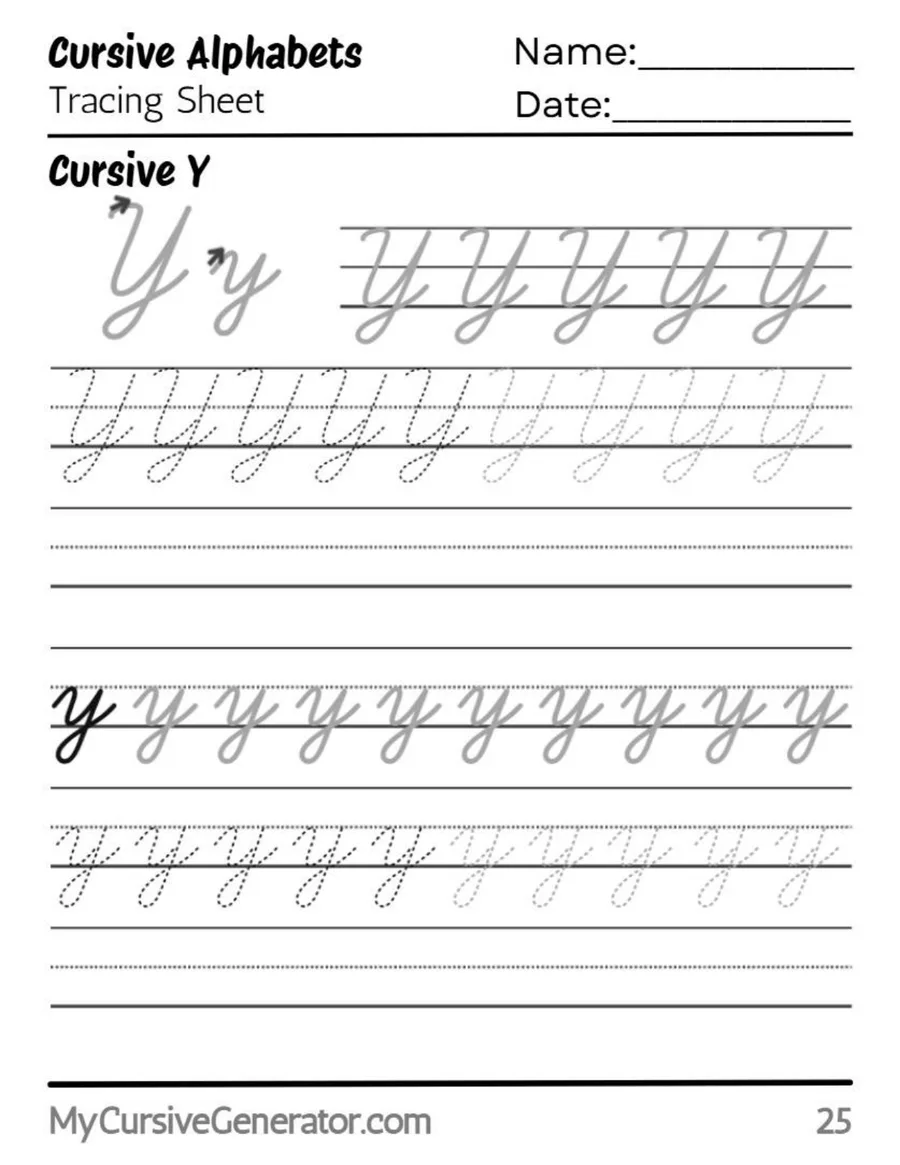
Trace slowly before you try to write from memory. Follow the numbered arrows on the diagram, not the finished shape alone, because the arrows show where each stroke starts, turns, and crosses. Trace each form five times, keeping your eyes on the lines rather than on the pen tip. Tracing them side by side fixes their key contrast fast: the capital ends above the baseline, while the lowercase ends after a loop below it.
Before You Start
Sit with both feet flat and tilt the paper slightly to the left if you write with your right hand, or slightly to the right if you write with your left hand. Hold the pencil loosely, about two finger widths above the tip, because a tight grip makes tall curves shaky and descender loops stiff. Keep your wrist relaxed and let the movement come from your forearm. Cursive Y rewards a relaxed hand, because both forms need one long, unhurried movement.
How to Write Cursive Y
This page follows the D’Nealian school form, the same form used on the worksheet above. That choice matters for Y, because some older styles give capital Y a long tail below the baseline, much like a capital J. The D’Nealian form here does not: its capital finishes above the baseline, and only the lowercase goes below it. Learn the lowercase first if you are short on time, since it appears in words such as my, day, yellow, and beyond far more often than the capital.
How to Write Capital Cursive Y
The capital form is one flowing movement, broken into three parts so you can check each turn. Do not lift the pen between the parts.
Curve Down the Left Arm
Start just below the top line on the left, curve up to touch it, then sweep down in a tall, slanting curve to the baseline, turning gently at the bottom.
Rise on the Right Diagonal
Without lifting the pen, swing up from that bottom turn in a long, straight diagonal to the top line on the right, the rght arm of the letter.
Cross Back and Loop Above the Line
From the top right, come back down on a diagonal that crosses the left curve, continue to just above the baseline, loop to the left, and return to the crossing point. Finish with a short connector to the right at mid height. Nothing here goes below the baseline.
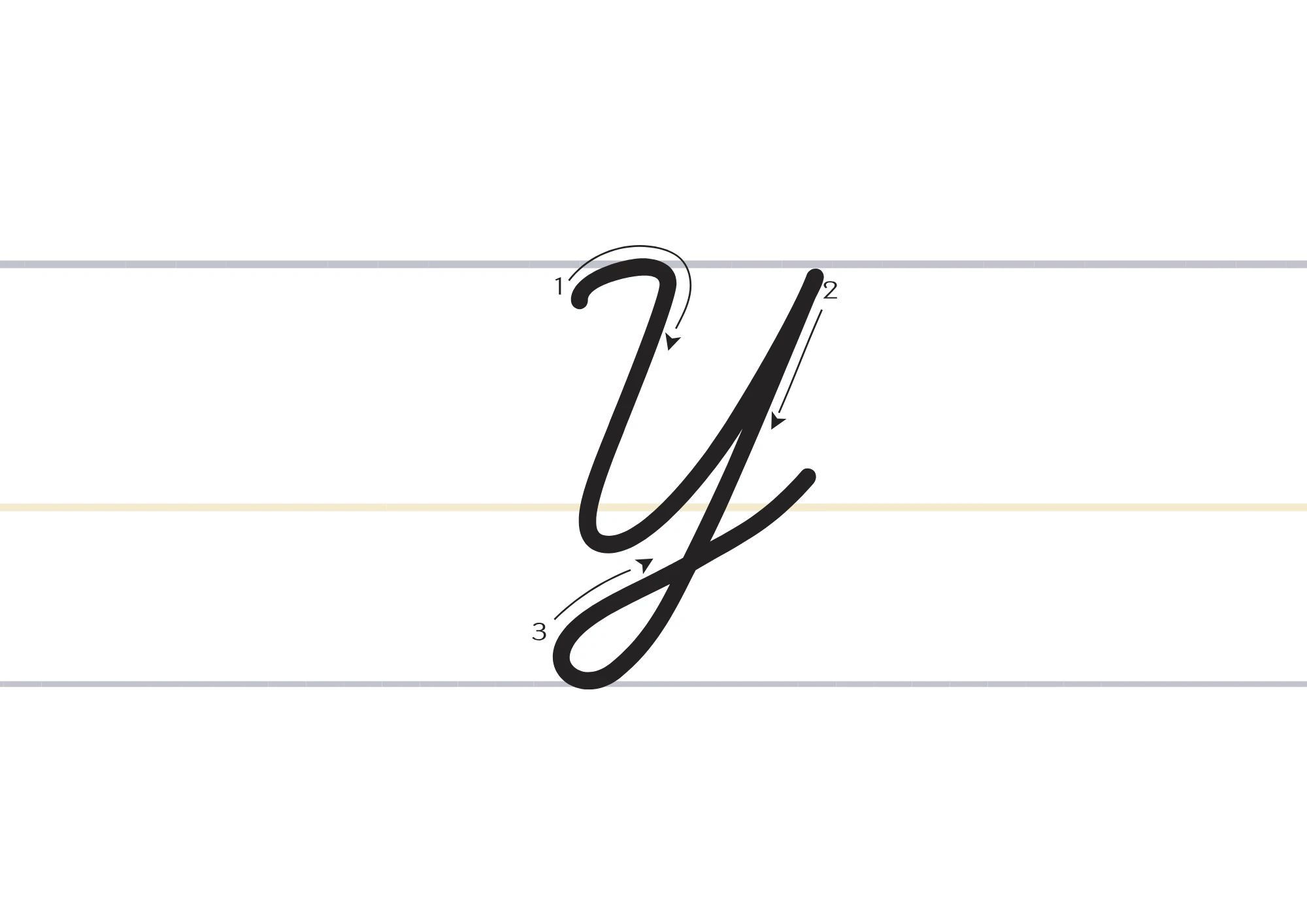
Check three points: the left arm curved and the right arm straight, the crossing point below the middle, and a small loop ending above the baseline.
Why Capital Y Has No Descender in D’Nealian Form
Many learners give capital Y a descender because lowercase y has one, and because capital J in the same style does drop below the baseline. That logic feels natural, but it is wrong for this letter in the D’Nealian form, and the descender is exactly what tells Y and J apart. Give capital J its descender loop, keep capital Y above the baseline, and a reader can tell them apart at a glance. In names such as Yara and Yusuf, a capital with a loop below the baseline also crowds the line below.
How to Write Lowercase Cursive Y
The lowercase form is also one flowing movement, broken into three parts. Slow down for the loop: most errors happen when the hand rushes the part below the line. Treat the loop as half the letter, not as a tail added at the end.
Slant Up From the Baseline
Start on the baseline and slant up to the midline in one smooth, light upstroke, leaning slightly to the right.
Form the Small Body
Curve over at the midline, come back down to the baseline, then rise again to the midline on the right, making a narrow, slanted u with both sides the same height.
Drop, Loop, and Cross at the Baseline
From the midline on the right, sweep down through the baseline and below it, loop to the left, and come back up to cross your downstroke exactly at the baseline. Finish with a short connector at baseline height. The loop should be about as deep as the body is tall.
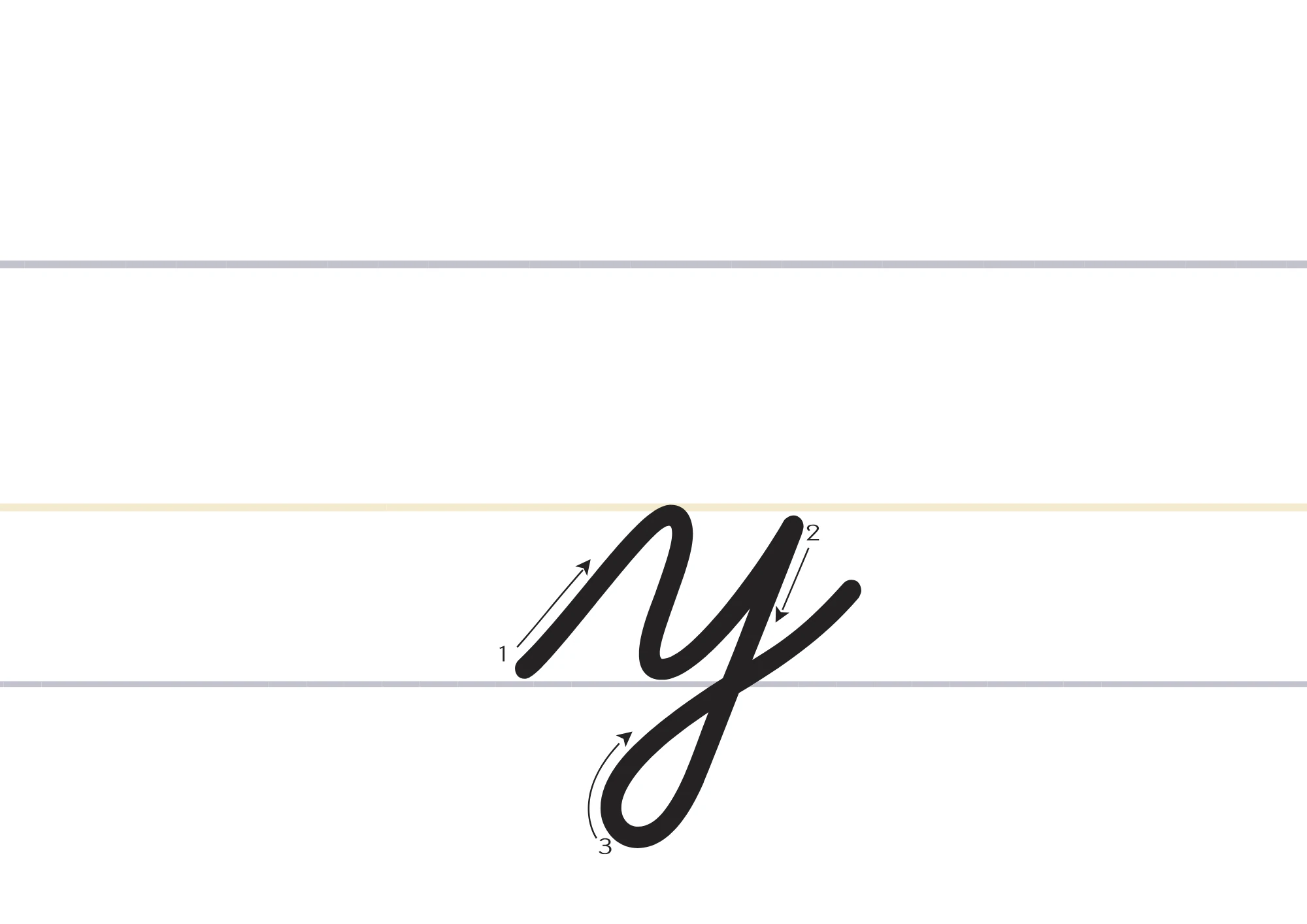
At the end of a word, as in my or day, the step 3 connector simply stops at baseline height. In the middle of a word, as in beyond or system, it flows into the next letter without a lift. Practice both cases, not only words that end in y.
Lowercase y and the Descender Loop: Size, Slant, and Crossing Point
Three measurements decide whether a lowercase y loop looks right. Depth: the loop should drop below the baseline by about the same distance as the body rises above it. Slant: it should read as a narrow oval tilted to the right. Crossing point: the return stroke must cross the downstroke at the baseline, not above or below it. Cover the loop and the rest should still read as a small u; cover the top part and the rest should still read as a closed loop.
How to Write Cursive Y: 10-Minute Daily Practice Routine
Ten focused minutes a day, for a week, is enough to make this letter feel natural. Use a lined notebook and stop when your hand gets tired, because tired hands practice mistakes.
- Warm-up loops (2 minutes): draw tall left curves and narrow descender loops, keeping every loop the same depth and slant.
- Capital form (2 minutes): write capital Y letters slowly, checking the right arm reaches the top line and the loop stays above it.
- Lowercase form (3 minutes): write small y letters, keeping every body the same height and every loop crossing at the baseline.
- Words (2 minutes): write two short words from the list below, joining each letter without lifting the pen.
- Quick check (1 minute): compare your last row with your first row for height and slant. If a row looks shaky, slow down rather than pressing harder.
Repeat the routine tomorrow with different words, covering y at the start, in the middle, and at the end of words.
Words That Start With Y in Cursive
Practice these common Y words. Read them, trace them, then write them on your own:
Yak · Yam · Yarn · Yacht · Yogurt · Yellow
Yara · Yusuf · Yasmine · Yohan · Yuki · Yasmin
See any of these words in copyable cursive text with our cursive generator, or go back to the full cursive alphabet chart.
Y Words in Start, Middle, and End Positions
Words that start with Y test the capital form: yak, yarn, yellow, and yacht, plus Yara and Yusuf, where the capital must stay twice as tall as the small letters after it. Words with y in the middle test the loop best, because the loop must finish with a connector that joins onward: try beyond, system, and cycle, and watch the crossing at the baseline. Words that end in y, such as my, day, and happy, are gentler, but they still expose a loop that is too shallow or a body that is too tall.
Common Mistakes With Cursive Y
- Drawing cursive Y like a printed Y. The cursive form is a flowing curve and loop, not separate straight lines, ending with a connector to the next letter.
- Giving capital Y a descender loop. In the D’Nealian form here, capital Y stays above the baseline. A loop below it belongs to lowercase y, and on a capital it reads as a J.
- Getting the height wrong. If the capital misses the top line, or the lowercase body rises above the midline, the letter looks out of place.
- Changing the slant halfway through. A steady slant to the right looks neat. A slant that changes inside one letter makes the whole word look shaky.
- Making the lowercase loop too shallow or too deep. A loop that barely dips looks like a tail, and one that drops far too deep looks like a different letter. Aim for a depth about equal to the body height.
- Crossing the loop away from the baseline. If the return stroke crosses above or below the baseline, the letter looks broken. Check that point first.
- Losing the lowercase body. A lowercase y without a clear small body and a closed loop can look like a small u or a small v.
Cursive Y or Cursive V, U, and J: A Quick Confusion Check
Against V, the test is the bottom: V ends in a point at the baseline, while lowercase y continues into a loop below it and capital Y ends in a loop above it. Against U, the test is the same loop: U stops at the baseline, while y adds the loop below it. Against J, the test is the top: capital J drops below the baseline, while capital Y stays above it. Write Y and J side by side five times, saying aloud: Y stays up, J goes down.
How to Join Y Cursive Letters
A capital usually starts a word, so it rarely joins from the left. Its job is to open the word cleanly through the connector at the end of its lower loop, leaving at about mid height. The lowercase form does most of the joining work, connecting on both sides: entered from the baseline, and leaving through the connector at the end of its descender loop, at baseline height. Practice ya, ye, yi, yo, yu, and yn first, then ay, ey, oy, and uy, keeping the pen on the paper through the whole word.
How to Write Y in Cursive: Practice Sentences
Single letters are only half the skill, because sentences teach spacing, rhythm, and stamina. Try each sentence three times: once very slowly, once at a normal pace, and once without stopping.
Yara yarned a yellow scarf.
Yusuf sailed a yacht at sunrise.
The yak yawned in the yard.
We practice cursive y with yak and yam every day.
When a sentence is finished, read it back: are the joins smooth, is the slant steady, and does every letter keep the right height? Circle the best attempt in each set of three.
Letter Y in Cursive for Names and Signatures
Names are where most people first notice their handwriting. For a name that begins with this letter, keep the capital a little larger and more open than in ordinary writing, so it reads well at a glance. The rest of the name should stay at normal size, with a smooth connector. For signatures, the shape can be faster and looser, but it should still be recognizable: the capital loop must stay visible above the baseline, and a lowercase y at the end of a name, as in Amy or Tony, must still drop below the baseline and close.
Cursive Y, Frequently Asked Questions
What does the letter Y look like in cursive?
Capital cursive Y is a tall, open fork with a small loop in its lower half, all above the baseline. Lowercase cursive y is a small slanted u, followed by a loop below the baseline that crosses back up at the baseline.
Is cursive Y hard to learn?
No. Practice the lowercase loop and the capital form separately for a few minutes, then join them into short words. Most learners can write a clean form within one short session.
Does capital cursive Y go below the baseline?
No, not in the D’Nealian form taught here. Capital Y finishes above the baseline. Only lowercase y drops below it. Giving the capital a descender makes it look like a capital J.
How do you join cursive Y to the next letter?
The capital leaves through a connector at about mid height, and the lowercase leaves through a connector at baseline height after its loop crosses the baseline. Start with ya, ye, yi, yo, yu, and yn.
What words can I practice with cursive Y?
Start with yak, yam, yarn, and yacht, then try Yara, Yusuf, and Yasmine. Add beyond and system for middle y, and happy and sunny for final y.
Should I learn the capital or the lowercase form first?
Start with the lowercase form. It appears in almost every short word, while the capital is only needed at the start of sentences and names.
Why does my lowercase y look like a u?
Usually the loop below the baseline is missing, too shallow, or left open. Check the body, the depth of the loop, and the crossing point at the baseline.
Why does my letter Y look wrong?
Usually the problem is height, slant, or the loop. Check height first, then slant, then the loop: the capital loop stays above the baseline, and the lowercase loop crosses at the baseline.
How do I teach cursive Y to a child?
Start with the lowercase form. Let the child trace it, copy it, then write it from memory. Teach one rule: capital Y stays up, lowercase y goes down.
What is the difference between cursive Y and print Y?
A print Y is made of separate strokes that do not join. The cursive form is made in a flowing movement, with a connector that joins to the next letter.
See Your Name in Cursive
Type any name or word and convert it into beautiful cursive text you can copy anywhere, free, with no sign-up.
Open the Cursive Generator