
Home › Cursive Alphabet › Cursive B
Cursive B: How to Write the Letter B in Cursive
Cursive B is a tall, looped letter with a straight stem and two rounded loops. The capital cursive B has a small upper loop and a larger lower loop, and the lowercase cursive b has a tall stem with a small oval at the baseline. Learn both forms of cursive B step by step below.
Cursive script is a style of handwriting in which the letters of a word are joined together, and the letter B is a strong second letter to learn. Its tall stem teaches height control, and its loops teach the rounded movement used across the whole cursive alphabet. Once you can write cursive B steadily, many other tall letters feel easier.
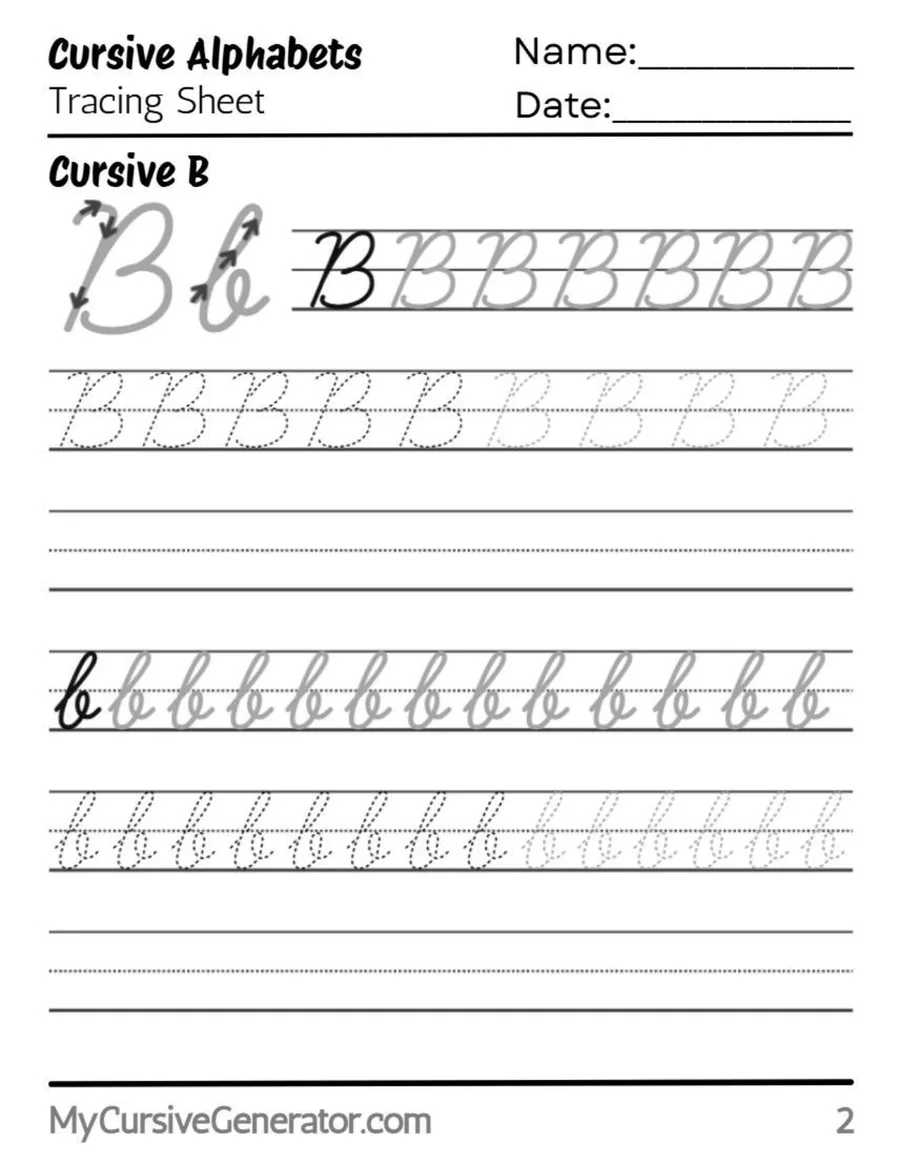
Trace the Cursive Letter B
Practicing cursive B is mostly about two habits: a straight, tall stem and loops that close cleanly. Start slowly, keep the stem upright, and let each loop return to the stem before you move on. Speed comes later, after the shape is steady.
Before You Start
Sit with both feet flat and the paper tilted slightly to the left if you write with your right hand (slightly to the right for left-handers). Hold the pencil loosely, about two finger-widths above the tip, because a tight grip makes loops shaky. Use a soft pencil or a smooth pen, and keep your wrist relaxed. The letter B is good for learning height, because its stem runs from the top line to the baseline while its small oval stays low.
How to Write Capital Cursive B
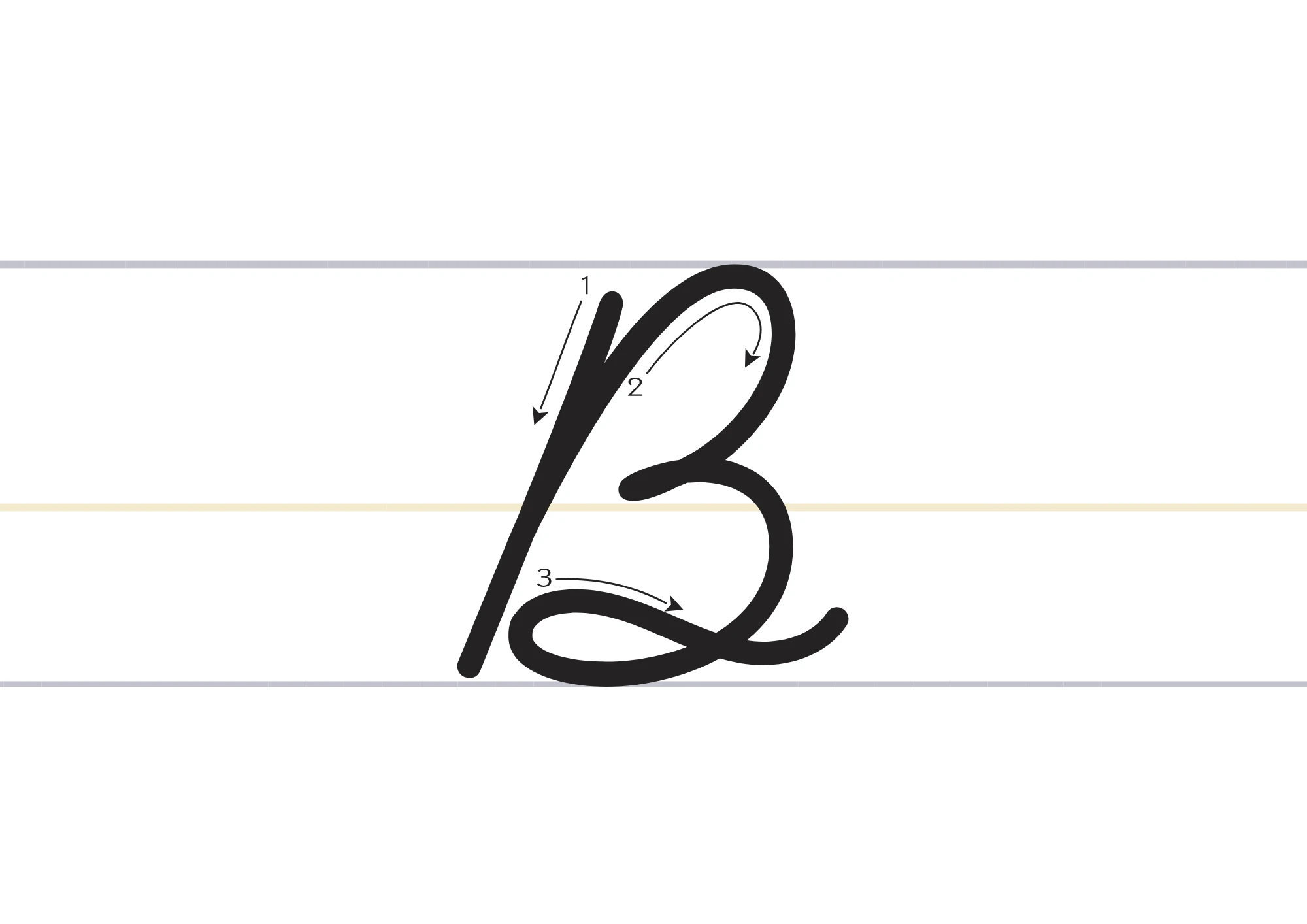
The capital cursive B is built from one tall stem and two loops. The upper loop is small, the lower loop is larger, and both loops return to the stem. Do not lift the pen until the exit tail is finished.
Draw the Stem
Start at the top line and pull a straight stem down to the baseline. Keep the stem tall, straight, and leaning slightly to the right.
Add the Upper Loop
From the top of the stem, curve to the right and around to make a small upper loop, then return to the middle of the stem, about halfway down.
Add the Lower Loop
From the middle of the stem, curve to the right again to make a larger lower loop, return to the baseline, and finish with a small exit tail to the right.
How to Write Lowercase Cursive b
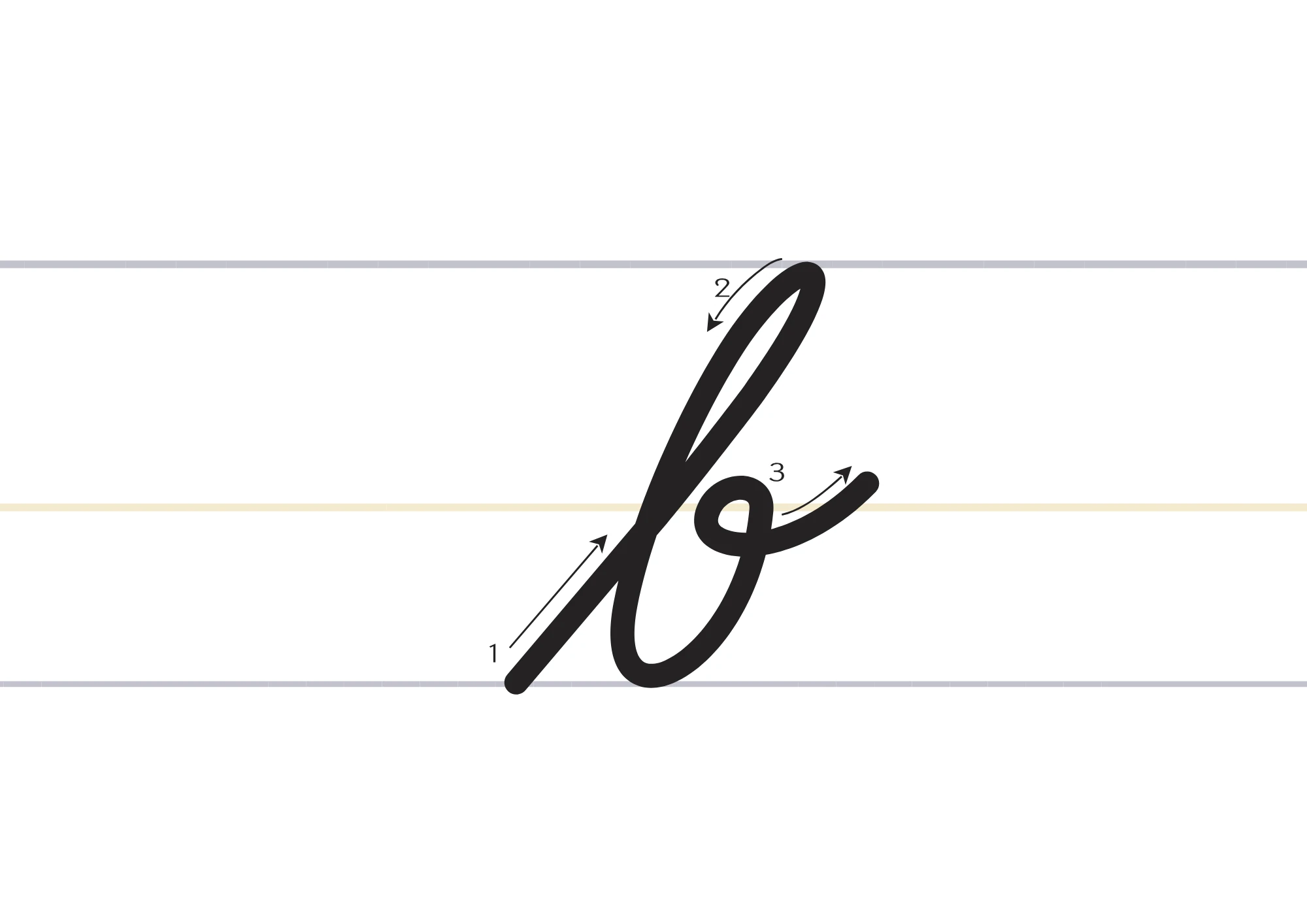
The lowercase cursive b is simpler than the capital, because it has one stem and one oval. The stem is tall, the oval is small and sits low, between the midline and the baseline. Watch the side of the oval carefully, because a lowercase b with the oval on the wrong side reads as a d.
Draw the Tall Stem
Start at the top line and pull a straight stem down to the baseline. This tall stem is what makes a lowercase b different from a small oval on its own.
Add the Oval
At the baseline, draw a small oval to the right of the stem, between the midline and the baseline, and close it back at the stem.
Finish with a Tail
Add a small exit tail to the right at the baseline. This tiny stroke is what joins the b to the next letter in a word.
How to Write Cursive B: 10-Minute Daily Practice Routine
A short daily routine beats one long session. Ten focused minutes a day, for a week, is enough to make cursive B feel natural. Use a lined notebook and keep the pen moving slowly.
- Warm-up stems (2 minutes): draw tall, straight stems from the top line to the baseline. Keep every stem the same height and the same gentle slant.
- Capital loops (2 minutes): write capital cursive B shapes slowly, checking that the upper loop stays small and the lower loop stays larger, with both loops closing back at the stem.
- Lowercase ovals (3 minutes): write small lowercase b shapes, with the tall stem first and the low oval second. Keep every oval the same height, between the midline and the baseline.
- Words (2 minutes): write two short words from the list below, slowly, joining each letter to the next without lifting the pen.
- Quick check (1 minute): compare your last row with your first row. Are the stems the same height? Are the loops closed? Are the exit tails sitting on the baseline? If a row looks shaky, slow down rather than pressing harder.
Repeat the same routine tomorrow. The goal is not a perfect page on day one, it is a steadier hand by the end of the week in Cursive.
Words That Start With B in Cursive
Practice these common B words. Read them, trace them, then write them on your own:

Ball · Bear · Book · Bird · Banana · Butterfly
Ben · Bella · Brian · Beth · Benjamin · Brandon
See any of these words in copyable cursive text with our cursive generator, or go back to the full cursive alphabet chart to pick your next letter.
Common Mistakes With Cursive B
- Drawing the capital like a printed B. The capital cursive B is a stem with two curves, not two straight sides with a crossbar in the middle.
- Making the upper loop as large as the lower loop. In a school style capital cursive B, the upper loop is small and the lower loop is larger. Equal loops make the letter look top heavy.
- Leaving a loop open. If a loop does not return to the stem, the letter falls apart and starts to look like a loose curve rather than a B.
- Putting the lowercase oval on the wrong side. The oval of a lowercase b sits to the right of its stem. Put it on the left and the letter reads as a d.
- Making the lowercase stem too short. If the stem of a lowercase b stops at the midline, the letter loses its height and can read as a small oval with a tail.
- Lifting the pen before the exit tail. The tail is what connects B to the next letter, so skipping it breaks the flow of the word.
How to Join B Cursive Letters
A capital letter usually starts a word, so it rarely joins from the left. Its job is to open the word cleanly and hand over to the next letter through its exit tail. The lowercase form does most of the joining work, because it connects on both sides.
Good pairs to practice first are the short, common ones: ba, be, bi, bo, bu and bl. Write each pair slowly and watch the join itself, not just the two letters. The tail should leave the baseline at the same gentle angle every time and meet the next letter at the same height, roughly the middle of the small letters.
Two habits make joins look natural. First, keep the pen on the paper through the whole word, because every lift creates a visible break. Second, keep the spacing even: the gap between two joined letters should be about the same as the width of one small oval. Practice these pairs for a few minutes a day and whole words will start to flow on their own.
How to Write B in Cursive: Practice Sentences
Single letters are only half the skill, because sentences teach spacing, rhythm and stamina. Try each sentence three times: once very slowly, once at a normal pace, and once without stopping.
Ben bought a big blue book.
Bella baked banana bread for Brian.
The brown bear sat beside the big bird.
Beth brought a bright butterfly book.
When a sentence is finished, read it back and check: are the joins smooth, is the slant steady, and does every small b close properly? Circle the best attempt in each set of three and try to beat it next time.
Letter B in Cursive for Names and Signatures
Names are where most people first notice their own handwriting, because a name is written far more often than any practice word. For a first name that begins with this letter, keep the capital a little larger and more open than in ordinary writing, because it reads better at a glance and gives the name a clear starting point. The rest of the name should stay at normal size.
For signatures, the same loops can be written faster and looser than in a school exercise, but the shape should still be recognizable: one tall stem, one small upper loop, one larger lower loop, and one exit tail. If a signature becomes a scribble, slow it down until both loops are visible again, then build speed back up gradually.
Cursive B, Frequently Asked Questions
What does the letter B look like in cursive?
The lowercase cursive b looks like a tall stem with a small oval at the baseline, to the right of the stem. The capital cursive B looks like a tall stem with a small upper loop and a larger lower loop, leaning slightly to the right, quite different from the straight printed B.
Is cursive B hard to learn?
No, B is a straightforward letter once the stem is steady. The lowercase b is one stem and one oval, and the capital adds a second loop to the same stem. Most people can write a clean cursive B within one short practice session.
How do you join cursive B to the next letter?
Both forms of cursive B end with a small exit tail at the baseline. That tail flows directly into the entry stroke of the next letter, so the pen never needs to leave the paper inside a word.
What words can I practice with cursive B?
Start with short, familiar words such as ball, bear, book and bird, then try names like Ben, Bella and Brian. Writing your own name is the best motivation, so type it into our cursive generator to see it first.
Should I learn the capital or the lowercase form first?
Start with the lowercase form. It appears in almost every word, so it pays off immediately, while the capital is only needed at the start of sentences and names. Once the small form feels easy, the capital loops take only a short session to learn.
Why does my lowercase b look like a d?
Usually because the oval is on the wrong side of the stem, or the stem is too short. For a b, the stem comes first on the left and the oval sits to its right at the baseline. Check the side of the oval and the height of the stem before you change anything else.
How do I teach cursive B to a child?
Start with the lowercase b, because its stem and oval are easy to see on lined paper. Let the child trace the form first, then copy it, then write it from memory. Keep sessions short, and praise the closed loops and the exit tail before correcting anything else.
What is the difference between cursive B and print B?
A print B is made of straight lines and, for the capital, two firm bumps. A cursive B is made of curves: the capital is one tall stem with two loops and the lowercase is a tall stem with a low oval, and both end with a small tail that joins to the next letter. That tail is the whole point of cursive, it is what lets letters connect into words.
See Your Name in Cursive
Type any name or word and convert it into beautiful cursive text you can copy anywhere, free, with no sign-up.
Open the Cursive Generator