
Home › Cursive Alphabet › Cursive X
Cursive X: How to Write the Letter X in Cursive
Learning cursive X is mostly about order. In the school form used here, the curved stroke comes first and the diagonal cross comes last, for both the capital and the small letter. Get that order right, and cursive X stays readable even when you write fast.
Cursive script is a style of handwriting in which the letters of a word are joined together. Cursive X tests that skill, because its cross must be added after the main shape is formed. Draw the cross first, and the rest of the letter drifts and the join gets lost. This page uses the D’Nealian school form from the worksheet, with capital and lowercase steps kept separate.
Trace the Cursive Letter X
Start on the worksheet, not on blank paper. Trace the big model first, then the dotted rows, then try one row on your own. Trace slowly enough to feel the curve turning at the baseline and the diagonal crossing it. Rush the trace, and the cross lands too high or too low. Move to a lined notebook once the crossing point stays steady.
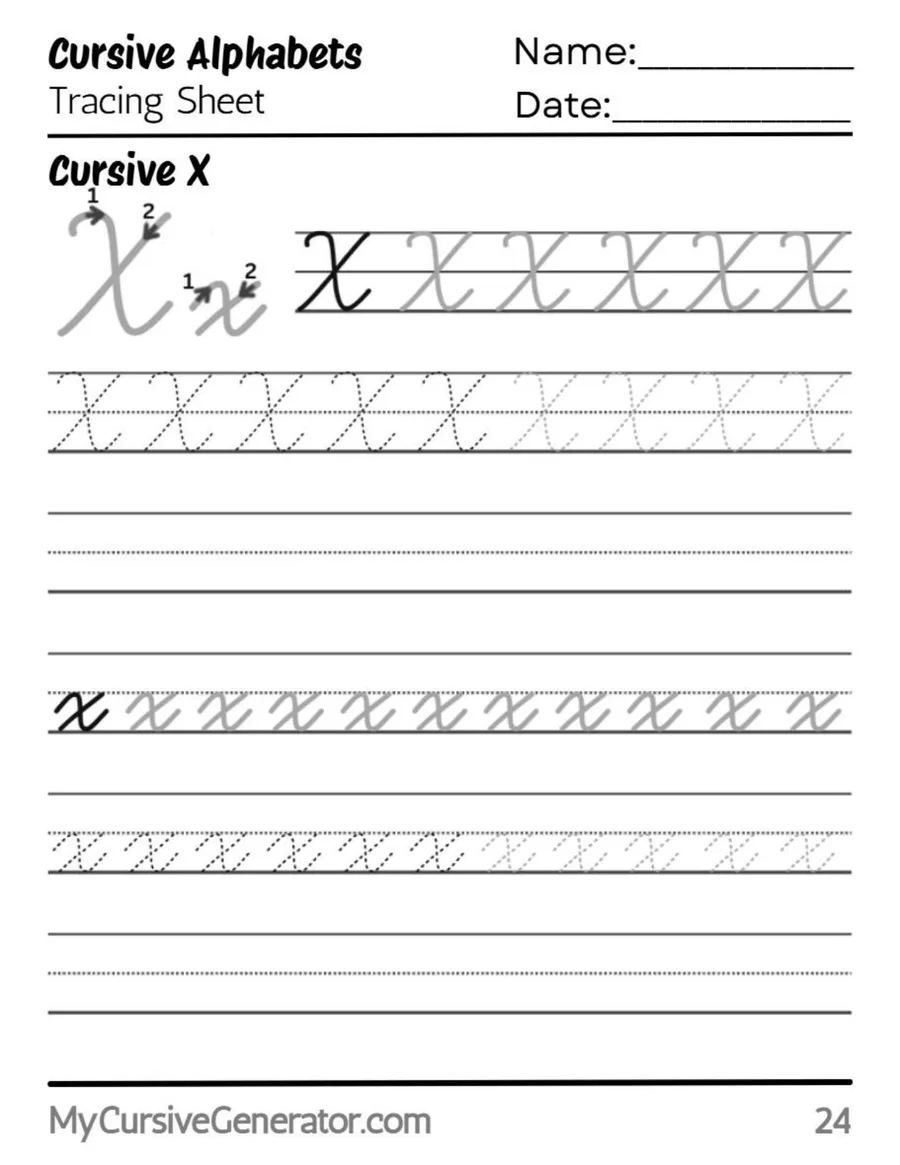
Before You Start
Sit with both feet flat and the paper tilted slightly to the left if you write with your right hand. The tilt for a left-handed writer is covered later on this page. Hold the pencil loosely, about two finger widths above the tip, because a tight grip pushes the cross off center. Check your lines first: the capital needs the top line and the baseline, and the small letter needs only the space between the midline and the baseline.
What Cursive Letter X Looks Like
Capital cursive X runs from the top line to the baseline, about twice as tall as the small letter. Lowercase cursive x sits only between the midline and the baseline, with no tall stem and no tail below the baseline. Both forms lean gently to the right.
The D’Nealian Model Used on This Page
US schools do not all teach the same model. This page follows the D’Nealian model on the worksheet diagram: the first curve is rounded at the top, the turn at the baseline is a smooth undercurve, and the cross is a straight diagonal. Use this one model for a whole assignment.
Where the Crossing Point Should Sit
For the capital, the diagonal crosses a little above the middle of the tall letter. For the small letter, it crosses near the center, halfway between the midline and the baseline. A cross near the top looks pinched, and a cross near the baseline looks flat.
How to Write Capital Cursive X
Capital cursive X uses two pen strokes, taught here in three cards so the turn at the baseline is easy to learn. The curve is written first, and the diagonal cross is added last.
First Curve, Written First
Start just below the top line on the left. Curve up over the top line, then slant down to the right to the baseline. This curve comes first in capital cursive X, before any diagonal.
Turn at the Baseline and Sweep Up
Without lifting the pen, curve at the baseline and sweep up to the right, ending above the baseline on the right. This sweep is still part of the first stroke. It is the true exit of the capital.
Diagonal Cross, Added Last
Lift the pen, place it at the top line on the right, and slant down to the left. Cross the first curve a little above the middle, and finish on the baseline on the left. Do not drag this diagonal into the next letter.
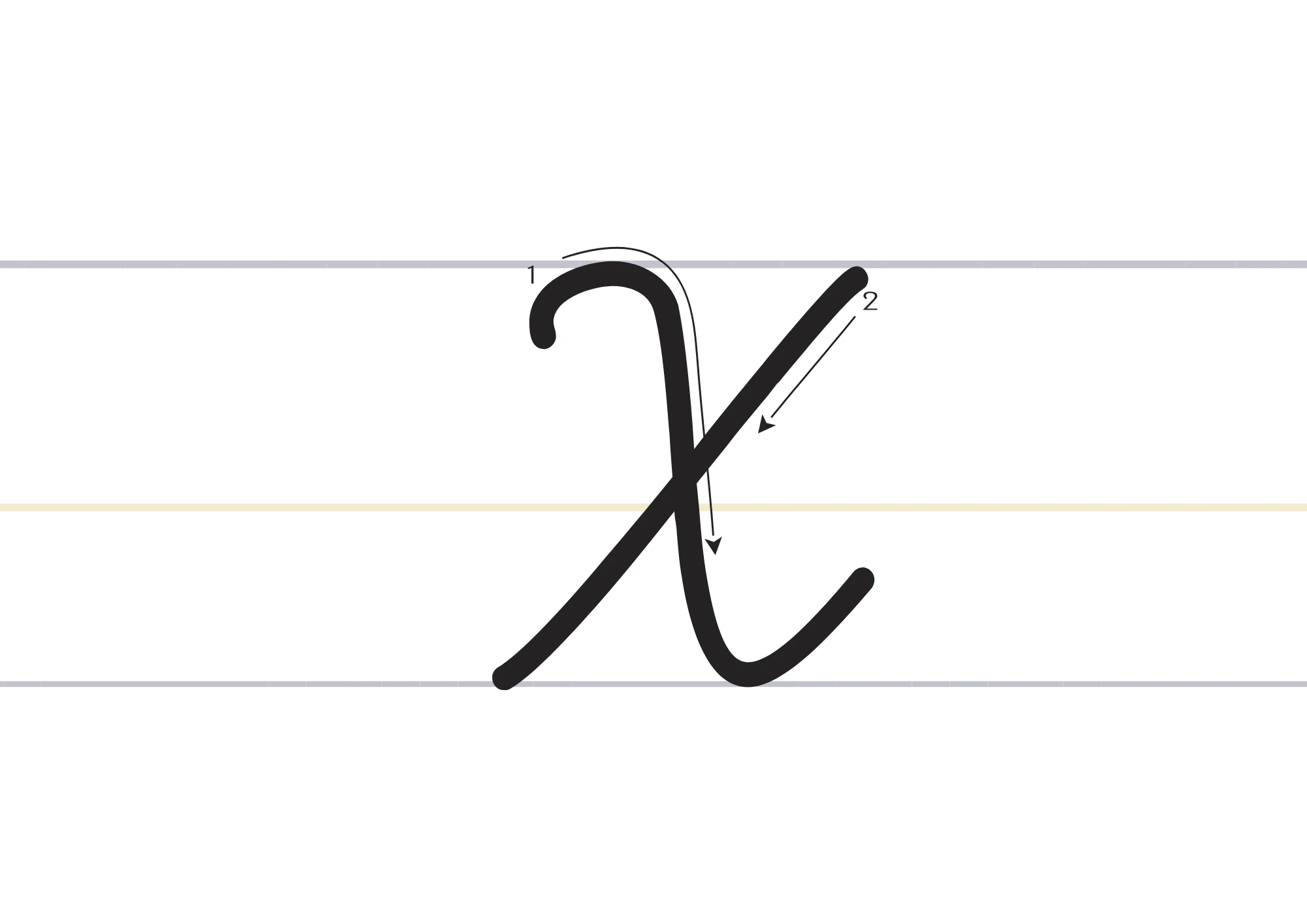
In the diagram, arrow 1 follows the first curve, and arrow 2 follows the diagonal cross.
How to Write Lowercase Cursive X
Lowercase cursive x is the form you will use most often, because most x letters sit inside words like box, fox, and next. It stays between the midline and the baseline, and it follows the same order as the capital: curved shape first, cross last.
Upstroke to the Midline
Start on the baseline, where the previous letter ends, and slant up to the right to the midline. Keep it short. If it rises above the midline, the small letter will look as tall as a capital.
Curve Over, Down, and Out
Without lifting the pen, curve over the top at the midline, slant down to the baseline, then curve at the baseline and sweep up to the right. This one movement forms the body of lowercase cursive x and its exit.
Diagonal Cross, Added Last
Lift the pen, place it at the midline on the right, and slant down to the left. Cross the body near its center, and finish on the baseline. Do not use the end of this cross to join onward. Fast writers often add it after the whole word, just as they dot an i after a word.
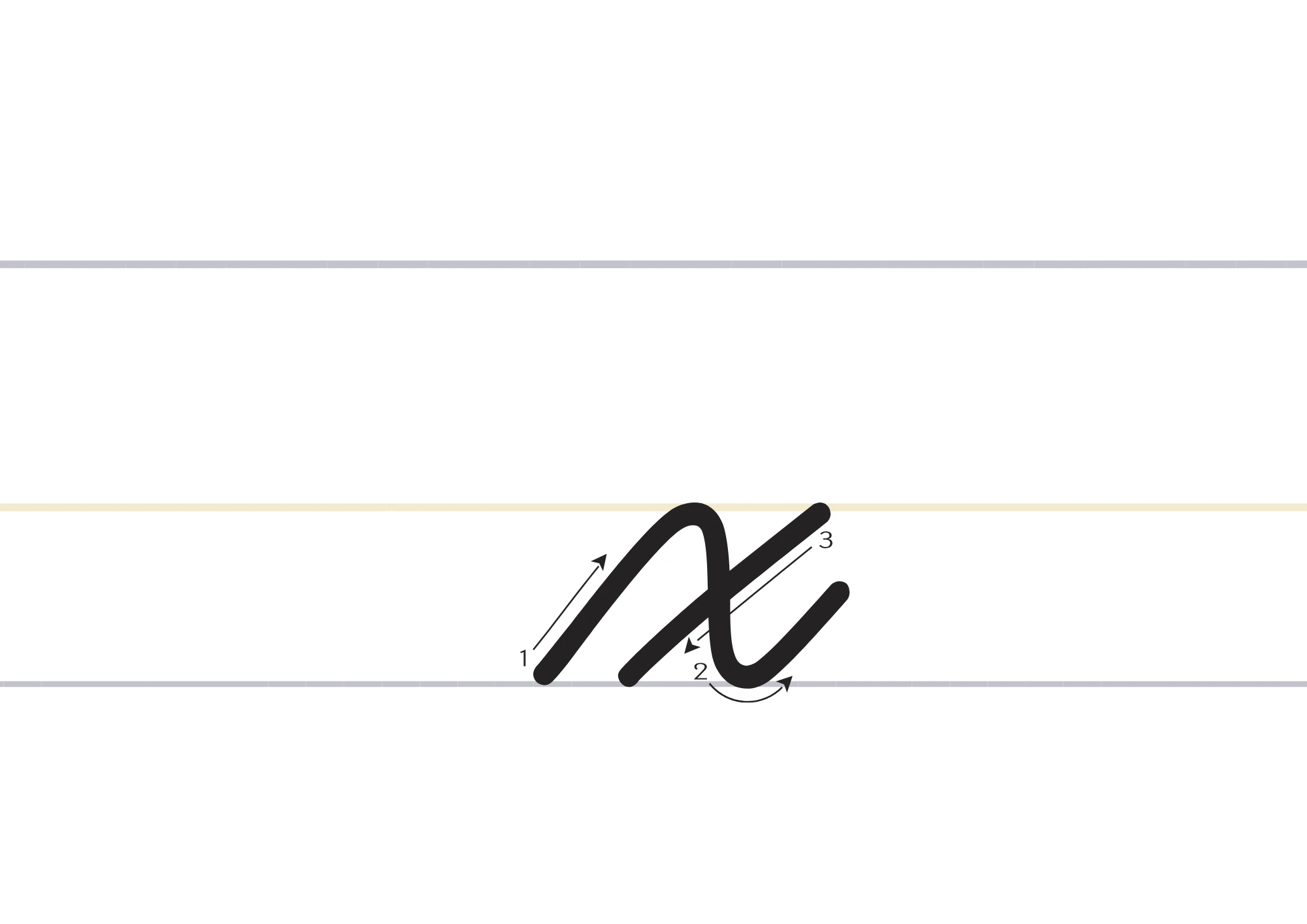
In the diagram, arrow 1 is the upstroke, arrow 2 marks the turn and sweep at the baseline, and arrow 3 is the diagonal cross. Read them as one body stroke plus one cross.
How to Write Cursive X: 10-Minute Daily Practice Routine
Ten focused minutes a day, for a week, is enough to make cursive X feel steady. Use a lined notebook, keep the pen moving slowly, and check the crossing point at the end of each row.
- Warm-up curves (2 minutes): draw the first curve again and again, capital size first, then small size.
- Capital form (2 minutes): write five capitals slowly, checking that the curve comes first and the cross sits a little above the middle.
- Lowercase form (3 minutes): write rows of the small letter, keeping every one between the midline and the baseline.
- Words (2 minutes): write box, fox, and next slowly, lifting the pen only for the cross of x.
- Quick check (1 minute): compare your last row with your first row. Are heights and slant steady? Does every cross sit near the center? If a row looks shaky, slow down.
Repeat the same routine tomorrow. The goal is a steadier hand by the end of the week.
X in Cursive: Words That Start With X
Words that start with X are scarce in English. Most X words learners meet are names, science terms, or short forms, not everyday nouns like apple or ball.
Xylophone · Xenops · Xylem · Xmas · X-ray
Xander · Xenia · Xavier · Xiomara · Ximena
Xylophone is a musical instrument with bars struck by mallets. Xenops is a small bird found in Central and South America. Xylem is plant tissue that carries water up from the roots. Xmas is a short form of Christmas, and X-ray is an image that shows bones inside the body. Xander is a short form of Alexander.
See these words with our cursive generator, or in the full cursive alphabet chart.
Cursive X in the Middle of Words
Do not judge your cursive X only on words that start with X. In everyday English, x shows up far more often in the middle or near the end of a word.
box · fox · ox · mix · fix · six
taxi · next · exit · extra · exact · exam
Box, fox, and ox are short and clear, so they show a joining mistake at once. Taxi, next, and exit test the join after x. Extra, exact, and exam test the join into x from e. Write each word three times: slowly, at normal pace, and without stopping except for the cross.
How to Join X Cursive Letters
A capital letter usually starts a word, so it rarely joins from the left. Its job is to open the word cleanly through the sweep made in step 2. The lowercase form does most of the joining work, because it connects on both sides, and the cross is not part of the join.
Good pairs to practice first are xa, xe, xi, xo, and xu. Watch the join itself, not just the two letters. The sweep should meet the next letter near the middle of the small letters. For xi, keep the connector short, and dot the i after the word is finished.
Also practice joins into x, which many guides skip. Try ax, ex, and ox. From a, the pen rises from the baseline into the upstroke of x. From e, it comes down from the e loop to the baseline. From o, it leaves the top of the o and drops to the baseline.
Common Mistakes With Cursive X
- Drawing cursive X like a printed X. The school form is a rounded curve crossed by a diagonal, not two straight lines. Print strokes have no exit, so the next letter cannot join.
- Drawing the diagonal first. When the cross comes first, the curve that follows it tends to be too wide or too narrow. Write the curve first, then add the cross last.
- Getting the height wrong. A capital short of the top line looks like a small letter, and a small letter above the midline looks like a capital.
- Placing the cross off center. A cross near the top pinches the letter, a cross near the baseline flattens it, and a cross that misses the curve leaves two loose marks.
- Changing the slant halfway through. A steady gentle slant to the right makes the letter look neat. A slant that changes inside one letter makes the whole word look shaky.
- Using the end of the cross as the join. The cross ends on the baseline on the left, so it cannot join forward. Join from the sweep at the end of the first curve.
- Mixing models in one word. A rounded D’Nealian curve plus an angular cross from another model looks inconsistent. Stay with the worksheet model until the letter is steady.
Cursive X for Left-Handed Writers
Left-handed writers do not need a different stroke order for cursive X. Changing the order breaks the worksheet model and makes the crossing point harder to judge. Change the setup instead. Tilt the paper slightly to the right, and keep the hand below the line, so the cross stays visible and does not get smudged.
Two checks help here. First, watch the sweep at the baseline: it moves up to the right, toward the next letter, and it is easy to cut short if the wrist is tight. Second, give the cross extra room at the top right, because a cramped start pushes the diagonal too steep.
Teaching Cursive X to a Child
Start with the small letter, and start with familiar words, not rare ones. A child who can already read box and fox will care about writing them well. Let the child trace first, then copy, then write from memory, in short sessions of about ten minutes.
Use a simple check the child can say out loud: curve first, cross last. Say it before each row, and point to the crossing point after each row.
How to Write X in Cursive: Practice Sentences
Sentences teach spacing, rhythm, and stamina. Try each sentence three times: very slowly, at normal pace, and without stopping except to add the cross of x.
Xander played a xylophone at noon.
Xenia fixed a box with wax.
The fox ran next to the taxi.
We practice cursive X with box, fox, and next every day.
When a sentence is finished, read it back: are the joins smooth, is the slant steady, and does every letter keep the right height? Circle the best attempt in each set of three. If the x in next looks crowded, practice ex on its own for a minute.
Letter X in Cursive for Names and Signatures
Names are where most people first notice their own handwriting, because a name is written far more often than any practice word. For a first name that begins with cursive X, keep the capital a little larger and more open than in ordinary writing, so it reads better at a glance.
For signatures, the same shape can be written faster and looser than in a school exercise, but it should still be recognizable: the first curve must stay visible, and the cross must still cross it. If a signature becomes a scribble, slow it down until the crossing point is visible again.
Cursive X, Frequently Asked Questions
What does the letter X look like in cursive?
Capital cursive X runs from the top line to the baseline, with a rounded curve written first and a diagonal crossing it a little above the middle. Lowercase cursive x sits only between the midline and the baseline. Both forms lean gently to the right.
Is cursive X hard to learn?
No, it is straightforward once you learn the order: curve first, cross last. Practice capital and lowercase separately for a few minutes each. Most learners can write a clean form within one short session.
Which curve is written first in cursive X?
The curved stroke is written first, in both forms. For the capital, start with the tall curve down to the baseline and sweep up to the right. For the lowercase letter, start with the upstroke and curved body between the midline and the baseline.
How do you join cursive X to the next letter?
Join from the sweep at the end of the first curve, not from the end of the cross. The sweep ends on the right, ready for the next letter. Start with xa, xe, xi, xo, and xu, plus ax, ex, and ox.
What words can I practice with cursive X?
Start with box, fox, and next, where x sits in the middle, then try Xylophone, Xenops, Xylem, and Xmas, and names like Xander, Xenia, and Xavier. You will meet x in the middle of words most often.
Should I learn the capital or the lowercase form first?
Start with the lowercase form. It appears inside words far more often than the capital, so it pays off immediately. Once the small form feels easy, the capital takes only a short session to learn.
Why does my letter X look wrong?
Usually the problem is order, size, or the crossing point. Check whether you drew the curve before the cross, then check the height against the lines, then check whether the cross sits near the center.
How do I teach cursive X to a child?
Start with the lowercase form, and start with box and fox, not rare X-start words. Let the child trace first, then copy, then write from memory. Keep sessions short, and use the phrase curve first, cross last.
What is the difference between cursive X and print X?
A print X is made of two straight, separate strokes that do not join. Cursive X is made from a rounded curve plus a diagonal cross, with a sweep that joins to the next letter.
See Your Name in Cursive
Type any name or word and convert it into beautiful cursive text you can copy anywhere, free, with no sign-up.
Open the Cursive Generator