
Home › Cursive Alphabet › Cursive G
Cursive G: How to Write the Letter G in Cursive
Cursive G is a letter with a clear split between its two forms. In cursive G, the capital form is a tall looped shape that starts at the baseline, rises to the top line, and finishes with a loop below the baseline, and the small form is a small oval with a descender loop below the baseline. Learn the oval first, and this letter becomes much easier, because both forms depend on a steady oval and a controlled loop below the line.
Cursive script is a style of handwriting in which the letters of a word are joined together, and cursive G is a good test of the control you built on earlier letters. It rewards a steady slant, a calm hand, and attention to where each stroke starts and stops on the lines.
Trace the Cursive Letter G
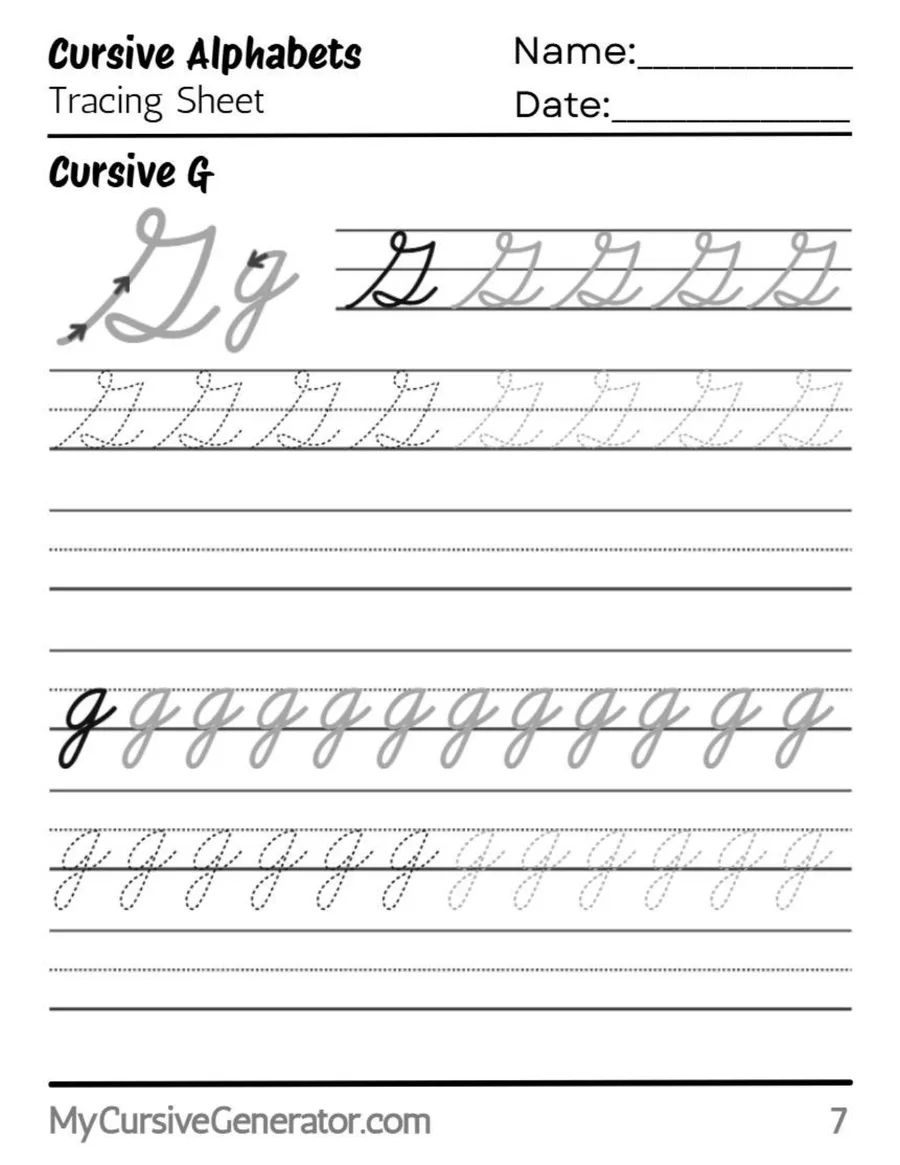
Start with the worksheet before you try cursive G from memory. The sheet shows a large model at the top, then dotted rows to trace, then blank lines for free writing. Trace the small oval first and keep it inside the midline to baseline space. Then trace the descender loop and check that it goes below the baseline by a controlled amount, not all the way to the next line. After two traced rows, cover the model and write one row on your own. Compare that row with the model and fix only the worst part, usually the descender loop. Do not fill a whole page with fast copies of this letter, because a descender loop that crashes into the next line is hard to fix once it becomes a habit.
Before You Start
Use lined paper with a clear top line, midline, and baseline, and leave a blank line below if you can, because the descender loop of cursive G needs space. Sit with your paper tilted a little to the left if you write with your right hand, and a little to the right if you write with your left hand. Hold the pencil about two finger widths above the tip and keep your wrist loose. Cursive G belongs with the wave family in its small form, because small g starts like a, c, d, and o, with an oval, and then adds a descender loop. That link is useful for teaching. If a student can write a steady small a, the next job is only the descender loop.
What Cursive G Looks Like
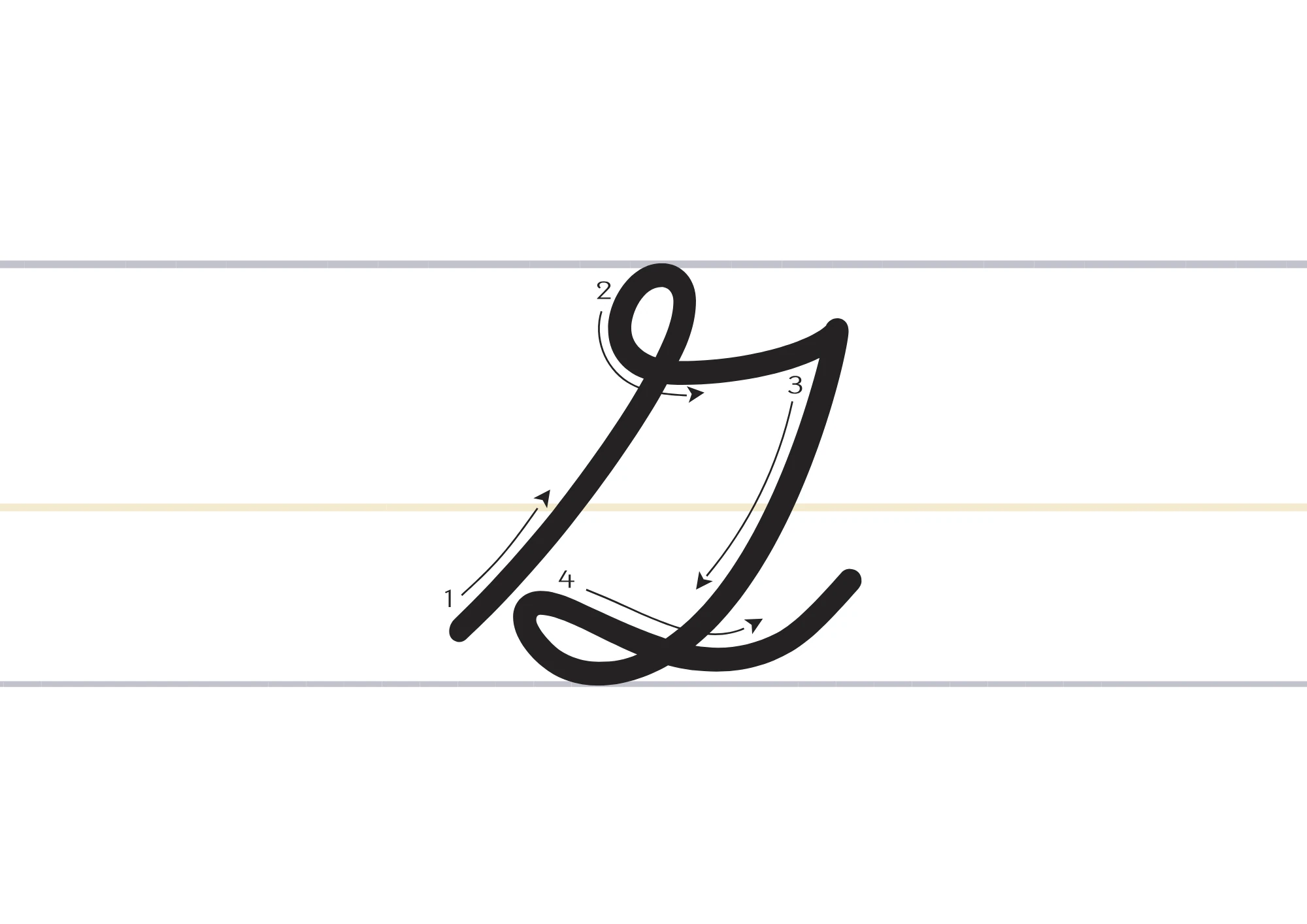
Capital this letter in the model on this page starts at the baseline, rises in a tall stem to a loop at the top line, sweeps across to the right, comes down to the baseline, and finishes with a loop below the baseline that returns to the right. It fills the full height from the top line to below the baseline, and it is wider than the small form. Small cursive g starts with a small oval between the midline and the baseline, then pulls a stem down below the baseline, loops to the left, and returns to the baseline, finishing with a short rise to the right. The key feature of small cursive g is that descender loop below the baseline. If that loop is missing, the letter reads as a, not g, and if that loop is too large, it crashes into the line below.
How to Write Capital Cursive G
Capital cursive G in the model on this page is written in four strokes in the diagram, and the step cards below group those strokes into three teaching steps. The pen lifts between the top loop and the lower loop, which is normal for a capital letter. Do not try to force the capital form into one stroke, because the lower loop will end up in the wrong place.
Rise to the top loop
Start at the baseline and rise in a tall stem to the top line, looping at the top and sweeping across to the right. Keep the top loop open and even, because a pinched top loop makes capital cursive G look like a tall hook.
Come down to the baseline
From the right side of the top loop, come down in a steady curve to the baseline. Keep the curve leaning slightly to the right and do not let it bulge on the right side only.
Loop below the baseline and finish
From the baseline, loop below the line to the left and back up to the baseline, finishing with a short rise to the right. Keep this lower loop controlled and finish it before you start the next letter, so the loop does not drag into the next word.
How to Write Lowercase Cursive g
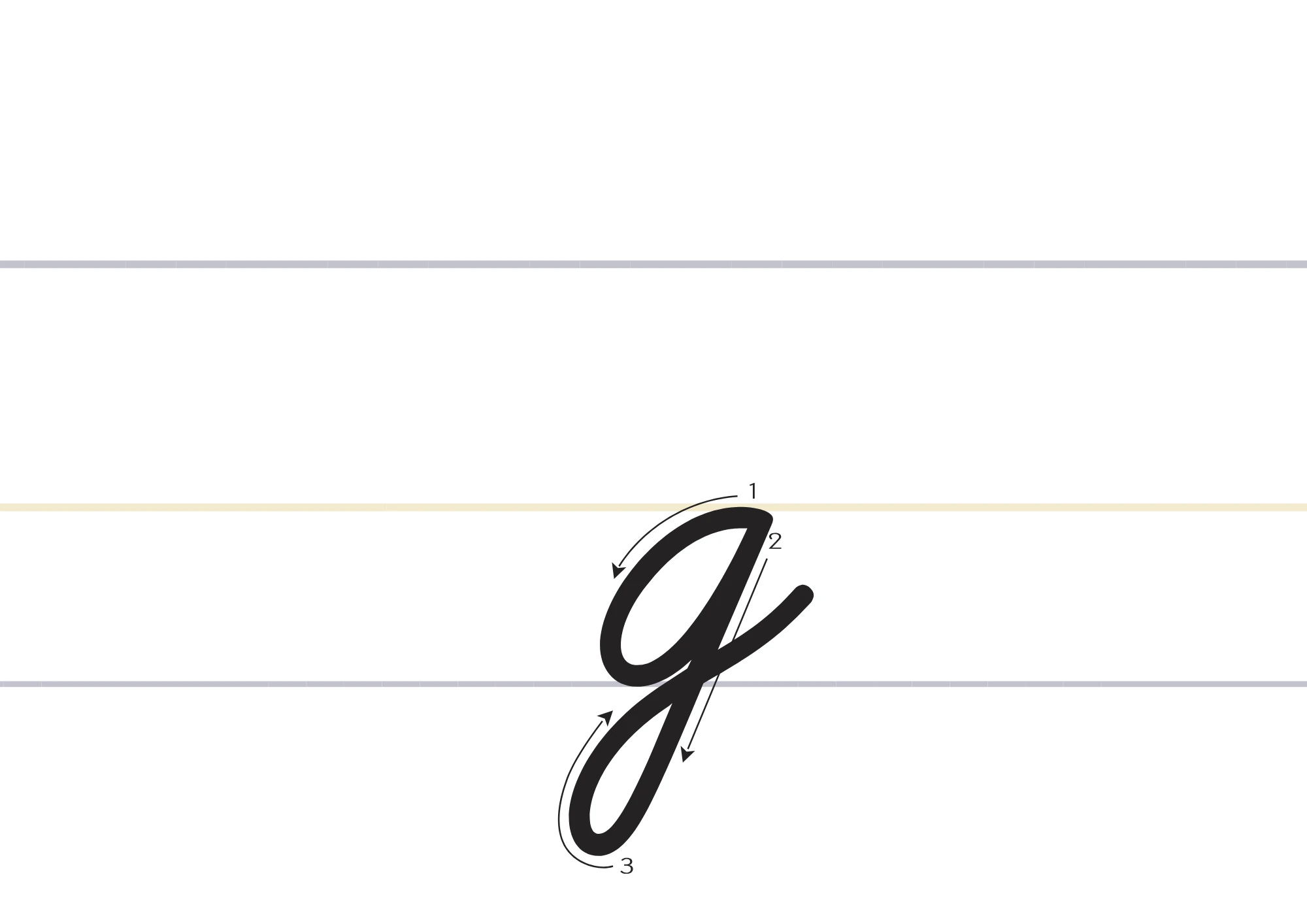
Small cursive g is the form you will use most often, because it appears inside almost every word that contains g. It is written in three motions, an oval, a descender, and a return, and the step cards below follow that order so you can check each part.
Draw the small oval
Start at the midline and draw a small oval down to the baseline and back up to the midline. Keep the oval closed and inside the midline to baseline space, like the oval of small a.
Pull down into the descender loop
From the right side of the oval, pull a stem down below the baseline, loop to the left, and come back up toward the baseline. Keep the descender loop narrow and leaning to the right, not wide like a bowl.
Return to the baseline and rise
Bring the loop back up to the baseline and finish with a short rise to the right. That rise is the exit into the next letter, so do not skip it or make it too long.
How to Write Cursive G: 10-Minute Daily Practice Routine
Ten minutes a day is enough for this letter if you split the time between the oval and the descender loop. Most students need more time on the descender loop than on the oval, because the loop below the line is what makes cursive G readable.
- Warm up for two minutes: draw small ovals between the midline and the baseline, five in a row, all the same size.
- Practice the descender for three minutes: write small g slowly and check that every descender loop goes below the baseline by a controlled amount and returns cleanly.
- Join for three minutes: write ga, ge, go, gi, and gu, one pair at a time, and check that the exit from cursive G stays level after the loop returns.
- Write words for two minutes: write Goat, Grapes, and Garden slowly, then read them back and fix only the worst letter in each word.
Words That Start With G in Cursive
Practice cursive G with short, familiar words first, so you can focus on the oval and the descender loop instead of the spelling. Say each word as you write it, and pause after the first letter to check the loop before you finish the word.
Goat · Grapes · Garden · Girl · Game · Gold
Grace · George · Gabriel · Gavin · Gemma · Grant
Names are useful for this letter because the capital form appears at the start, where it is easy to see. Write Grace and George in a column and compare the capital forms. If one capital loop below the baseline is much larger than the other, the lower loop changed, not the letter itself. For small cursive g in the middle of a word, use words like tiger, sugar, and dragon, because the entry into g from another letter is different from the entry at the start of a word, and the descender loop must still return cleanly to the baseline.
Common Mistakes With Cursive G
- Missing the descender loop. If the stem below the baseline has no loop, small cursive g looks like small a. Loop below the baseline to the left and return to the baseline before you exit.
- Making the descender loop too long. A descender loop that is too long crashes into the line below and makes the page look crowded. Keep the loop compact and return to the baseline promptly.
- Making the small oval too tall. If the small oval rises above the midline, small g looks like a tall letter in the middle of a word. Keep the oval inside the midline to baseline space.
- Drawing cursive G like printed G. A printed G is made of separate curves with no join. In cursive G, the small form ends with a rise that joins to the next letter, and that rise is part of the letter.
- Changing the slant halfway through. A steady, slight slant to the right makes cursive G look neat. A slant that changes inside one letter makes the whole word look shaky.
- Skipping the exit rise. The rise at the baseline is what connects cursive g to the next letter. Skipping it breaks the flow of the word and turns cursive back into print.
How to Join G Cursive Letters
Small cursive g joins from a short rise at the baseline, after the descender loop has returned to the baseline. That rule is the key to cursive G, because the descender loop must be complete before any connector starts. The pairs ga, ge, go, gi, and gu are the best first practice, because each one tests a different next letter shape. Into a and o, keep the rise level and let the next oval start at the midline. Into e, keep the rise short so the small loop of e does not start too high. Into i, use a short connector and add the dot only after you finish the whole word. Capital cursive G usually starts a word, so it does not join from the left. Write the capital, lift the pen, and start the next letter separately, unless your teacher uses a connected capital model.
Joining cursive G to the next letter
Into tall letters, the rule is simple: finish small g at the baseline, then rise into the tall stem of the next letter without a kink. Into l, t, and h, the rise should be smooth and the tall stem should start at the same slant as the g oval. If the rise is too steep, the next tall letter will lean too far to the right. If the rise is too flat, the next tall letter will start too low and look separate. Practice go and ga first, because o and a show the difference between a midline entry and a low entry very clearly. Once those pairs feel steady, add ge and gi, which need a tighter, smaller entry, and then try g in the middle of real words like tiger and sugar.
How to Write G in Cursive: Practice Sentences
Sentences teach spacing and stamina, which single letters cannot teach. Write each sentence three times: once very slowly, once at a normal pace, and once without stopping.
Grace grew grapes in the garden.
George gave the goat some grass.
The girl played a game at noon.
We practice this letter with goat and garden every day.
Letter G in Cursive for Names and Signatures
For a first name that starts with cursive G, keep the capital a little larger and more open than in ordinary writing, because it reads better at a glance and gives the name a clear start. The rest of the name should stay at normal small letter size. For a signature, the same capital can be written faster and looser, but the top loop and the lower loop must stay visible. If a signature loses the lower loop, it reads as a tall C, so slow it down until the loop returns, then build speed back up.
Teaching Cursive G to a Child
Teach small cursive g before capital this letter, because the small form appears in almost every word and pays off right away. Let the child trace the oval first, then add the descender loop, then write the whole letter from memory. Keep sessions short, ten minutes a day, and praise the finished descender loop before you correct anything else. A useful check is to write g and a side by side and ask which one goes below the baseline. That one question teaches the key rule of cursive G faster than a long list of rules. For a child who writes with the left hand, tilt the paper a little to the right and move the paper, not just the hand, as the line goes on, so the hand does not cover the part of the letter that still needs checking.
Cursive G, Frequently Asked Questions
What does cursive G look like?
Capital cursive G is a tall looped shape with a loop below the baseline, from the top line to below the baseline. Small cursive g is a small oval between the midline and the baseline, with a descender loop below the baseline.
How do you write small cursive g?
Draw a small oval between the midline and the baseline, pull a stem down below the baseline, loop to the left, return to the baseline, and finish with a short rise to the right into the next letter.
Why does my cursive g look like an a?
Your descender loop is missing or too short. Loop below the baseline to the left and return to the baseline before you exit, so the loop is clearly visible.
How do you join cursive G to the next letter?
Small cursive g joins from a short rise at the baseline, after the descender loop returns. Practice ga, ge, go, gi, and gu first. Capital this letter usually starts a word, so write it, lift the pen, and start the next letter separately.
Should I learn capital or small cursive G first?
Learn small cursive g first, because it appears inside words far more often. Once the oval and the descender loop feel easy, the capital form takes only a short session, because it uses the same loop idea at a larger size.
What words can I practice with cursive G?
Start with Goat, Grapes, Garden, and Girl, then try names like Grace, George, and Gabriel. For g in the middle of a word, try tiger, sugar, and dragon.
How do I teach cursive G to a child?
Start with the small form, trace the oval, add the descender loop, then write it from memory. Keep sessions to ten minutes and praise the finished descender loop first. Compare g and a side by side to teach the key rule.
See Your Name in Cursive
Type any name or word and convert it into beautiful cursive text you can copy anywhere, free, with no sign-up.
Open the Cursive Generator