
Home › Cursive Alphabet › Cursive C
Cursive C: How to Write the Letter C in Cursive
This letter is an open curve, not a closed oval. In the letter, the capital form is a tall open crescent that runs from the top line to the baseline, and the small form is the same crescent at half the height, between the midline and the baseline. Learn that open shape first, and this letter becomes one of the easiest letters in the alphabet to write well.
Cursive script is a style of handwriting in which the letters of a word are joined together, and the letter is a good test of the control you built on earlier letters. It rewards a steady slant, a calm hand, and attention to where each stroke starts and stops on the lines.
Trace the Cursive Letter C
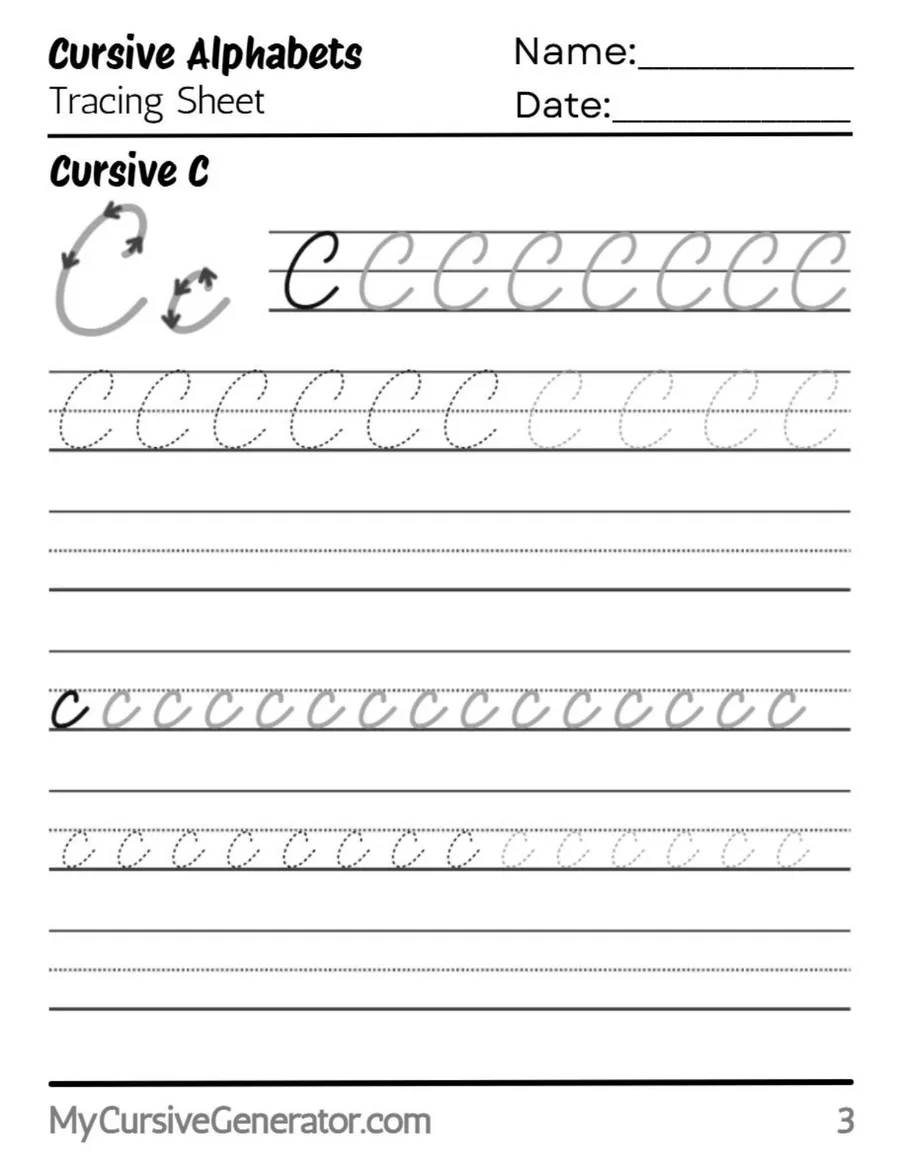
Start with the worksheet before you try the letter from memory. The sheet shows a large model at the top, then dotted rows to trace, then blank lines for free writing. Trace the open crescent slowly and stop where the model stops. Do not close the right side to make an oval, and do not flatten the curve into a straight line. After two traced rows, cover the model and write one row on your own. Compare that row with the model, circle the best crescent, and repeat only the part that went wrong. That short loop, trace, write, compare, is more useful than filling a whole page with rushed copies of this letter.
Before You Start
Use lined paper with a clear top line, midline, and baseline. Sit with your paper tilted a little to the left if you write with your right hand, and a little to the right if you write with your left hand. Hold the pencil about two finger widths above the tip and keep your wrist loose. A tight grip is the most common reason cursive C looks shaky, because the hand tries to force a curve instead of letting it swing. Cursive C belongs to the wave family, with a, d, g, o, and q, so if you can write a smooth lowercase a, you already know the first motion of this letter. The difference is that cursive C stops early. It never closes, and that open right side is what lets the next letter enter the word.
What Cursive C Looks Like
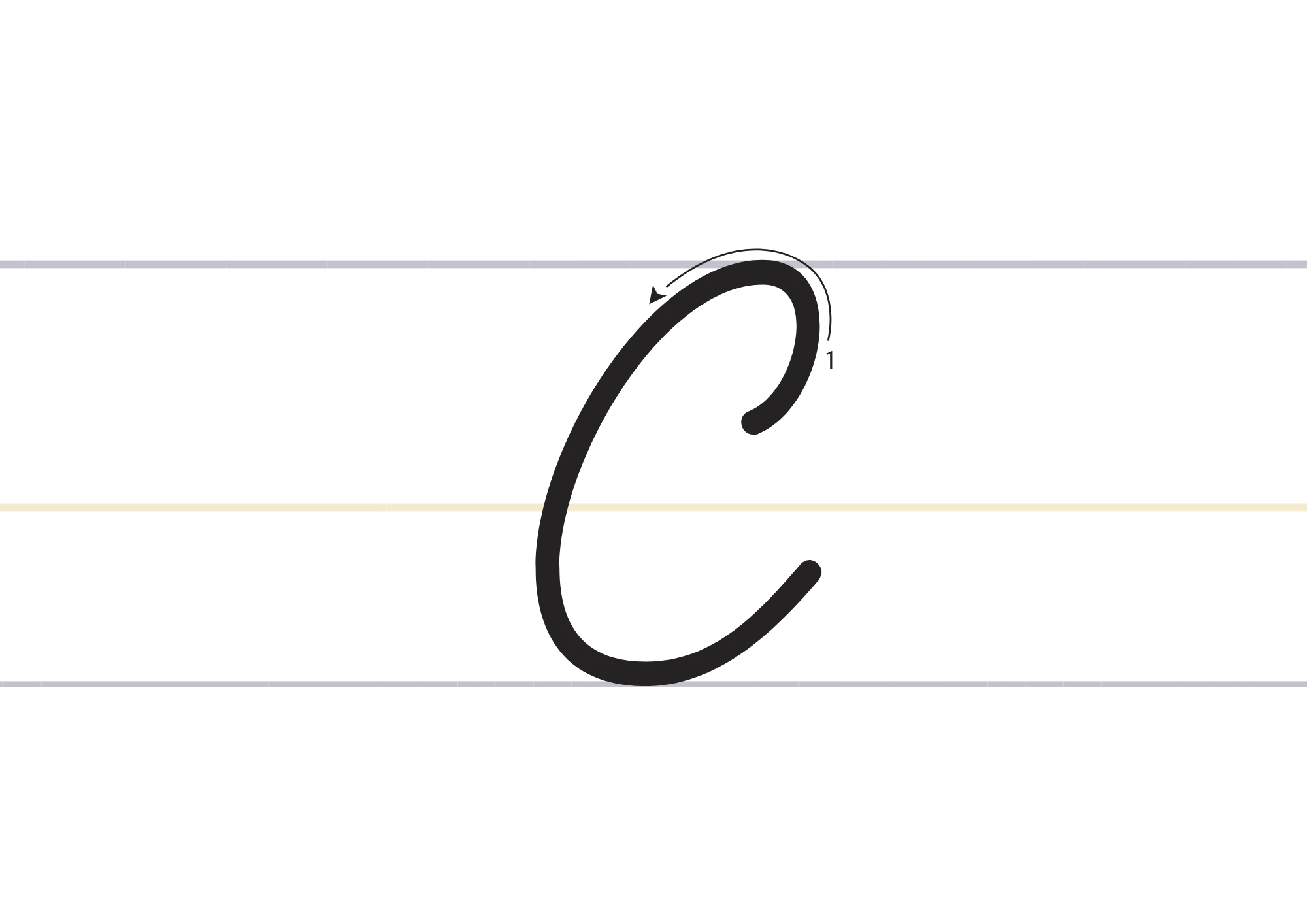
Capital cursive C starts near the top line on the right, sweeps left and down in a wide curve, touches the baseline, and finishes by curving up to the right, still open. It is about twice the height of the small form. Small cursive c starts near the midline on the right, makes the same sweep at a smaller size, and finishes at the baseline with a short rise to the right. Both forms lean slightly to the right, and both stay open on the right side. The width matters as much as the height. A narrow this letter looks like a tall hook, and a wide cursive C looks like a shallow bowl. Aim for a width that is a little more than half the height.
How to Write Capital Cursive C
Capital cursive C is one continuous stroke. The three steps below are three phases of that one stroke, not three separate strokes. Keep the pen on the paper from the first undercurve to the final rise, and do not lift it in the middle to fix the shape.
Enter from the right
Start just below the top line on the right side and make a short undercurve to the left. This small entry sets the slant and gives the main curve a smooth start instead of a sharp point.
Sweep the main crescent
Continue left and down in one wide curve to the baseline, keeping the curve even from top to bottom. Do not pinch the curve at the middle and do not let it bulge on the left side only.
Finish open at the baseline
Curve up from the baseline toward the right and stop while the letter is still open. End with the pen pointing right at about midline height in your mind, ready for the next letter, without closing the crescent into an oval.
How to Write Lowercase Cursive c
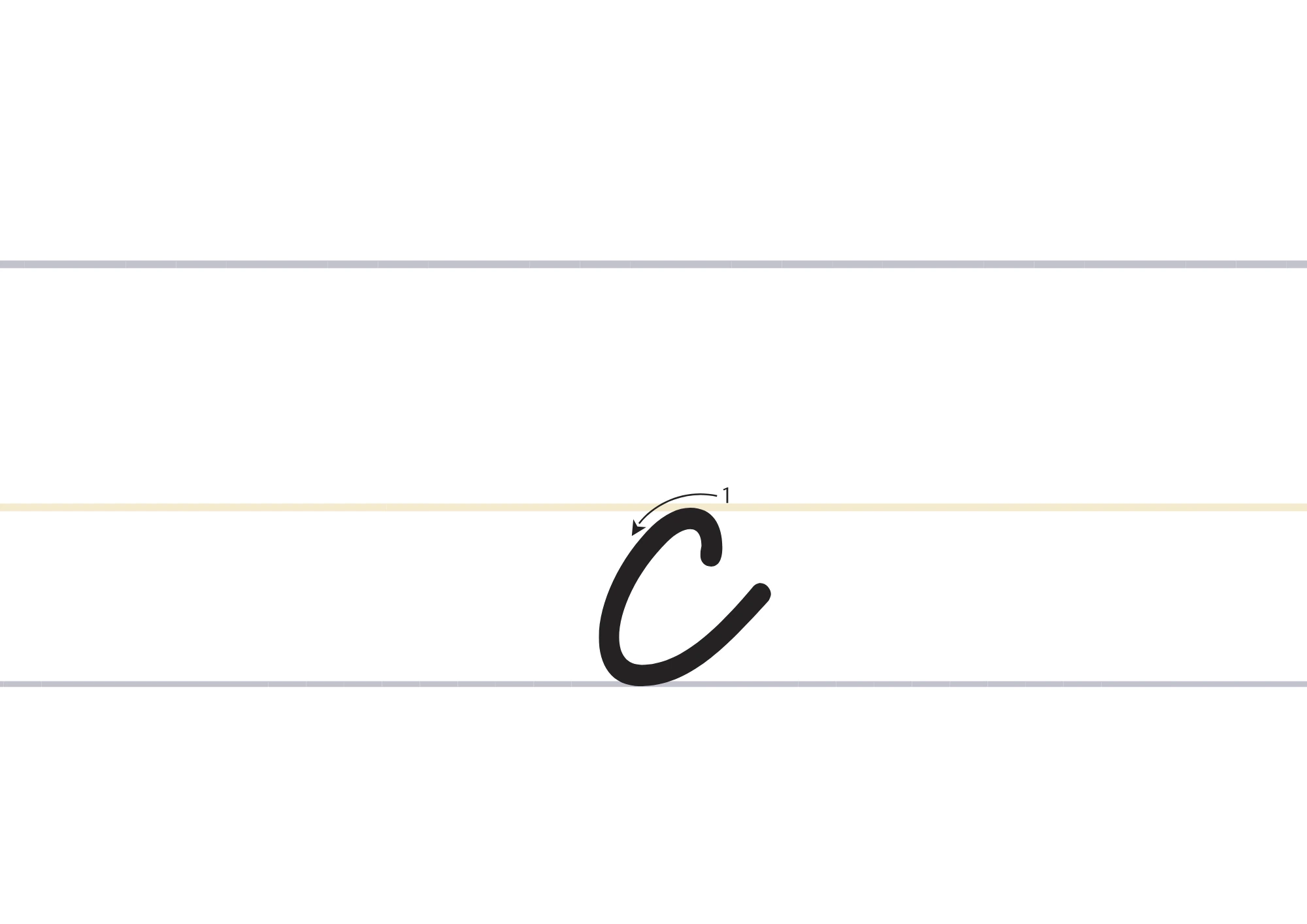
Small cursive c uses the same motion at half the size. It is written between the midline and the baseline, and it is the form you will use most often, because it appears inside words far more often than the capital form.
Enter at the midline
Start just below the midline on the right and make a short undercurve to the left. Keep this entry small, because a large entry will push the whole letter above the midline.
Sweep the small crescent
Continue left and down to the baseline in one even curve. Match the shape of capital this letter, but keep the height inside the midline to baseline space.
Stop open and rise
Curve up from the baseline to the right and stop while the letter is still open. Finish at a height that lets the next letter start without a jump or a gap.
How to Write Cursive C: 10-Minute Daily Practice Routine
Ten minutes a day is enough for cursive C if every minute has a job. Do not fill a page with fast, careless crescents and call it practice. Slow, checked rows build the shape, and speed follows on its own after a few days.
- Warm up for two minutes: draw the open crescent in the air, then on paper, five times large and five times small, with no words yet.
- Trace for three minutes: trace one row on the worksheet, then write the same row without tracing, and circle the crescent that best matches the model.
- Join for three minutes: write ca, ce, ci, co, and cu, one pair at a time, and check that the exit from cursive C stays at the same height each time.
- Write words for two minutes: write Cat, Cake, and Come slowly, then read them back and fix only the worst letter in each word.
Words That Start With C in Cursive
Practice cursive C with words you already know, so your brain can focus on the shape instead of the spelling. Say each word as you write it, and pause after the first letter to check the open crescent before you finish the word.
Cat · Cake · Cup · Cow · Car · Corn
Clara · Caleb · Chloe · Colin · Cara · Cyrus
Names are useful for this letter because the capital form appears at the start, where it is easy to see. Write Clara and Caleb in a column and compare the capital forms. If one capital is taller than the other, the slant or the start point changed, not the letter itself. For small cursive c, use words with c in the middle, such as ice, face, and school, because the entry into c from another letter is different from the entry at the start of a word.
Common Mistakes With Cursive C
- Closing cursive C into an o. If the finishing curve reaches the start point, cursive C becomes o. Stop the curve early and leave a clear gap on the right side, wide enough to fit a pencil tip.
- Starting small cursive c too high. A small c that reaches the top line looks like a capital in the middle of a word. Start small cursive c at the midline, not at the top line.
- Making cursive C too narrow. A narrow crescent looks like a hook and is hard to read in a word. Widen the curve until the width is a little more than half the height.
- Flattening the bottom. If the bottom of cursive C is flat, the letter looks like a bowl. Keep the bottom rounded and let it touch the baseline at one smooth point.
- Lifting the pen inside the crescent. A lift in the middle of cursive C leaves a visible break and a sharp corner. Keep the pen down for the whole crescent and lift only after the finishing rise.
- Joining too low into the next letter. If the exit from cursive C drops to the baseline, the next letter starts too low and the word looks broken. Exit at mid height, then glide into a, e, o, or u without a jump.
How to Join C Cursive Letters
Cursive C joins from its open right side, not from a closed loop. That is why the exit height matters more for cursive C than for many other letters. If you exit too high, the next letter starts above the midline. If you exit too low, the next letter starts on the baseline and looks separate. The safest exit is a short, level glide at about the middle of the small letter space. From there, a and o accept the glide easily because they start with a curve. The letter e also accepts it well, but keep the glide level so the small loop of e does not collide with the end of this letter.
Joining cursive C to the next letter
Into tall letters, the rule changes a little. Into l or t, lift the exit slightly so the tall stem starts cleanly, without a kink at the join. Into h, keep the glide short and let the tall loop of h do the work. Into i, use a short connector and add the dot only after you finish the whole word. That last point is important for beginners, because dotting i in the middle of a word breaks the flow and often pulls the next letter out of line. Practice the pairs ca, ce, co, and cu first, then add ci, cl, and ch once the basic glide feels steady.
How to Write C in Cursive: Practice Sentences
Sentences teach spacing and stamina, which single letters cannot teach. Write each sentence three times: once very slowly, once at a normal pace, and once without stopping.
Clara caught a cat in the garden.
Caleb cooked corn for lunch.
The cow came home at noon.
We practice cursive C with cat and cake every day.
Read each sentence back and check three things: is every cursive C still open, is every small c the same height, and does the exit from each c lead smoothly into the next letter? Circle the best sentence in each set of three and try to beat it next time.
Letter C in Cursive for Names and Signatures
For a first name that starts with this letter, keep the capital a little larger and more open than in ordinary writing, because it reads better at a glance and gives the name a clear start. The rest of the name should stay at normal small letter size. For a signature, the same capital can be written a little faster and looser, but the open crescent must stay visible. If a signature turns into a closed oval, slow it down until the opening returns, then build speed back up. Names like Clara, Caleb, and Chloe are good signature practice because they pair a clear capital cursive C with simple small letters after it.
Teaching Cursive C to a Child
Teach small cursive c before capital cursive C, because the small form appears in almost every word and pays off right away. Let the child trace the open crescent first, then copy it beside the model, then write it from memory. Keep sessions short, ten minutes a day, and praise the open right side before you correct anything else. A useful game is to ask the child to spot the closed ones: write five crescents, close one on purpose, and ask which one is not this letter. That game teaches the key rule of cursive C faster than a long lecture about shape. For a child who writes with the left hand, tilt the paper a little to the right and move the paper, not just the hand, as the line goes on, so the hand does not cover the part of the letter that still needs checking.
Cursive C, Frequently Asked Questions
What does cursive C look like?
Cursive C is an open crescent, like an oval that never closes. The capital form runs from the top line to the baseline, and the small form runs from the midline to the baseline, with a clear opening on the right side.
How do you write cursive C in one stroke?
Start with a short undercurve on the right, sweep left and down in one wide curve to the baseline, then curve up to the right and stop while the letter is still open. Keep the pen on the paper for the whole crescent.
Why does my cursive C look like an o?
Your finishing curve is going too far and closing the gap. Stop earlier, leave a gap wide enough for a pencil tip, and check the opening before you start the next letter.
How do you join cursive C to the next letter?
Exit from the open right side with a short level glide at mid height. That glide leads into a, e, o, and u easily. Into l or t, lift the glide slightly so the tall stem starts cleanly.
Should I learn capital or small cursive C first?
Learn small cursive c first, because it appears inside words far more often. Once the small crescent feels easy, the capital form takes only a short session, because it is the same motion at a larger size.
What words can I practice with cursive C?
Start with Cat, Cake, Cup, Cow, and Car, then try names like Clara, Caleb, and Chloe. For c in the middle of a word, try ice, face, and school.
How do I teach cursive C to a child?
Start with the small form, trace the open crescent, copy it, then write it from memory. Keep sessions to ten minutes and praise the open right side first. Use a spot the closed one game to teach the key rule.
Is cursive C the same as a printed C?
No. A printed C is a separate curve with no join. In this letter, the open right side ends with a glide that leads into the next letter, which is what makes it part of a connected word.
See Your Name in Cursive
Type any name or word and convert it into beautiful cursive text you can copy anywhere, free, with no sign-up.
Open the Cursive Generator