
Home › Cursive Alphabet › Cursive J
Cursive J: How to Write the Letter J in Cursive
Cursive J is the letter that drops below the line on purpose. Its capital starts high, loops at the top, and swings into a loop under the baseline. Its small form is shorter at the top, yet it makes the same drop, and it waits for its dot until the word is done.
Cursive script joins the letters of a word together, and cursive J shows why line control matters. One letter must stay tall at the top, short in the middle, and deep at the bottom, all in one movement. Once a learner controls that range, the rest of the alphabet gets easier.
Trace the Cursive Letter J
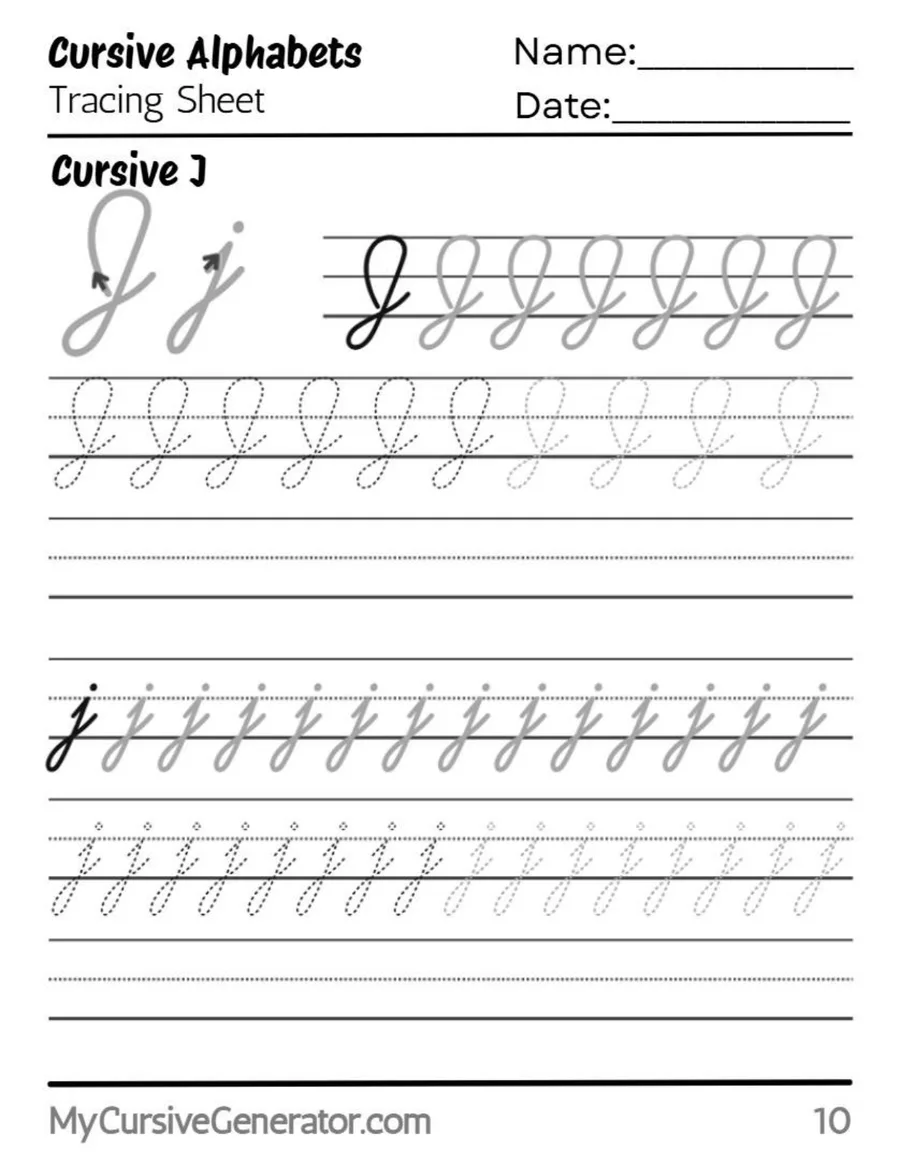
Start on the worksheet, not on blank paper. Trace the capital of cursive J first, watching the top loop stay narrow. Then trace the small form, watching how little height it needs above the baseline. The drop below the baseline is shared, so the two forms should look like family.
Use three passes: trace the model slowly, copy it beside the model, then write it from memory inside a short word. Do not add the dot during these passes, only after the whole word is finished.
Before You Start
Name the three lines before you write: the top line, the ceiling for the capital; the midline, usually dashed, the ceiling for the small form; and the baseline, the floor where most letters sit. The descender space below it is where the loop of cursive J belongs. A small form that rises to the top line is too tall, and a capital that stops at the midline is too short.
Hold the pencil loosely, about two finger widths above the tip, and keep the wrist relaxed. A tight grip makes the loop below the baseline stiff and flat. Tilt the paper slightly left if you write with your right hand, or slightly right if you write with your left hand, and keep one gentle slant to the right.
What Cursive J Looks Like in Real School Writing
In school writing, cursive J is a descender letter. A real part of it lives below the baseline, unlike most small letters, which sit on the baseline. The capital is a tall loop at the top with a long drop and a loop underneath. The small form is a short stem with the same drop and loop underneath, plus a dot above the midline.
Both forms lean slightly right, and both end at the baseline with a connector that moves right into the next letter. That ending is what makes cursive J cursive. A printed J stands alone, while a cursive J is built to keep moving.
J Cursive: Why It Is Not a Capital I
This confusion trips up more readers than any other point about cursive J. A capital I in school cursive is a tall, narrow loop that starts at the baseline and ends at the baseline. A capital J starts with a loop at the top too, but then it keeps going below the baseline into a loop down there. That lower loop is the sign that the letter is J, not I.
When a writer makes the capital I loop too wide, or lets it slip below the baseline, a reader can easily read it as J. When a writer makes a capital J loop too shallow, or stops it at the baseline, a reader can easily read it as I. Keep I inside the top line and baseline, and let cursive J go clearly below the baseline every time.
How to Write Capital Cursive J
Capital cursive J is one continuous movement. Do not lift the pen, and do not draw the top loop and lower loop as two separate shapes. The hand starts high, loops, drops, loops again below the line, and comes back up to join the next letter.
Loop at the Top
Start near the top line and form a tall, narrow loop for cursive J. Curve left at the top, then come back down close to the rising stroke. Keep it slim, because a wide top loop makes the letter look heavy.
Drop and Loop Below the Baseline
Without lifting the pen, carry the stroke past the baseline and curve left into a loop below the line. This lower loop is wider than the top loop, and it should swing back toward the center, not drift far left.
Return Up and Connect
From the lower loop, return up to the baseline and curve right. This connector is the end of the same stroke, and it should leave at a gentle angle, ready to enter the next letter.
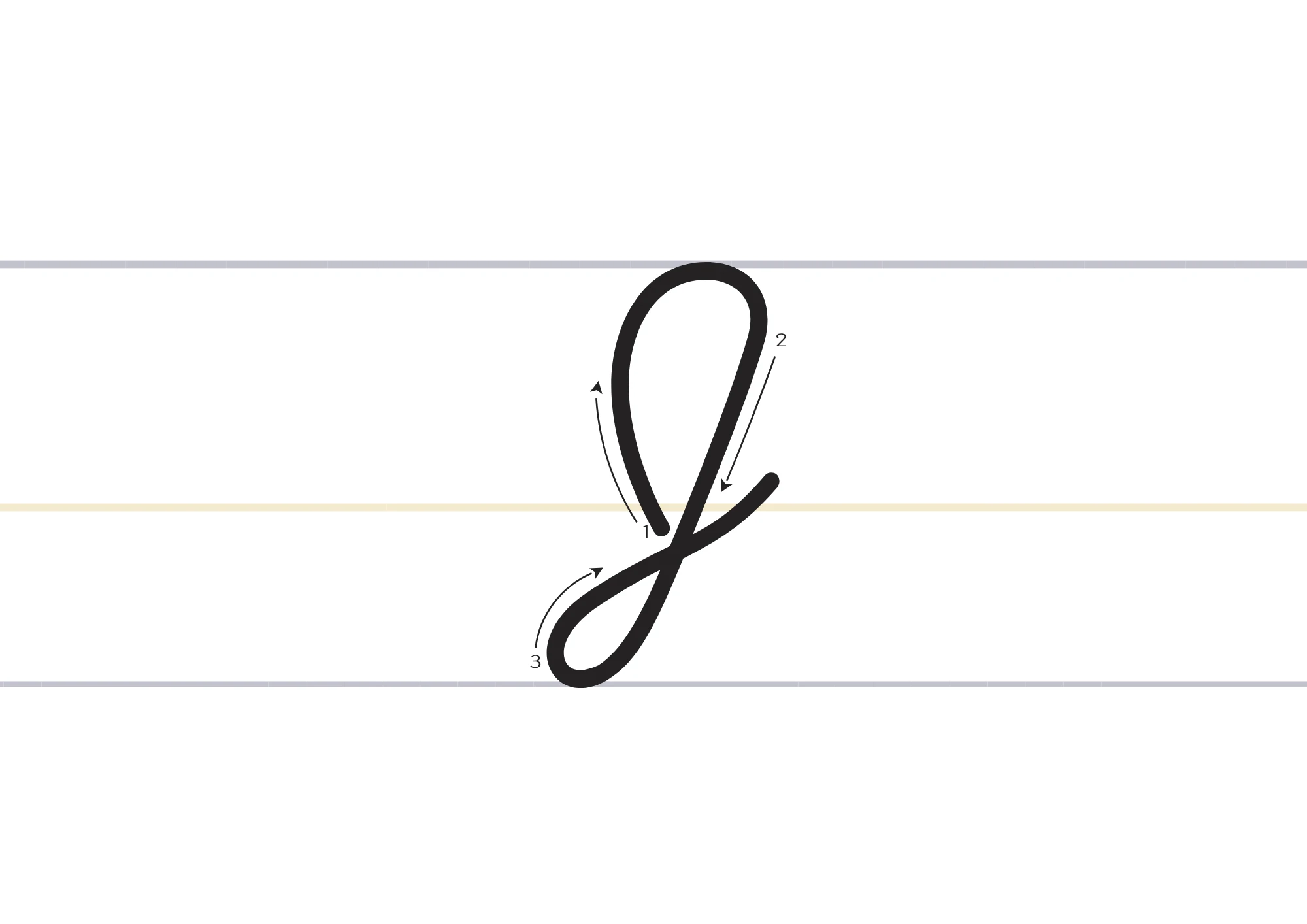
Check the finished capital: does the top loop reach the top line, does the lower loop drop clearly below the baseline, and does the connector leave to the right without a sharp corner? If any answer is no, trace again at half speed. Capital cursive J rewards a slow hand.
How to Write Lowercase Cursive J
The small form of cursive J is the form you will use most often, in words such as jump and enjoy. It uses the same drop and lower loop as the capital, but it begins at the midline, not at the top line, and that height difference keeps it readable as a small letter.
Stem Down From the Midline
Start at the midline and draw a short stem past the baseline for cursive J. Keep it slanted gently right and short above the baseline. A stem that rises above the midline will look like a tall letter, not a small j.
Loop to the Left Below the Baseline
Carry the stem below the baseline and curve left into a loop, just as the capital does. Keep it about the same depth as the capital loop, so the two forms look related.
Return Up and Connect
From the lower loop, return up to the baseline and curve right into the next letter. Do not stop or lift the pen here. The connector is part of the same stroke, and it keeps the word joined.
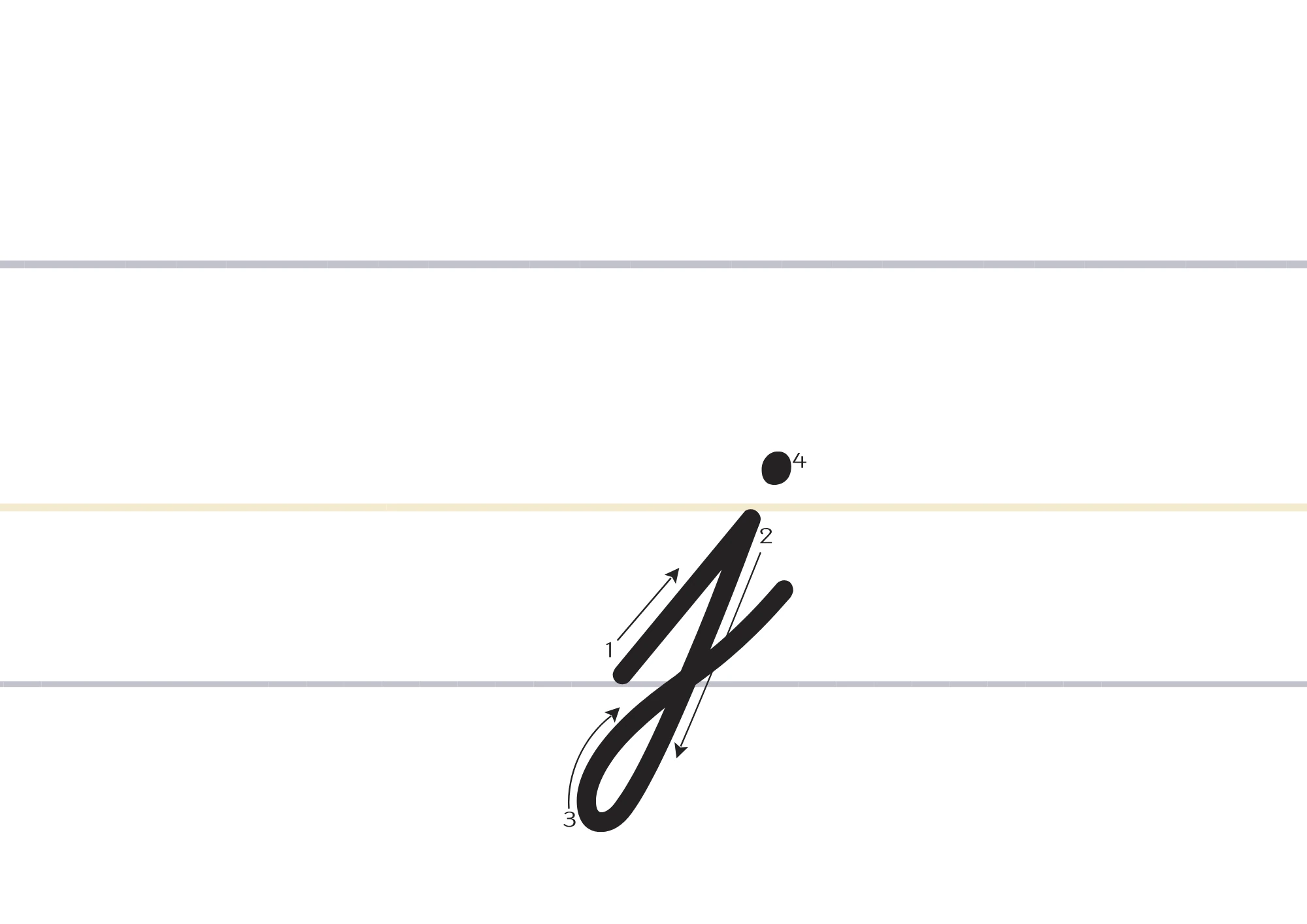
The dot is not part of these three phases. Finish the whole word first, then return to the small form of cursive J and place a small dot just above the midline, centered over the stem.
Letter J in Cursive: Size, Lines, and the Descender Loop
Size is where most cursive J pages go wrong, because the two forms share a bottom but not a top. The capital rises to the top line, the small form only to the midline, and both drop below the baseline by roughly the same amount. Remember that pattern and the letter stays clear.
For descender depth, drop the loop about as far below the baseline as a tall letter rises above it, and keep it in its own space. A loop too shallow looks like a hook. A loop far too deep eats into the line below. Aim for a loop that is easy to see, closed at the turn, and clear of the next line.
J in Cursive: Joining Pairs That Actually Appear in Words
The small form joins on both sides, because it usually sits inside a word. It enters at the baseline, drops into its loop, returns to the baseline, and exits right. The capital joins only on the right, because it usually starts a word, and its connector should enter the next letter without a lift.
Good pairs to practice first are ja, je, ji, jo, and ju. These drills for cursive J matter, because they start real words: jam, jet, jingle, joy, and jump. Write each pair slowly and watch the connector itself. It should leave the baseline at the same gentle angle every time.
Joining into a vowel needs care. In ja and jo, the connector should rise to the midline and enter the oval of a or o without pulling that oval down. If the connector stays too low, the oval sinks below the baseline. Lift the connector to the midline first, then let the oval close at normal height.
How to Write J in Cursive: 10-Minute Daily Practice Routine
A short daily routine works better than one long session. Ten focused minutes a day, for a week, is enough to make cursive J feel steady. Use a lined notebook and keep the pen moving slowly.
- Warm-up loops (2 minutes): draw the lower loop five times slowly, keeping each loop the same depth and slant.
- Capital form (2 minutes): write the capital five times, checking that the top loop stays narrow and the lower loop drops clearly below the baseline.
- Small form in pairs (3 minutes): write ja, je, ji, jo, and ju twice each, dotting each small form only after the pair is finished.
- Words (2 minutes): write jam, joy, and jump slowly, joining every letter without lifting the pen, and watch the connector into each vowel.
- Quick check (1 minute): compare your last row with your first. Are the tops at the right lines and the loops the same depth? If a row looks shaky, slow down rather than pressing harder.
Repeat it tomorrow. The goal is not a perfect page on day one, it is a steadier hand by the end of the week.
How to Write Cursive J in Words and Names
Practice these common J words. Read them, trace them, then write them on your own:
January · jam · joy · jump · jet · jungle
James · Julia · Jason · Jack · Jade · Jasmine
Names show why the capital of cursive J matters. James, Julia, and Jason all open with the same tall loop and deep drop, so a reader should spot the name at a glance. Keep the capital a little larger and more open, then bring the rest of the name back to normal size. A small j inside a longer name still waits for its dot until the name is finished.
Try these sentences three times each: slowly, at normal pace, and without stopping. James jumped for joy in January. Julia made jam in June. Jason kept the jet toy in a jar. Then read back each sentence of cursive J and check the joins and slant.
See these words in copyable cursive text with our cursive generator, or go back to the full cursive alphabet chart.
Common Mistakes With Cursive J
- Stopping the capital at the baseline. A capital of cursive J with no loop below the baseline reads as I, not J. Drop clearly below the line every time.
- Making the small form too tall. A small stem that reaches the top line looks like a tall letter. Stop the stem at the midline, every time.
- Flattening the lower loop. If the loop below the baseline is flattened or left open, the letter looks like a hook. Close the turn and swing back toward the center.
- Dotting in the middle of a word. Stopping to dot breaks the flow, and the dot often lands over the wrong stem. Finish the word, then dot.
- Pulling the next oval down. In ja and jo, a connector that stays too low drags the vowel oval below the baseline. Lift the connector to the midline before the oval closes.
- Changing the slant inside one word. A stem that leans left while the next stem leans right makes the whole word look shaky. Keep one gentle rightward slant for every stem in the word.
Dot Timing for Lowercase j
Dot timing is a separate skill from shape, and it is easy to get wrong because print writing teaches the opposite habit. In print, you dot the j as soon as you write it. In cursive J, you do not. You write the stem, loop, and connector, keep moving, and only when the word is complete do you go back and dot.
If a word has more than one dotted letter, dot them from left to right after the word is done, keeping each dot light and round, centered over its stem. Practice first in jam and joy, where cursive J needs only one dot.
When Cursive J Keeps Breaking
If the capital keeps looking like I, the problem is depth. Drop the lower loop further below the baseline. If the small form keeps looking tall, the problem is height. Place a ruler along the midline for one row and stop every stem at that edge. If dots land in the wrong place, the problem is timing. Write the word, look at it, then dot from left to right.
Cursive J, Frequently Asked Questions
What does the letter J look like in cursive?
The capital form of cursive J is a tall loop at the top with a stroke down below the baseline into a leftward loop, returning up to the baseline with a rightward connector. The small form is a short stem from the midline down below the baseline into a leftward loop, with a dot added after the word.
Why does capital J look like capital I in cursive?
Because both start with a loop at the top, and a shallow cursive J can read as I. Cursive J drops below the baseline and loops there, while a capital I ends at the baseline. Make that lower loop clear.
When do you dot a lowercase j in cursive?
After the whole word is finished, in cursive J writing. Write the stem, loop, and connector, keep moving through the word, then place a small dot just above the midline, centered over the stem.
Is cursive J hard to learn?
No, cursive J is straightforward once you separate height at the top from depth below the baseline. Practice the capital loop alone, then the small stem in short pairs, then words such as jam and joy.
How do you join cursive J to the next letter?
Both forms of cursive J return to the baseline and curve right into the next letter. Start with ja, je, ji, jo, and ju. In ja and jo, lift the connector to the midline so the vowel oval does not sink.
What words can I practice with cursive J?
Start with January, jam, joy, and jump, then try James, Julia, and Jason. Writing your own name is the best motivation, so type it into our cursive generator to see it first.
Should I learn the capital or the lowercase form first?
Start with the small form of cursive J. It appears inside many words, so it pays off quickly, while the capital is needed mainly at the start of sentences and names. Once the small form feels easy, the capital takes only a short session.
What is the difference between cursive J and print J?
A print J is made of separate strokes that do not join. Cursive J is made in one flowing movement, with a lower loop and a connector to the next letter. That connector lets letters connect into words.
See Your Name in Cursive
Type any name or word and convert it into beautiful cursive text you can copy anywhere, free, with no sign-up.
Open the Cursive Generator