
Home › Cursive Alphabet › Cursive M
Cursive M: How to Write the Letter M in Cursive
Learning cursive M gives your hand a steady, repeating rhythm. The capital form fills the full writing space, while the small form stays low and quick. Once the arches are even and the heights true, words such as mom, milk, and moon start to flow.
Cursive script joins the letters inside a word, and cursive M is a strong early test of that skill. It repeats one movement: rise, curve over, and come back down to the baseline. That repetition teaches height, width, and slant at the same time, and it rewards a slow hand, because a rushed second arch usually spoils the letter.
Trace the Cursive Letter M
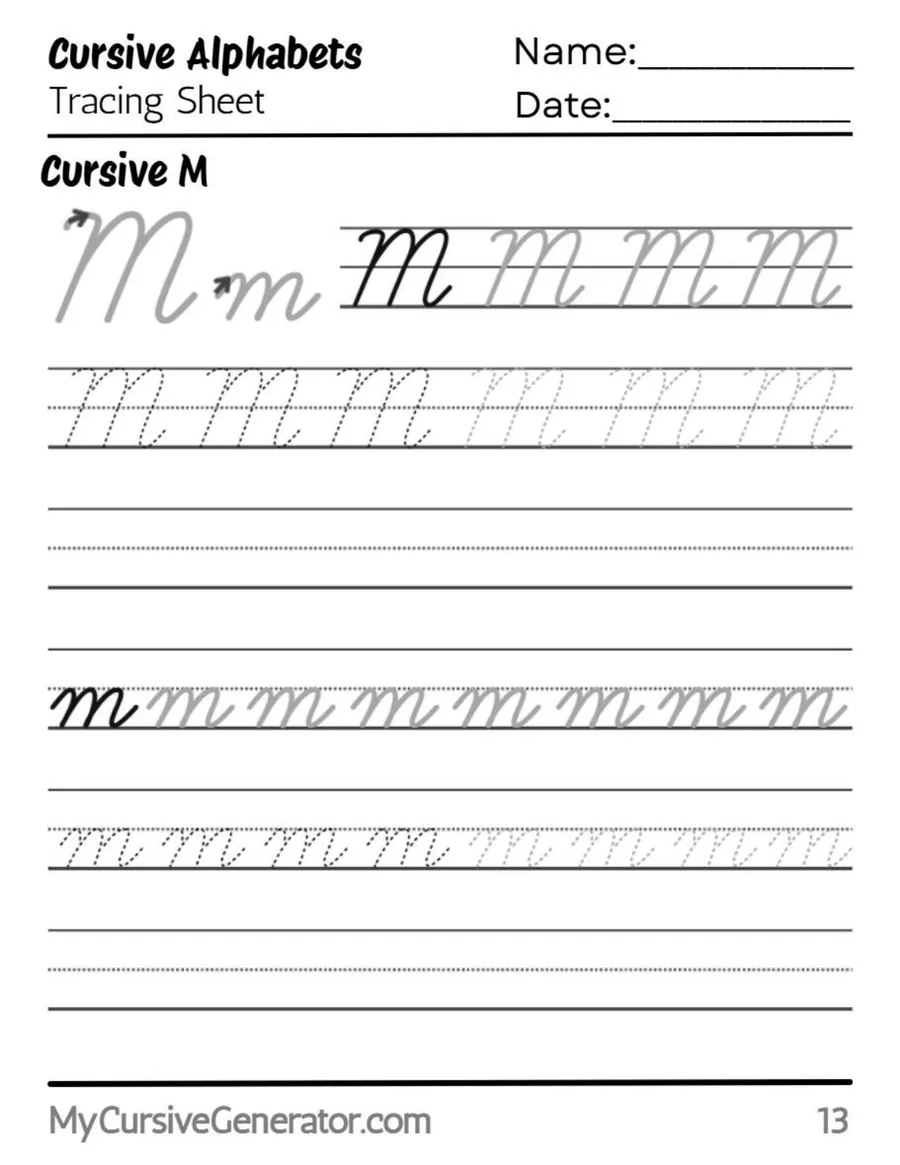
Start on the worksheet, not on a blank page. Trace the capital form first and watch the top line, then trace the small form and watch the midline. Say the movement as you trace it: up, down, up over, down, connect.
Use the worksheet in three passes: trace, copy beside the model, then write from memory in mom. If the arches drift, go back to tracing for one more row.
Before You Start Writing M in Cursive
Name the three lines before you write. The top line is the ceiling for the capital form, the midline, usually dashed, is the ceiling for the small form, and the baseline is the floor where both forms land. A short capital looks unsure, and a small form that climbs past the midline crowds the line above it.
Hold the pencil loosely, about two finger widths above the tip, with a relaxed wrist. Tilt the paper slightly to the left if you write with your right hand, or slightly to the right if you write with your left hand. Keep one gentle rightward slant for every downstroke.
How to Write M in Cursive, Step by Step
Both forms of cursive M are one continuous movement. Do not lift the pen in the middle of the letter. The steps below divide that movement into phases, but on paper the pen should keep moving to the connector.
How to Write Capital Cursive M
Capital cursive M is full height, with an entry curve and two arches. It starts low, climbs to the top line, then repeats a rise and fall twice. Give it room, because it is wider than most capitals.
Entry Curve and First Downstroke
Start at the baseline with a small entry curve. Sweep up to the top line, then pull down to the baseline, landing firmly before you rise again.
First Arch to the Baseline
Without lifting the pen, rise into the first arch. Curve over at the top line, then come back down to the baseline, keeping this arch about as wide as the second arch.
Second Arch and Light Connector
Rise into the second arch, touch the top line, and come down to the baseline. Then add a short, light connector. In many school models, capital M ends with a light pause before the next letter, so do not force a heavy join.
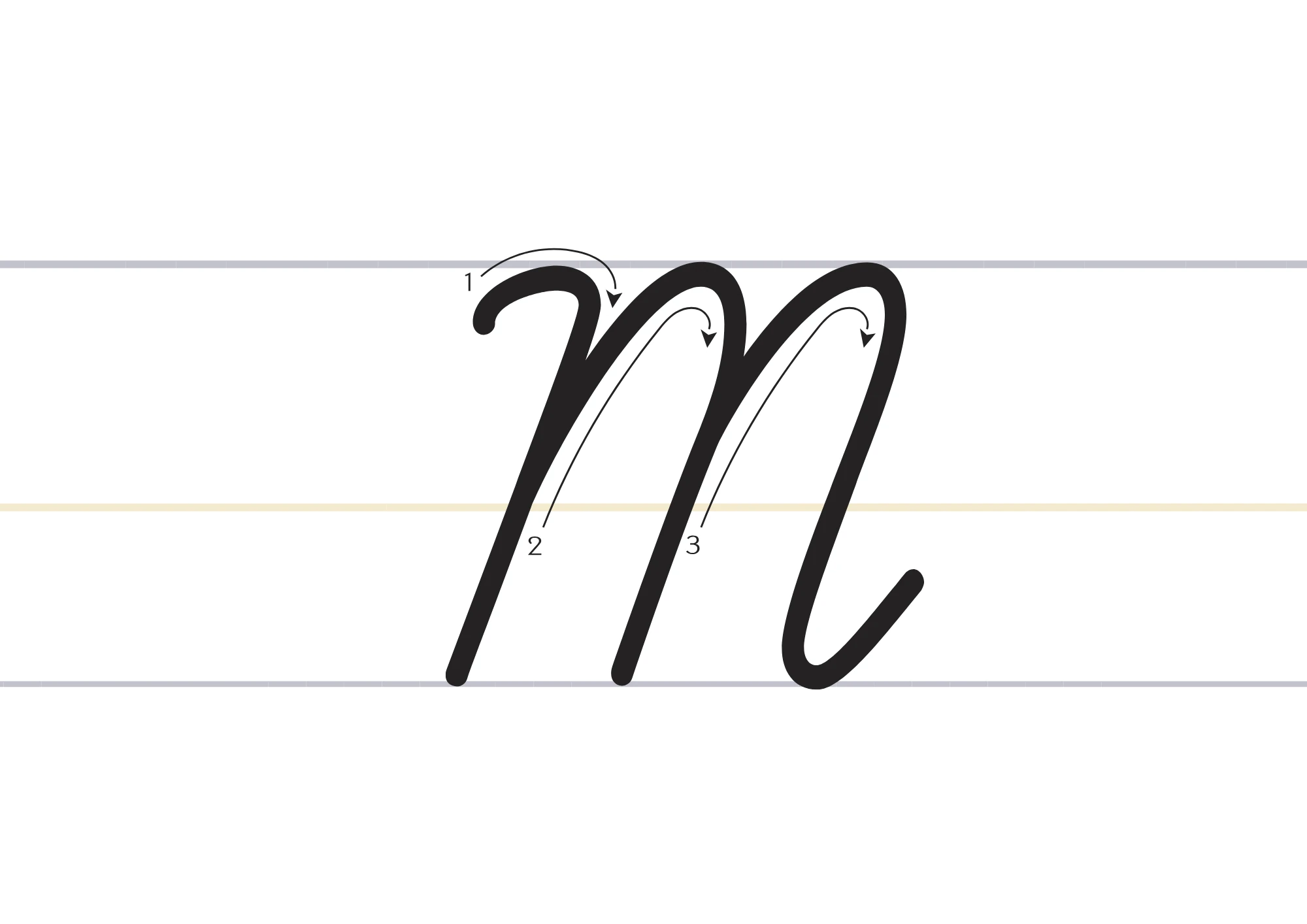
Check the finished capital: does the entry stem reach the top line, do both arches reach the same height, and does the connector leave the baseline without a sharp corner? A lower second arch makes the letter look as if it is sinking.
How to Write Lowercase Cursive m
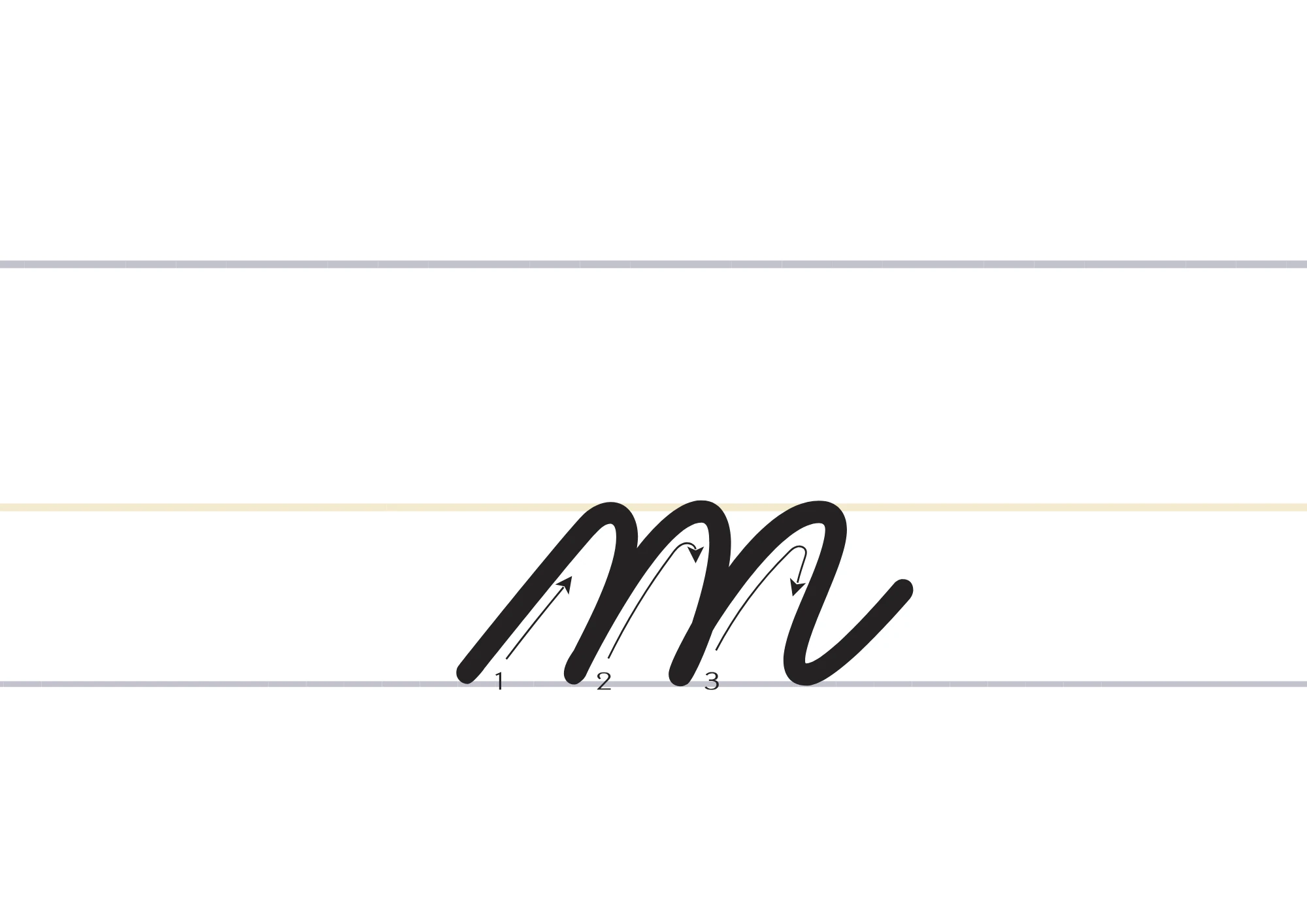
Lowercase cursive m is midline height, with an entry stem and two arches. It is the form you will use far more often, inside words such as mom, milk, and music, so keep it compact and regular.
Entry Stem to the Baseline
Start with a small entry curve, rise to the midline, and come back down to the baseline. This first stem sets the height and slant for the whole letter.
First Arch to the Baseline
Rise into the first arch, curve over at the midline, and come back down to the baseline. Keep the arch rounded at the top, not pointed, and about as wide as the entry stem.
Second Arch and Connector
Rise into the second arch, touch the midline, come down to the baseline, and finish with a short connector to the right. Keep it at baseline height and keep the pen on the paper.
How to Count the Strokes in Cursive M
Counting causes more confusion for cursive M than for almost any other letter, so settle it now. Both forms have an entry stem plus two arches. Each stem and each arch ends with a downstroke to the baseline, so the letter has three downstrokes in total. That is why some sources say three humps.
Do not call it three arches. There are two, not three. The first downstroke belongs to the entry stem, and only the next two movements are arches. Count it this way: one stem, two arches, three downstrokes.
Cursive M vs Cursive N: Counting Arches
The fastest way to learn cursive M is to compare it with cursive N, because they share the same movement and differ only in count. Lowercase n has an entry stem plus one arch, giving two downstrokes. Lowercase m has an entry stem plus two arches, giving three downstrokes. Write n and m side by side, and the difference becomes clear.
Capital M and capital N work the same way, at full height, except N has one arch and M has two. Learners who rush often drop the second arch of m and write n by mistake, especially in summer or common.
Keeping Both Arches the Same Height and Width
Arch height and width decide whether cursive M looks neat, even when the stroke order is correct. For the small form, both arches must peak at the midline. For the capital form, both must peak at the top line. A short second arch makes the letter slope downward.
Arches that are too cramped turn the letter into a tight zigzag. Arches that are too wide stretch the letter and crowd the next letter. Aim for arches about as wide as the entry stem. Each arch on its own should look like a small, rounded hill.
Reading m vs n vs u in Fast Handwriting
In fast handwriting, m, n, and u can blur together, because all three use short downstrokes and curves at the baseline. For cursive M, the tops are rounded and there are three downstrokes. The letter n has a rounded top and two downstrokes. The letter u has a rounded bottom, no arch on top, and two downstrokes joined at the bottom rather than at the top.
When you read handwriting and cannot tell which letter you are seeing, count the downstrokes and look at where they join. Strokes joined at the top with rounded arches point to m or n, and the count settles which one. Strokes joined at the bottom with an open top point to u. When you write, keep the tops of m rounded and u open at the top, which prevents most misreadings in mum, nun, and sun.
How to Join M in Cursive
The small form of cursive M joins on both sides: it enters at the baseline, works through its stem and arches, and exits at the baseline to the right. The capital form usually starts a word, so it joins only on the right, and lightly.
Joining m Into Vowels
For cursive M, joining m into vowels is the most useful joining skill, because so many common words pair m with a vowel right after it. Practice ma, me, mi, mo, and mu in that order. In ma, the connector rises into the oval of a. In me, it rises into the small loop of e. In mi, it rises into the short stem of i, and the dot of i is added after the word is finished. In mo, it rises into the oval of o. In mu, it rises into the first downstroke of u.
Watch the height change in each pair. The connector leaves m at the baseline, and the vowel stays at midline height or below. Keep the rise smooth, or the vowel will look detached even though the pen never left the paper.
Joining Into m From Other Letters
Letters before m matter too. In am, em, im, om, and um, the previous letter must end at the baseline so it can flow into the entry stem of m. Write am and em slowly, and check that the join is a smooth curve.
M Cursive in Words and Names
Practice cursive M in real words first, then in names. Start with m at the start of a word, then with m in the middle, where joining is harder.
mom · milk · moon · monkey · music · map
Maya · Michael · Mia · Mason · Molly · Marcus
Write mom slowly and count the strokes in each m: two small m letters give six downstrokes in one short word. Then write milk, where m leads into i and l, and moon, where m leads into a double o. Then write monkey and music, where m leads into a vowel and a longer word.
Capital M for Names and Months
Capital M in cursive appears most often at the start of a name or a month, so it must read clearly at a glance. For Maya, Michael, Mia, and Mason, keep the capital a little larger and more open than in a practice row, and keep both arches visible.
March and May both start with a capital M, and both are short enough to write many times in a row. Monday also starts with this letter. When you write a date by hand, such as March 12 or May 4, the capital must be clear enough to read without guessing.
Common Mistakes With Cursive M
- Counting three arches instead of two. The letter has an entry stem plus two arches.
- Dropping the second arch. A rushed m with one arch reads as n, especially in summer and mom.
- Making the arches too cramped. Tight arches merge into a wavy line. Widen each arch until it matches the entry stem.
- Making the arches too wide. Wide arches stretch the letter and crowd the next letter. Keep the width even.
- Letting the second arch fall short. If it peaks below the midline for a small m, or below the top line for a capital, the letter looks as if it is sinking.
- Forcing a heavy join after a capital. Capital M often ends with a light pause before the next letter. A heavy join spoils the start of the word.
- Closing the tops of u by mistake. A fast u can pick up a rounded top and look like n or m. Keep u open at the top and joined at the bottom.
How to Write Cursive M: 10-Minute Daily Practice Routine
A short daily routine works better than one long session. Ten focused minutes a day, for a week, is enough to make cursive M feel steady.
- Warm-up arches (2 minutes): Draw rounded hills at midline height, all the same width.
- Capital form (2 minutes): Write the capital slowly, checking both arches reach the top line.
- Lowercase form (3 minutes): Write the small form in rows, counting stem, arch one, arch two.
- Words and joins (2 minutes): Write mom, milk, moon, and music, then ma, me, mi, mo, and mu, watching each join.
- Quick check (1 minute): Compare your last row with your first row. Are the arches even, and does m still read as m?
Repeat the routine tomorrow. The goal is a steadier hand by the end of the week, and a letter you can write without stopping to count every stroke.
Letter M in Cursive: Practice Sentences
Sentences teach spacing, rhythm, and stamina. Try each sentence three times: slowly, at normal pace, and without stopping.
Maya made music on Monday morning.
Mia drank milk under the moon.
The monkey munched a mango in March.
Mason made a map for May.
When a sentence is finished, read it back: are the joins smooth, is the slant steady, and does every m keep two clear arches?
Letter M in Cursive for Names and Signatures
Names are where most people first notice their own handwriting. For a first name that begins with this letter, keep the capital a little larger and more open than in ordinary writing. The rest of the name should stay at normal size.
For cursive M signatures, the same shape can be written faster and looser, but it should still be recognizable: both arches must stay visible. If a signature becomes a scribble, slow it down until the arches are visible again. A signature that loses its second arch will read as N, not M.
Cursive M, Frequently Asked Questions
What does the letter M look like in cursive?
Capital cursive M is full height, with an entry curve and two arches that reach the top line and return to the baseline. Lowercase cursive m is midline height, with an entry stem and two arches that reach the midline and return to the baseline. Both end with a short connector.
How many arches does a lowercase m have in cursive?
It has two arches, plus an entry stem. That gives three downstrokes in total, which is why some sources say three humps. Do not count it as three arches, because the first downstroke belongs to the entry stem.
How is cursive m different from cursive n?
Cursive m has an entry stem plus two arches, while cursive n has an entry stem plus one arch. Count the downstrokes: m has three and n has two.
How do you join cursive m to a vowel?
Let the connector leave m at the baseline and rise gently into the vowel. Practice ma, me, mi, mo, and mu in order. In mi, add the dot of i only after the word is finished.
Why does my cursive m look like n or u?
Usually one arch is missing, cramped, or flattened. If the second arch is dropped, m reads as n. If the tops are flattened and the strokes join at the bottom, the letter reads as u. Slow down and count stem, arch one, arch two.
Should capital M join heavily to the next letter?
No. In many school models, capital M ends with a light pause before the next letter. Use a short, light connector at baseline height. The small form joins firmly on both sides inside a word.
What words can I practice with cursive M?
Start with mom, milk, moon, monkey, and music, then try names such as Maya, Michael, Mia, and Mason. Type your own name into our cursive generator to see it first.
Should I learn the capital or the lowercase form first?
Start with the lowercase form. It appears in almost every word, while the capital is only needed at the start of sentences, names, and months. Once the small form feels easy, the capital takes only a short session to learn.
See Your Name in Cursive
Type any name or word and convert it into cursive text you can copy anywhere, free, with no sign-up.
Open the Cursive Generator