
Home › Cursive Alphabet › Cursive N
Cursive N: How to Write the Letter N in Cursive
Cursive N is a steady, readable letter built on one clear idea: one arch, and only one arch. Learn that count, keep the height true to the lines, and cursive N will look clean in real words, not just in a practice row.
Cursive script joins the letters of a word so the pen keeps moving, and cursive N shows that idea in its simplest useful form. It uses the same entry, slant, and exit connector found in many other small letters, and it appears in common words such as and, in, on, and when, so a shaky n shows up fast in ordinary writing.
What Cursive N Looks Like in Real School Writing
In the school form used on this page, capital cursive N is full height: entry curve, rise to the top line, down to the baseline, one arch up to the top line, down to the baseline, and a connector to the right. Lowercase cursive n is the same movement at a smaller size: entry stem up to the midline, down to the baseline, one arch up to the midline, down to the baseline, and a connector to the right. Neither form lifts the pen in the middle.
N Cursive at a Glance: One Arch, Not Two
Think of capital N as capital M with one arch missing, and lowercase n as lowercase m with one arch missing. A capital M has an entry, a downstem, an arch, a downstem, a second arch, and a final downstem. Remove the second arch and its final downstem, and what is left is a capital N. A lowercase m has two arches. Remove the second arch, and what is left is a lowercase n. After one arch, you exit.
Trace the Cursive Letter N
Start on the worksheet, not on a blank page. Trace the capital form slowly, and say the movement in your head as you write: entry up, down, arch up, down, connect.
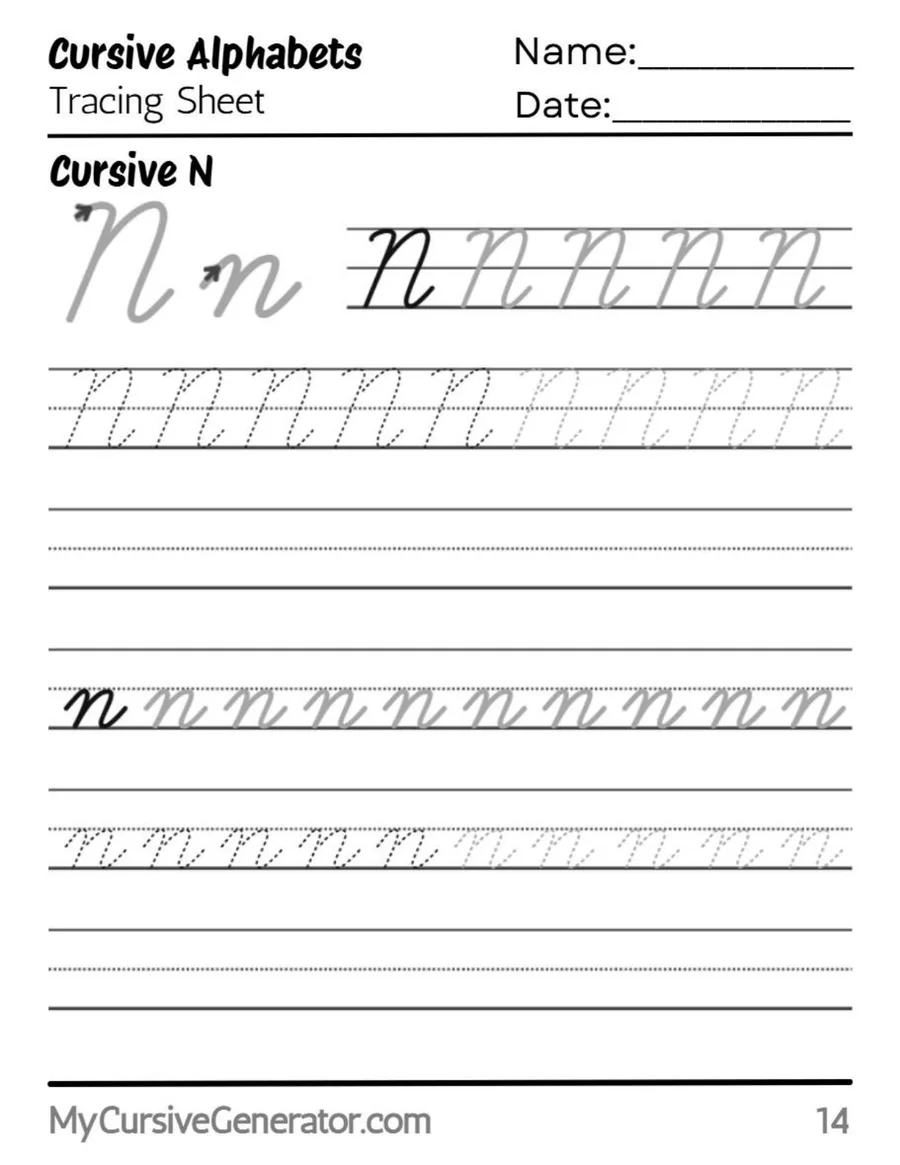
Letter N in Cursive: Why the Arch Count Matters
Most letters are easy to recognize by outline, but cursive N is easy to recognize only by its count. A lowercase n, a lowercase m, and a lowercase u all sit between the same two lines, lean the same way, and end with a connector. The reliable difference in fast writing is how many arches rise from the baseline. Count them, and the letter names itself. An extra bump after the arch turns it into m, and a flattened arch turns it into u.
Before You Start
Use three lines, and name them before you write cursive N. The top line is the ceiling for capitals. The midline, usually shown as a dashed line, is the ceiling for small letters such as n. The baseline is the floor where most letters sit. Hold the pencil loosely, about two finger widths above the tip, and keep one gentle slant to the right.
How to Write N in Cursive
Both forms of cursive N are one continuous movement. Do not lift the pen in the middle of the letter, and do not draw the arch as a separate hump placed on top of a stem. Practice slowly at first, because speed without a clean arch only makes a messy letter faster.
Capital Cursive N
Capital cursive N is full height, so it needs the full writing space. Use it at the start of a sentence, at the start of a name, and at the start of a month such as November. Keep it a little larger and more open than the small form, so it reads clearly at a glance.
Entry Curve and First Downstem
Start at the baseline with a small entry curve to the right. Sweep up to the top line, then pull down to the baseline on a steady slant. Keep this first stem tall and straight, because a short stem makes the arch that follows look out of place.
Rise Into the One Arch
Without lifting the pen, rise from the baseline and curve over into one arch that reaches the top line, then come down to the baseline. This is the only arch in capital cursive N. Make it round at the top, not pointed and not flat.
Finish at the Baseline and Connect
At the baseline, curve gently to the right into a short connector. Do not add a second arch, and do not lift the pen before the connector is done. In a name such as Noah, that connector should flow straight into the small o without a gap.
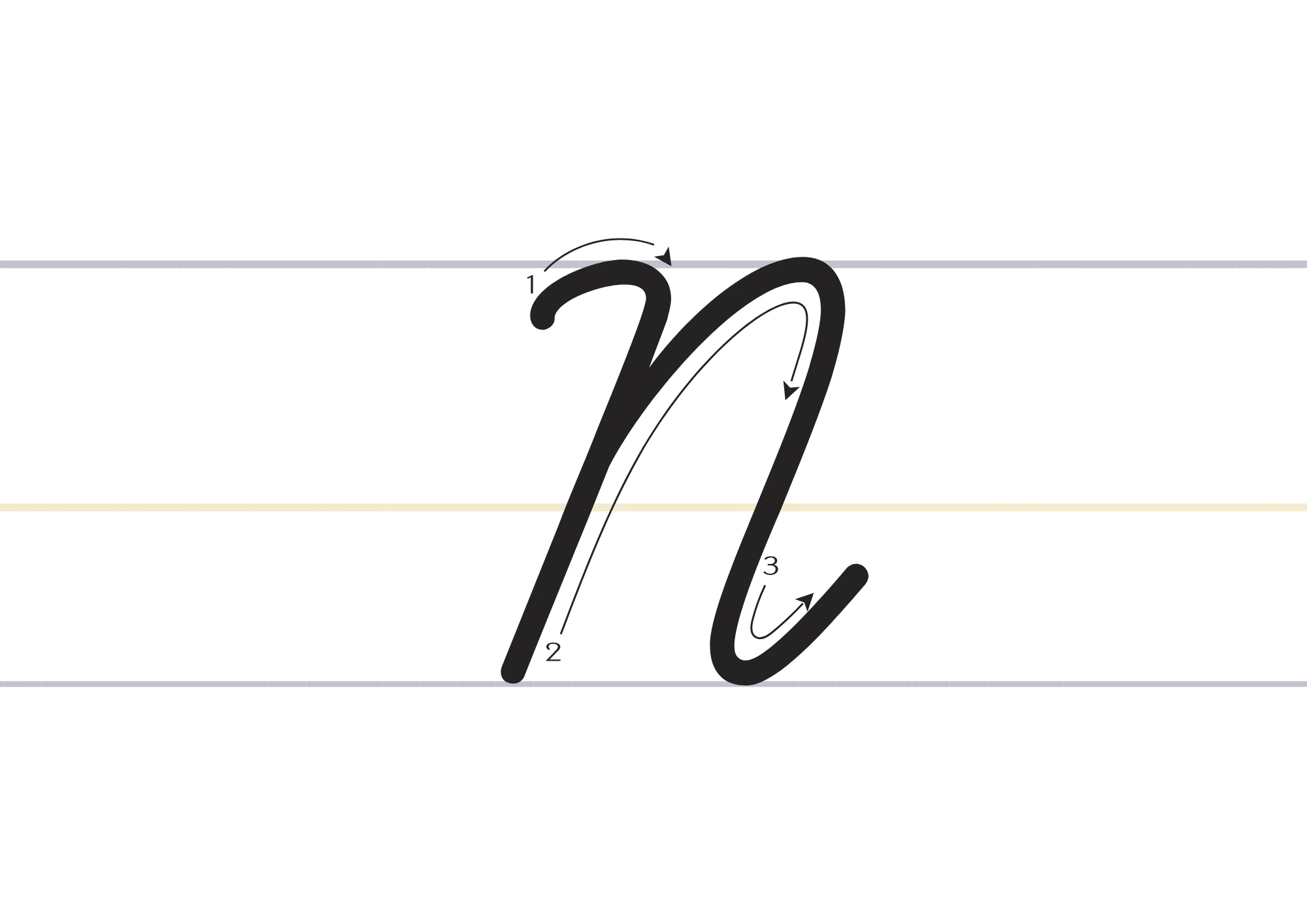
Check the finished capital of cursive N. Does the first stem reach the top line? Does the single arch reach the top line as well? Does the letter end at the baseline with a connector, not with a second arch?
Lowercase Cursive N
Lowercase cursive n is the form you will use most often, because it appears inside words such as in, and, on, and night. It is midline height, so it must stay between the midline and the baseline. Its movement mirrors the capital form at a smaller size: entry stem, one arch, connector.
Entry Stem to the Midline
Start at the baseline with a small entry curve to the right. Rise to the midline, then come down to the baseline. Keep this entry stem short and slanted, and stop exactly at the midline. A stem that rises above the midline starts to look like a tall letter.
Rise Into the One Arch
Without lifting the pen, rise from the baseline and curve over into one arch that reaches the midline, then come down to the baseline. This is the only arch in lowercase cursive n. Keep it round at the top, and bring it fully down to the baseline before you think about the next letter.
Finish at the Baseline and Connect
At the baseline, curve gently to the right into a short connector. That connector is part of the same movement, not a new stroke. In nest, it should flow into the small e without lifting the pen. In nose, it should flow into the small o at a steady height.
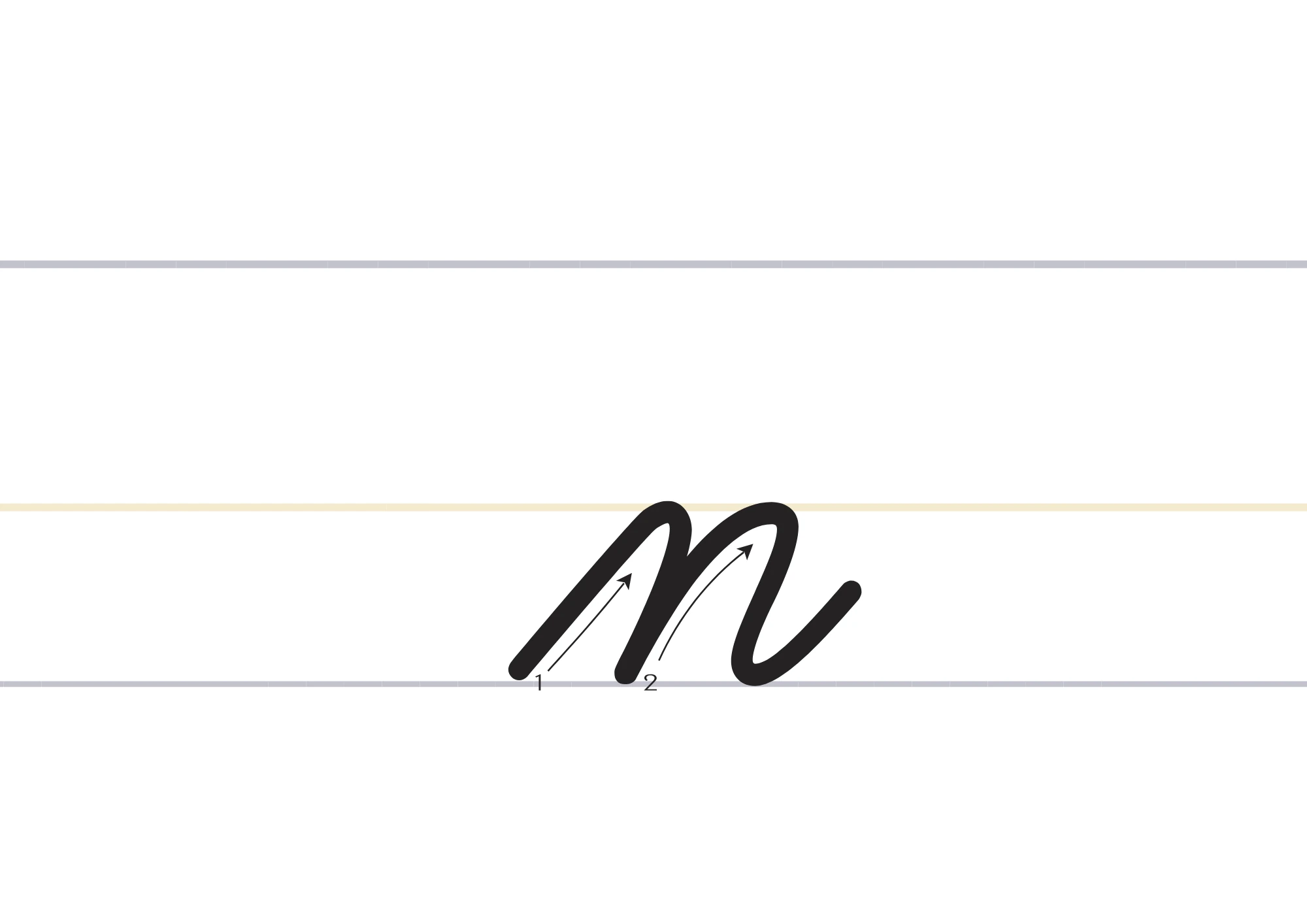
Check the finished small form of cursive N. Does the entry stem stop at the midline? Does the single arch stop at the midline as well? Does the letter end at the baseline with a connector?
How to Write Cursive N in Words
Do not practice cursive N only in rows of the same letter. Rows teach shape, but words teach use. Start with nest, nose, night, and notebook, then try and, in, on, and when, where n must enter and exit at the baseline without changing height in the middle.
Arch Width and Height: Making the Single Arch Even
Arch width and arch height decide whether cursive N looks neat. Height is the easier check: stem and arch must both reach the top line in the capital form, and both reach the midline in the lowercase form. If the arch is shorter than the stem, the letter looks as if it is sinking. If it is taller, the letter looks as if it is jumping out of the word.
N in Cursive: Telling n Apart From m and u
In fast handwriting, n, m, and u cause more reading errors than any other small group. All three sit between the same lines, lean the same way, and end with a connector, so the differences must be made on purpose. Count arches first. Lowercase m has two arches. Lowercase n has one arch. Lowercase u has no true arch top, only a low open curve.
Joining N: na, ne, ni, no, nu and More
Lowercase cursive n joins on both sides. It enters from the previous letter at the baseline, rises into its arch, returns to the baseline, and exits to the right. Good pairs to practice first are na, ne, ni, no, and nu. In na, the connector rises gently into the small a oval. In ne, it stays low and rises into the small e loop. In ni, it is short. In no, it rises into the small o oval. In nu, it rises into the low curve of u, without letting n and u blend into one long wave.
Finishing Cleanly Before g, d, and t
The joins before g, d, and t deserve special care, because those letters change height or direction right after n. Before g, as in sing or long, the arch of cursive N must finish fully at the baseline before the g loop drops below the line. Before d, as in and or find, it must finish before the tall stem of d rises. Before t, as in ant or want, it must finish before the tall stem of t rises, and the cross of t is added later. In all three cases, close the arch at the baseline first, then start the next letter.
Words That Start With N in Cursive
Practice these common N words. Read them, trace them, then write them on your own:
Night · Nose · Nest · Notebook · November
Noah · Nora · Nathan · Nina · Neil · Nadia
Night, nose, nest, and notebook put cursive N at the start and ask it to join to different letters. November needs a capital N, and it is long enough to test stamina. If the capital stays tall and the small letters stay at midline height through the whole word, the practice has worked.
Capital N in Names and Months
Capital cursive N appears most often in names and months. In Noah, Nora, Nathan, and Nina, keep the capital a little larger and more open than in ordinary writing, so it reads well at a glance. In a date such as November 12, the capital should match the height of the other capitals in the sentence.
Common Mistakes With Cursive N
- Adding a second arch to cursive N. After one arch, stop arching and exit. A second arch turns n into m.
- Flattening the arch into a wave. If the arch has no rounded top, the letter reads as u. Keep the top of the arch round, even when you write quickly.
- Making the arch taller than the entry stem. Stem and arch must reach the same line: the top line for the capital form, the midline for the lowercase form.
- Making the arch wider than the stem space. A wide arch looks stretched, and a reader may count it as two arches.
- Leaving the arch open at the baseline. The arch must come fully down to the baseline before the connector starts, especially before g, d, and t.
- Skipping the exit connector. The connector joins cursive N to the next letter, so skipping it breaks the flow of the word.
- Changing the slant inside one letter. A stem that leans one way and an arch that leans the other way makes the whole word look shaky.
How to Write N in Cursive: 10-Minute Daily Practice Routine
A short daily routine beats one long session. Ten focused minutes a day, for a week, is enough to make cursive N feel natural. Use a lined notebook and keep the pen moving slowly.
- Warm-up arches (2 minutes): Draw the single arch of cursive N again and again, keeping every arch the same height and width.
- Capital form (2 minutes): Write capital cursive N slowly, checking that stem and arch both reach the top line and that only one arch appears in each letter.
- Lowercase form (3 minutes): Write lowercase cursive n, keeping every letter between the midline and the baseline. This form matters most in real writing, so give it the most time.
- Words and joins (2 minutes): Write nest, nose, night, and notebook slowly, joining each letter to the next without lifting the pen.
- Quick check (1 minute): Compare your last row with your first row. Are the heights the same? Is the slant steady? Does every letter show one arch, not two and not none?
Cursive N, Frequently Asked Questions
What does the letter N look like in cursive?
Capital cursive N is full height, with an entry curve up to the top line, a downstem to the baseline, one arch up to the top line and down to the baseline, and a connector to the right. Lowercase cursive n is midline height, with an entry stem up to the midline, a downstem to the baseline, one arch up to the midline and down to the baseline, and a connector to the right.
Is cursive N hard to learn?
No, cursive N is straightforward once you learn the arch count. Practice the capital form and the lowercase form separately for a few minutes, then join them into short words such as nest and nose. Most learners can write a clean form within one short practice session.
How do you join cursive N to the next letter?
Both forms end with a short connector at the baseline, and that connector flows into the next letter, so the pen stays on the paper inside a word. Good pairs to start with are na, ne, ni, no, and nu. Before g, d, and t, finish the arch fully at the baseline first, then start the next letter.
What words can I practice with cursive N?
Start with night, nose, nest, and notebook, then try November and names such as Noah, Nora, Nathan, and Nina.
Should I learn the capital or the lowercase form first?
Start with the lowercase form of cursive N. It appears in almost every word, so it pays off at once, while the capital is only needed at the start of sentences, names, and months. Once the small form feels easy, the capital form takes only a short session to learn.
Why does my cursive n look like m or u?
Usually the problem is the arch count. If your cursive n shows two arches, it reads as m. If it shows no rounded arch, only a low wave, it reads as u. Count the arches in your row, keep the arch round and at midline height, and keep the entry stem and the arch at the same height.
How do I teach cursive N to a child?
Start with the lowercase form of cursive N, because its size is easier to see on lined paper. Keep sessions short.
What is the difference between cursive N and print N?
A print N is made of separate straight strokes and a diagonal that do not join. Cursive N is made in one flowing movement, with an entry curve, one arch, and a connector that joins to the next letter. That connector is what lets letters connect into words.
See Your Name in Cursive
Type any name or word and convert it into beautiful cursive text you can copy anywhere, free, with no sign-up.
Open the Cursive Generator